

Quick Answer: What Is Traditional Chinese Clothing?
Traditional Chinese clothing includes many dress traditions shaped by period, community, occupation and occasion. There is no single historical outfit that represents everyone in China.
- Hanfu: Hanfu(汉服,hànfú)is a broad name associated with historical Han Chinese dress and its modern revival, covering more than one garment or dynasty.
- Qipao: The qipao(旗袍,qípáo), commonly called cheongsam in English, has a distinctive modern fashion history, especially in the twentieth century.
- Tang suits: Modern tangzhuang(唐装,tángzhuāng)jackets combine recognizable Chinese dress elements with later tailoring; the name does not make them Tang-dynasty clothing.
Regional and community traditions extend beyond these familiar names. Identify a garment through its date, construction and context rather than a collar or decorative motif alone.
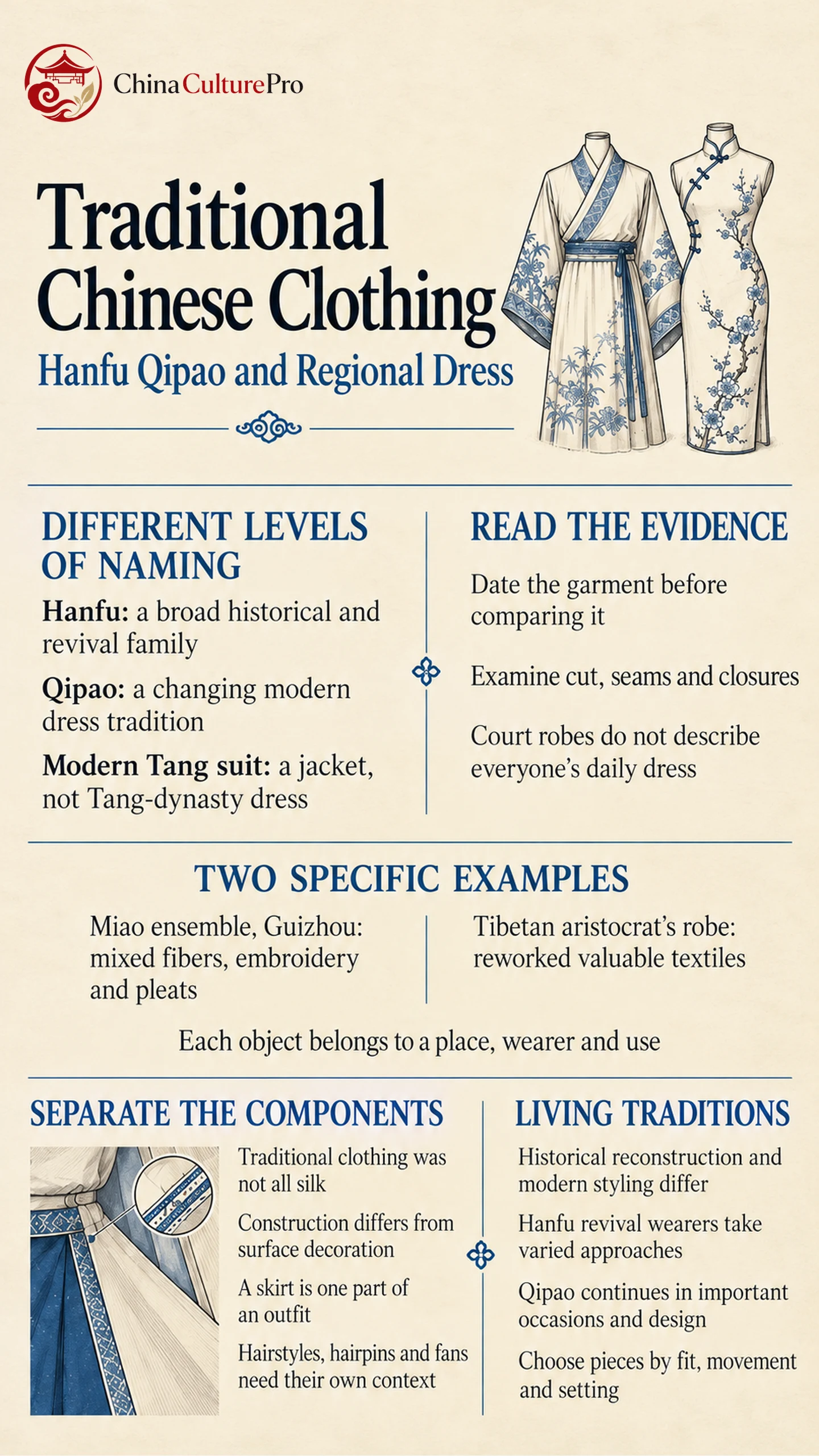
A flowing robe, a tailored cheongsam and an embroidered festival jacket may all appear under the label “traditional Chinese clothing.” They belong to different histories. Within Chinese culture, clothing is best understood through the people who wore it, the garment’s construction and the setting in which it was used.
Main Clothing Names and Garment Families
The names below work at different levels. Hanfu describes a broad field of dress, while qipao usually identifies a more particular garment family. Modern Tang suits are another category again. A useful comparison therefore asks what each name includes before treating the clothes as alternatives.
| Название | What it commonly describes | Useful recognition clues | Важное уточнение |
|---|---|---|---|
| Hanfu | Historical Han Chinese dress traditions and contemporary interpretations | Robes, jackets, skirts and trousers in varied combinations; overlapping collars are common in some forms | It is broader than one flowing dress, sleeve width or period |
| Qipao / cheongsam | A dress tradition that developed through major twentieth-century changes | Often a standing collar and a continuous dress silhouette; fit, sleeves and length vary | Its familiar fitted form is not an unchanged ancient garment |
| Modern Tang suit | A Chinese-style jacket family familiar in modern formal and celebratory dress | Standing collar, front opening and knotted fasteners in many versions | It is not a reconstruction of clothing from the Tang dynasty |
The Hanfu guide explores the wider clothing family and revival. The separate qipao and cheongsam guide follows the dress’s changing silhouette and cultural meanings.
For a direct choice between the first two, the Hanfu versus qipao comparison focuses on construction and modern uses. Compare the particular garments and intended use.
Modern Tang suits provide a particularly clear example of adaptation. Jackets worn at the 2001 APEC meeting in Shanghai retained standing collars, symmetrical fronts and knotted buttons, but used modern shoulder construction and set-in sleeves.[3] The tangzhuang guide separates that modern jacket from the clothing of the historical Tang period.
Why Date and Construction Matter
Chinese dress changed within dynasties as well as between them. Surviving garments, excavated textiles, images and written records provide different kinds of evidence. Research on Eastern Zhou, Qin and Han clothing, for example, examines upper and lower garments, headwear, materials and regional variation together rather than reducing early dress to one silhouette.[1]
That is why “Hanfu” should not be read as “only clothes worn during the Han dynasty.” In contemporary discussion, it spans a much broader historical and revival field. A robe and a jacket-and-skirt outfit may belong to different forms within that field. The Hanfu styles guide explains the garment names more precisely.
Qing-period clothing introduces another set of distinctions. A court robe was connected to status and regulated occasions; it was not the everyday wardrobe of everyone living under the dynasty. Some Manchu court garments retained features associated with riding, including narrow sleeves and horse-hoof-shaped cuffs.[7] The Manchu clothing guide follows that particular historical context.
The modern qipao also changed considerably. Hong Kong’s cheongsam culture developed from the 1920s, with Shanghai tailors contributing to its later industry and strong demand in the 1950s and 1960s.[2] Its modern chronology helps distinguish it from early imperial clothing.
Use the clothing history guide for the fuller sequence. For identifying one object, a date range, material description and view of its seams or closures usually offer more useful evidence than a seller’s broad “ancient style” label.
Regional Dress Through Two Documented Examples
Clothing traditions are also local and community-specific. The two examples below show why a single national costume cannot cover the subject. They are individual documented garments, not uniforms for every member of either community.
Miao Embroidery and Pleated Skirts
A twentieth-century Miao ensemble from Taijiang in Guizhou combines a jacket with a pleated wraparound skirt. Its listed materials include hemp, linen, silk and metal foil. Embroidery and appliqué decorate selected bands, while the skirt’s fine pleating contributes a different kind of craftsmanship.[4]
The example is useful because it separates several things often blurred in a photograph: the garment’s cut, its base cloth, surface decoration and skirt structure. Embroidery does not identify the base fiber, and elaborate decoration alone does not establish whether an outfit was worn daily or for a particular occasion.
It also shows why place matters. Naming a particular Guizhou ensemble tells the reader more than presenting an elaborate outfit as generic “ethnic dress.” Other localities and occasions can produce different forms within a larger community tradition.
Tibetan Robes and Textile Exchange
An eighteenth-century Tibetan aristocrat’s robe, described as a chuba, was made using valuable Chinese textiles. Its dragon designs do not align perfectly, suggesting that cloth from a larger garment or several robes was reworked into the new form.[5]
This is evidence of exchange and adaptation, rather than a contradiction between “Chinese textile” and “Tibetan garment.” Cloth can travel, be valued and acquire a different cut and use. The robe’s aristocratic context is also essential: it cannot stand for every Tibetan person’s clothing, climate or occupation.
When reading regional dress, keep three questions together: where the garment was used, who wore it and for what purpose. Community names alone cannot answer all three.
Fabric, Decoration and Accessories
Silk is important in Chinese clothing history, but traditional clothing was not all silk. The mixed fibers of the Miao ensemble illustrate that clearly, while early dress research also considers silk alongside plant-fiber textiles.[1] The silk clothing guide distinguishes the fiber from particular weaves and garment uses.
Construction and decoration need separate attention. A woven pattern, applied panel and embroidered motif are different techniques. A dragon, flower or color may be meaningful, but its role depends on the garment’s date and setting. Use clothing symbolism to investigate those contexts rather than assigning rank or marital status from a motif alone.
A named part is also different from a complete outfit. A mamianqun(马面裙,mǎmiànqún)is a particular skirt form; the mamianqun guide explains it separately from the top and accessories paired with it.
The same care applies to styling. Traditional hairstyles require their own period and social context. Chinese hairpins are a separate subject from the garment that happens to appear beside them, while fan types differ in construction and use. Adding an ornate hairpiece or fan does not, by itself, establish a historically coherent ensemble.
Traditional Dress in Modern Life
Today, wearing historical-style clothing can express cultural interest, personal taste or participation in a community activity. Among Hanfu wearers studied in Shanghai, some prioritized historical authenticity, while others accepted freer arrangements and ways of wearing the clothes.[6]
That distinction is more useful than treating every modern outfit as either an exact reconstruction or a mistake. A contemporary design can draw on older forms while using different fabric, convenient closures or new styling. Describe it as an interpretation when that is what the evidence supports.
Qipao also continues as clothing for important occasions and as a source for new design.[2] Its modern life is part of its history, rather than proof that all Chinese women dress alike or wear it every day.
If you want to wear an outfit, identify the actual pieces and their intended arrangement first. Check fit, ease of movement and the event’s expectations. The Hanfu wearing guide explains layers and closures for that next task; one generic set of instructions cannot cover every form.
For a museum object, ask about provenance and construction. For a present-day outfit, ask what inspired it and how its wearer describes it. They distinguish the history of an object from the intentions of a present-day wearer.
FAQs About Traditional Chinese Clothing
Is all traditional Chinese clothing called Hanfu?
No. Hanfu relates to historical Han Chinese dress and its modern revival. Qipao, Manchu clothing and the traditions of other communities have distinct histories.
Does Hanfu mean clothing only from the Han dynasty?
No. In current usage, the term covers a wider field of historical Han Chinese clothing and revival styles, rather than one dynasty’s wardrobe.
Are qipao and cheongsam different dresses?
In common English usage, both names can refer to the same dress family. Individual garments still differ in period, cut, length and tailoring.
Do people in China wear traditional clothing every day?
Some people incorporate it into daily life, while others wear it for particular events or activities. Contemporary revival practice varies, and traditional clothing is not everyone’s everyday dress.
Источники
[1] Wang Fang. The Formation of Hanfu: Archaeological Research on Eastern Zhou, Qin and Han Dress
[2] Hong Kong Museum of History. A Century of Fashion: Hong Kong Cheongsam Story
[3] Ministry of Foreign Affairs of China. Modern Tang Suits Unveiled at the Bank of Huangpu River
[4] The Metropolitan Museum of Art. Recent Acquisitions: A Selection 1986–1987
[5] The Metropolitan Museum of Art. Robe for Tibetan Aristocrat: Chuba
[6] Tianyue Tang and Yasuhisa Abe. Hanfu Revival Inspired Activities and Their Venues in Shanghai, China
[7] The Metropolitan Museum of Art. Robe of State