

Quick Answer: How Have Chinese Personal Pronouns Changed?
Chinese personal pronouns (人称代词, rén chēng dài cí) have changed in form, grammatical use and social meaning. A modern English I–you–he chart cannot simply be projected onto every historical text.
- Early texts: Several forms can identify a speaker or addressee.
- Sentence roles: An object form or possessive expression may not work like a modern subject pronoun.
- Social position: Imperial self-reference needs a historical setting.
- Modern writing: Different written ta forms do not imply different spoken Mandarin words.
The readings below are modern Mandarin reference readings, not reconstructions of ancient pronunciation.
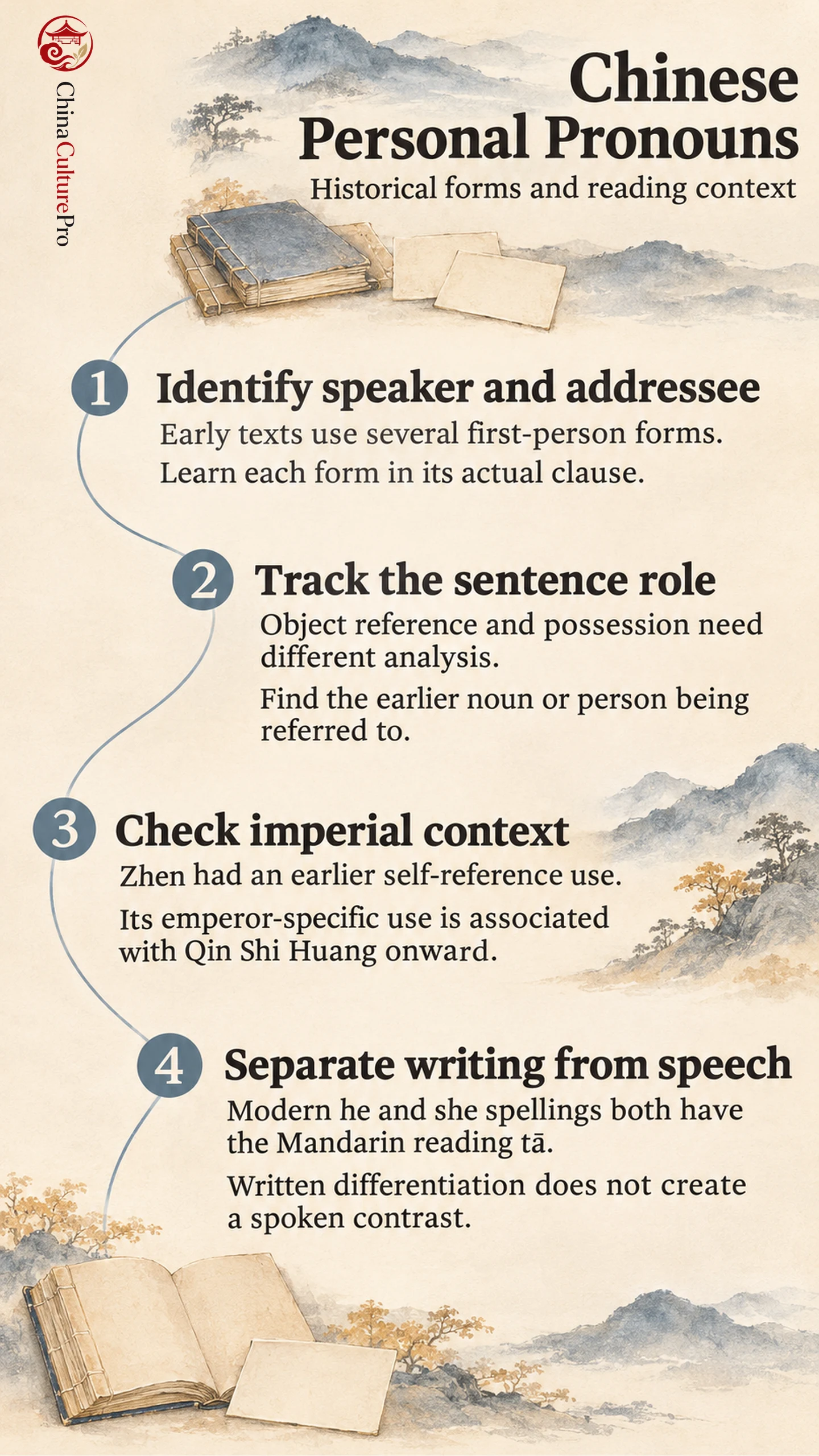
When a historical sentence seems to lack “he,” or uses an unfamiliar word for “I,” start with the whole passage. Identify who is speaking, who is addressed and which noun the next clause refers to. Pronoun recognition helps, but sentence structure and textual context do the rest.
Recognize Early First- and Second-Person Forms
A useful introductory inventory includes the following forms. The gloss identifies a broad person-reference role; it does not guarantee identical usage or number in every text. [1]
| Broad role | Forms with modern reference readings |
|---|---|
| First person: speaker | 我, wǒ; 吾, wú; 余, yú; 予, yú |
| Second person: addressee | 汝, rǔ; 爾, ěr |
Do not treat this as a replacement keyboard for modern Chinese. A choice of form can depend on its grammatical position and the text being read. Scholars also consider variation between texts when explaining distributions that do not fit a simple universal case chart. [2]
Keep an unfamiliar form beside its actual clause in your notes. Use the gloss to identify a likely role, then let the clause determine the translation.
Read Third-Person Reference Through the Sentence
Classical reference does not reproduce the modern Mandarin pattern of placing 他, tā, before a verb as a general “he.” Common forms include 之, zhī, in object reference, and 其, qí, in possessive or modifying uses. Their functions must be determined in the sentence; neither should be translated by one English pronoun everywhere. [1][2]
When a passage has already named a person, subsequent clauses may rely on that established reference rather than repeat an explicit subject. Read back for an antecedent before assuming a missing word is a copying error. [2]
This connects with Classical Chinese function words: a small familiar character can perform several jobs. A dictionary’s first modern meaning may be the wrong choice in a historical construction.
Place Imperial Self-Reference in Its Period
Zhen (朕, zhèn) is associated with imperial “I,” but its history is older than that restriction. The dictionary records an earlier self-reference use and identifies its emperor-specific use from Qin Shi Huang onward. A pre-Qin occurrence therefore does not by itself identify an imperial speaker. [3]
Use the speaker and period together. In a later imperial edict, the social restriction matters; in an earlier literary passage, applying the later rule automatically can misidentify the voice. Historical drama is not enough to settle which use a text contains. [3]
The separate forms-of-address guide explains why social relationship remains relevant to reference even outside imperial settings.
Keep Modern Written and Spoken Distinctions Apart
Modern written Mandarin distinguishes 他, tā, conventionally “he,” and 她, tā, “she.” Both are pronounced tā. The feminine written pronoun gained its modern role during early twentieth-century language reform and is associated with Liu Bannong’s advocacy; this is a history of written differentiation, not the creation of a contrasting spoken syllable. [4][5]
The exact historical stage matters. Do not read a modern translated sentence back into an ancient text and infer that the same written or social distinction must already have existed. Equally, do not assume that Chinese speakers cannot express gender merely because these particular spoken forms sound alike. [4]
For a first reading, mark three things: the pronoun’s person, its role in the clause, and its textual period. Then test your English rendering against the surrounding passage. The Classical Chinese grammar introduction offers the next step in sentence analysis.
FAQs About Chinese Personal Pronouns in History
Did ancient Chinese have only one word for I?
No. Early inventories include several first-person forms. Their distribution needs to be read in context rather than treated as free substitution. [1]
Was zhen always reserved for an emperor?
No. Its earlier self-reference use precedes the emperor-specific restriction associated with Qin Shi Huang. Check the date and speaker. [3]
Do modern ta spellings preserve an ancient spoken gender contrast?
No. Modern 他 and 她 share the Mandarin pronunciation tā. Their written distinction should not be mistaken for two contrasting spoken syllables. [4][5]
Источники
[1] Academy of Korean Studies teaching resource. History of Chinese: Syntax and Morphology
[2] Alain Peyraube, The Routledge Encyclopedia of the Chinese Language. Ancient Chinese: Empty words
[3] Ministry of Education, Taiwan. Revised Mandarin Dictionary: 朕
[4] Hsiang-Yun Chen, Hypatia. Pronouns and Linguistic Amelioration
[5] Ministry of Education, Taiwan. Revised Mandarin Dictionary: 她