


Quick Answer: What Should You Call Someone?
Begin with the name or title a person offers. In Mandarin, a title commonly follows the surname. Confirm the form when you are unsure rather than guessing someone’s rank, age or preferred level of familiarity.
- Use the offered name: Keep the spelling and form the person chooses.
- Confirm the surname: Do not assume the last written word is the family name.
- Match the title: Use a professional title when you know it applies.
- Ask when unsure: A short question is better than a confident guess.
Mandarin patterns are useful starting points. Regional languages, workplaces and personal preferences can change the best choice.
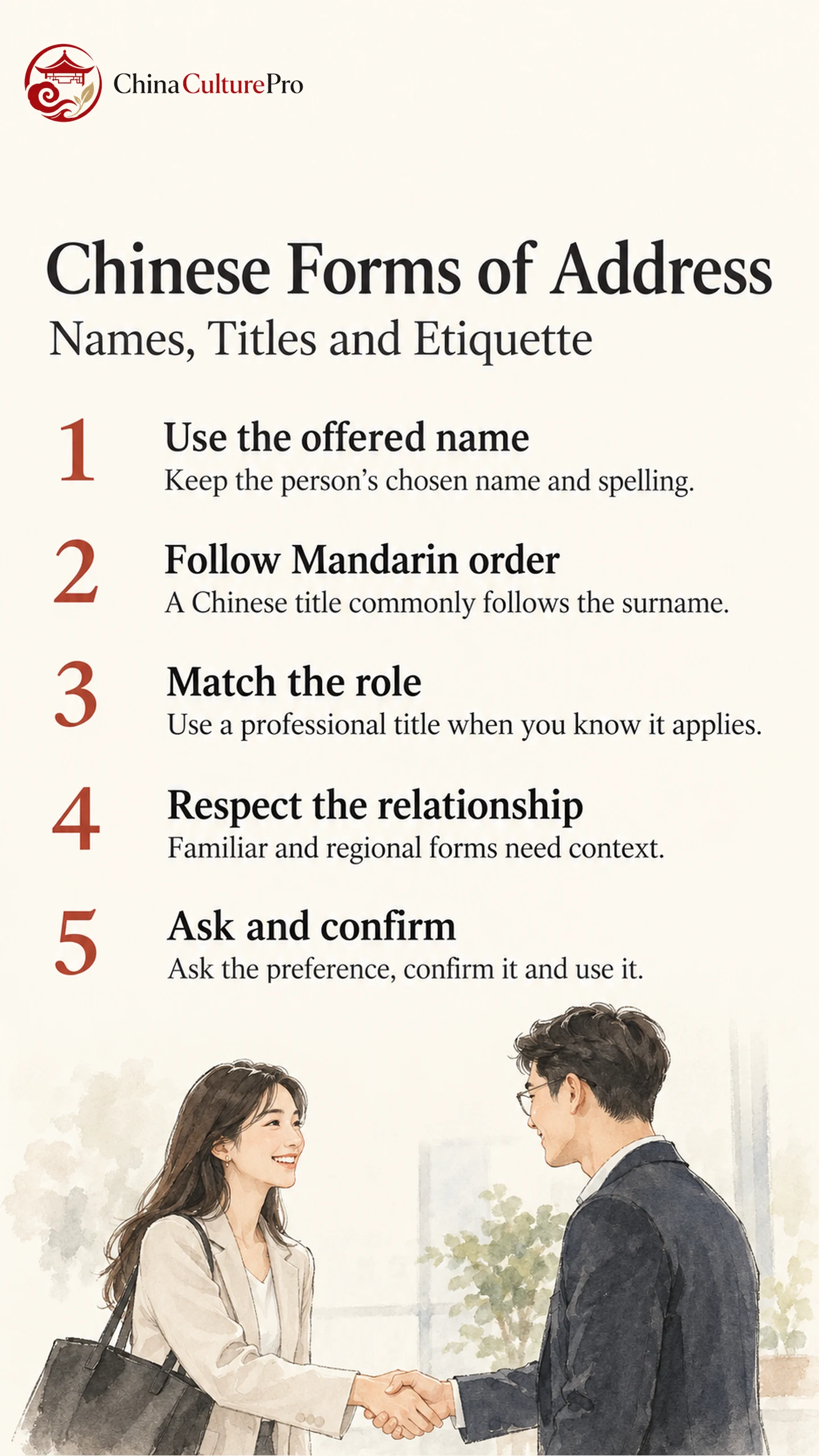
Choosing a Chinese form of address involves more than translating “Mr.” or “Ms.” The name’s order, the language being spoken, the person’s role and your relationship all matter. A respectful choice should identify the person clearly and let them set the level of familiarity.
This guide focuses on Mandarin names and titles used in everyday introductions and professional encounters. It also explains when a title can be left out, and how to recover easily if you choose the wrong form.
Start with the Name the Person Uses
Chinese names commonly place the family name before the given name, but an English-language presentation may rearrange the parts or add an English name. Do not automatically treat the final word as the surname. Spacing alone may not tell you how the name is structured.[1]
For an illustrative name, Wang Mei, Wang is the surname if that order has been confirmed. The person might instead introduce herself in English as Mei Wang or offer another name for conversation. Use what she asks you to use. Do not invent a shorter nickname because the full name feels unfamiliar.
A business card, email signature or event list can help, but it does not always reveal the preferred spoken form. Ask, “How would you like me to address you?” For the wider naming system, see Chinese names and naming traditions и Chinese surnames.
Keep a person’s chosen romanization. A spelling associated with Cantonese or another regional tradition is not an error to correct into Mandarin pinyin. Regional Chinese name spellings deserve the same care as the name order itself.
Put a Chinese Title After the Surname
The common Mandarin pattern is surname followed by title. Xiansheng (先生, xiānsheng) is a general title corresponding to Mr. in the examples here. Thus 王先生 (Wáng xiānsheng) is Mr. Wang: the order changes when you render it naturally in English.[2]
Nvshi (女士, nǚshì) is a respectful title for a woman, often rendered as Ms. For example, 李女士 (Lǐ nǚshì) is Ms. Li. It does not require you to determine whether she is married.[3]
These examples demonstrate structure rather than a rule that everyone must be addressed by a gendered title. If the person provides a different name or form, follow that choice. When you cannot confidently select a title, use the confirmed full name or ask the preference.
Use the order appropriate to the language: “Wang Xiansheng” in Mandarin, “Mr. Wang” in English. For a complete first meeting rather than just title selection, see Chinese greetings and introductions.
Choose a Title That Fits the Role
Professional address works best when the role is known. A title is not simply a more elaborate way of saying hello, and choosing a higher-sounding title does not automatically make an introduction more respectful.
| Mandarin title | Значение | Illustrative address |
|---|---|---|
| Laoshi (老师, lǎoshī) | A respectful form of address for a teacher or instructor | 张老师 Zhāng lǎoshī, Teacher Zhang |
| Jiaoshou (教授, jiàoshòu) | Professor, a title that identifies an academic role or rank | 陈教授 Chén jiàoshòu, Professor Chen |
| Jingli (经理, jīnglǐ) | Manager, a professional title used with a surname | 王经理 Wáng jīnglǐ, Manager Wang |
The teacher and professor terms overlap in educational encounters, but they do not mean the same thing. Calling someone a teacher can be respectful without asserting that they hold a professorial rank. Use the title their institution or introduction provides when the distinction matters.[4][5]
Manager is also a role, not a gendered title. The surname-plus-title construction appears in Mandarin teaching examples, but it should not be assigned merely because someone looks senior or is leading one part of a meeting.[2]
In Chinese business etiquette, introductions can establish both the person’s name and their responsibilities. Record those separately. Knowing whom someone represents is more useful than guessing a grander title, and a spoken courtesy title is not independent evidence of credentials.
Treat Familiar and Regional Forms with Care
You may hear family words used for people who are not relatives, or familiar ways of shortening names. Such forms can express warmth, but they also imply a relationship. Their meaning depends on the speaker, recipient and setting. Kinship address varies with region and age.[6]
For that reason, hearing a child call a family friend “auntie” does not make it the best address for a professional contact. Nor does a colleague’s affectionate nickname give every newcomer permission to use it. Listen, then confirm when needed.
Some titles also differ in use between mainland China, Taiwan and overseas communities. Older textbooks are helpful for recognizing those differences, but they are not a survey of every speaker today. Avoid treating a list of translated titles as a universal menu.[6]
This guide gives Mandarin pronunciation. It should not be used to overwrite Cantonese or another language’s forms in a conversation conducted in that language. The Chinese languages and dialects overview explains that broader diversity.
Ask, Confirm and Correct Naturally
When you have insufficient information, use this short sequence. It works in English as well as in a multilingual exchange; you do not need an elaborate Mandarin formula to show care.
- Ask the preference: Ask how the person would like you to address them.
- Confirm the form: Repeat the name or title and check any uncertain pronunciation.
- Use the correction: Adopt the form they give you and continue the conversation.
For an unnamed stranger, a polite opening before your question can avoid a guessed title altogether. This lets you get attention without inventing a relationship.[6] See Chinese politeness and apologies for the difference between getting attention and apologizing.
If corrected, a brief acknowledgment is enough: “Thank you—Ms. Li.” Do not make the person reassure you repeatedly. In messages, check the addressee against their signature before sending. If you are learning pronunciation, pinyin can help, while the person’s own pronunciation remains your guide to their name.
The same approach helps during a home visit: let the introduction establish the relationship, rather than assigning everyone a family title immediately.
FAQs About Chinese Forms of Address
Can I use a Chinese person’s given name?
Yes, when that is the form they offer or prefer. Do not assume it is automatically rude or automatically appropriate. Use the confirmed full name or title while you establish the preference.
Do Chinese women take their husband’s surname?
Do not infer a woman’s surname from her spouse’s. Address her by the name she gives you. Marriage-related social titles and legal or professional names can differ, so a guessed substitution can identify her incorrectly.
What if I do not know someone’s title?
Ask how they would like to be addressed, or use the confirmed full name. When approaching a stranger with a question, a polite opening can work without a title. Avoid assigning an occupation, age relationship or marital status.
Should I translate a Chinese title into English literally?
Use a natural equivalent where one exists, such as Professor Chen. For a less familiar title, confirm how the person presents it in English. A word-for-word translation may sound unusual or misstate the role.
Источники
[1] W3C Internationalization. Personal names around the world
[2] Julian K. Wheatley, MIT OpenCourseWare. Learning Chinese, Unit 2: Names and titles
[3] Taiwan Ministry of Education. Concised Mandarin Chinese Dictionary: 女士
[4] Taiwan Ministry of Education. Concised Mandarin Chinese Dictionary: 老師
[5] Taiwan Ministry of Education. Concised Mandarin Chinese Dictionary: 教授
[6] Julian K. Wheatley, MIT OpenCourseWare. Learning Chinese, Unit 4: Forms of address