

Quick Answer: What Is Guanxi?
Guanxi(关系,guānxì)means relationships or connections. In discussions of Chinese social life, it often refers more specifically to personal ties sustained through mutual attention, support and expectations of reciprocity.
- The tie: Shared experience or an introduction can connect people, but contact details alone do not establish a close relationship.
- The exchange: Assistance can strengthen a bond and create an expectation of a later response.
- The context: Affection, trust, social standing and institutional rules all influence what a request means.
Guanxi is broader than a business contact list and is not automatically bribery. It can support everyday cooperation, while also creating pressures or unfair advantages that deserve scrutiny.
An introduction can lead to a friendship, a useful piece of information or nothing further. What happens afterward depends on the people involved and the relationship they maintain. Understanding guanxi means looking beyond who knows whom to how help, trust and obligations develop within Chinese social etiquette.
A Relationship Is More Than a Contact
The ordinary word guanxi has a wider range than any single sociological definition. Scholarship often narrows it to a personally cultivated relationship through which favors and obligations circulate. One analysis distinguishes the expressive side of a tie, such as affection and mutual sympathy, from its instrumental potential to help someone achieve an objective. The two can coexist. [1]
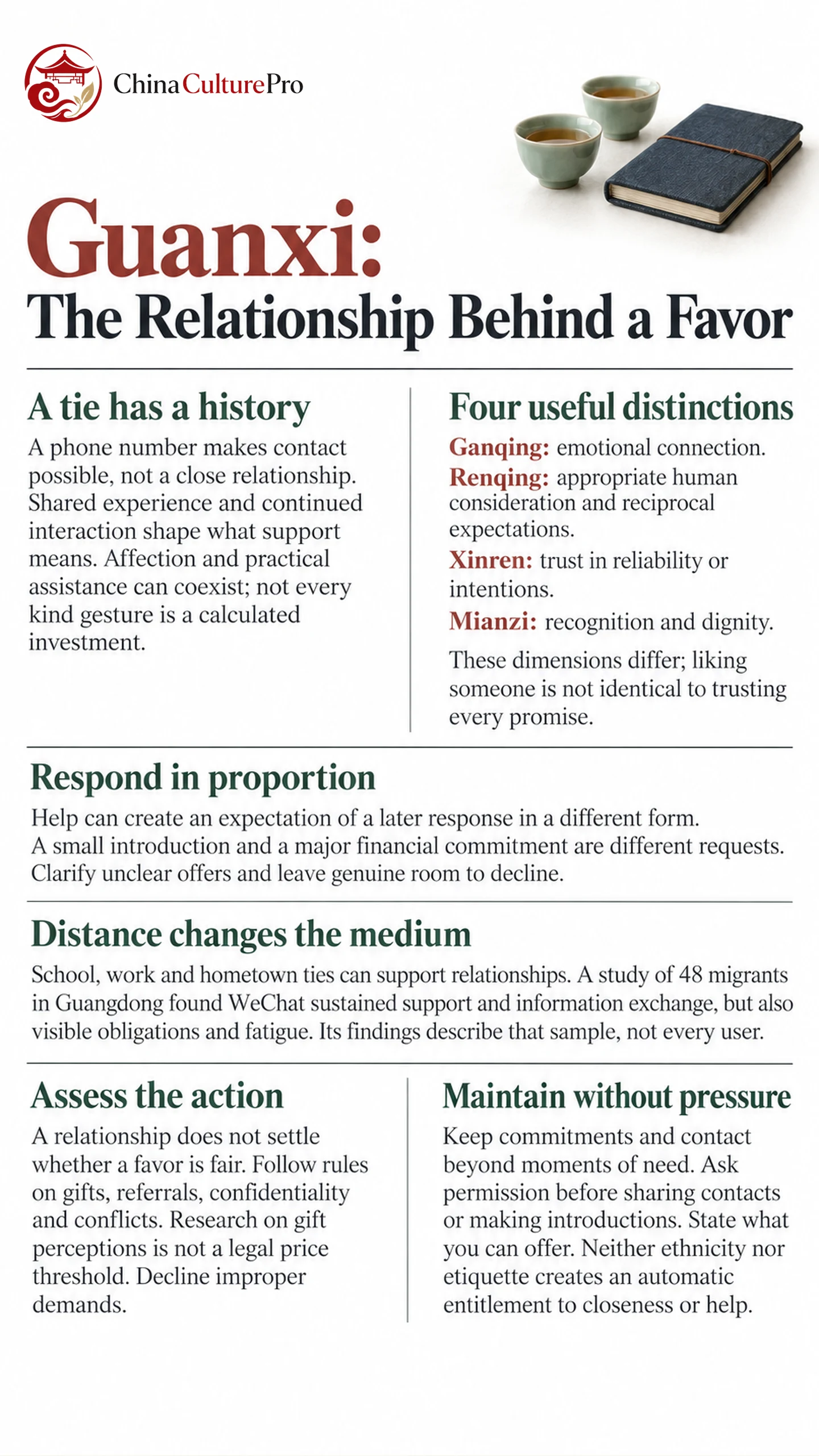
A classmate’s number in your phone tells you that contact is possible. It does not tell you whether you can ask for a substantial favor, whether that person trusts you or what they expect in return. Repeated interaction and the history of the tie make those questions intelligible.
Personal trust and obligations are prominent in explanations of guanxi, including accounts intended for professional newcomers. [2] But reducing the concept to “knowing important people” misses ordinary ties and what participants actually do for one another. Equally, it is misleading to assume every friendly action is a calculated investment.
There is no single threshold at which a casual acquaintance becomes “real guanxi.” Ask how a particular relationship functions rather than trying to count contacts as if they were interchangeable assets.
Affection, Reciprocity, Trust and Face
Several related concepts help explain the different dimensions of a relationship. They are useful analytical distinctions, not a recipe requiring an identical balance in every tie. Reviews of guanxi scholarship emphasize affectionate interaction, reciprocal obligations and recognition of standing, while also noting differences among definitions. [3]
| Понятие | Что это помогает понять | Illustrative question |
|---|---|---|
| Ganqing(感情,gǎnqíng) | Affection and emotional connection built through interaction | “Do we care about one another beyond this request?” |
| Renqing(人情,rénqíng) | Human feeling and expectations about responding appropriately to others, including favors | “What response would fit the relationship and the help received?” |
| Xinren(信任,xìnrèn) | Trust in another person’s intentions or reliability | “Can I rely on what this person says and does?” |
| Mianzi(面子,miànzi) | Social recognition, dignity and reputation in an interaction | “Does this exchange acknowledge people’s standing?” |
Renqing should not be translated only as a favor debt. It can include sympathy, consideration and a sense of proportion in how people treat one another. [1] Nor is trust identical to affection: you may like someone while doubting their ability to keep a particular promise.
The face culture guide explains mianzi in more detail. Here, its role is relational: the manner of making or declining a request can affect how the people involved are regarded.
Favors and the Expectation of a Response
Help can establish or reinforce an expectation that the recipient will respond when the relationship calls for it. That response may happen later and in a different form. A long-term account of guanxi emphasizes relationships maintained over time, sometimes before either person has a specific need. [4]
Consider an illustrative example: a former classmate explains how to find publicly available information in a new city. Later, you help them understand something in your own area of experience. Neither favor needs a price tag or a simultaneous repayment. A request for privileged access or a decision outside the proper process would raise a different question.
The scale of a request matters. A brief introduction, a substantial loan and access to confidential information are not equivalent simply because all can be called “help.” Before asking, explain what you need and leave a genuine option to decline. Before accepting, clarify whether the offer is a gift, a loan, a paid service or informal assistance if that distinction is unclear.
Reciprocity can create expectations, but neither participant gains unlimited claims. A clear agreement is more useful than accepting something uncomfortable and assuming an unspoken debt can never be discussed. The Chinese gift giving guide considers a related situation in which kindness and obligation may be interpreted differently.
Guanxi in Everyday and Digital Social Life
Shared school experience, work, neighborhood life or a hometown can provide occasions to build relationships. Kinship and friendship also matter, although scholars differ over whether the closest family ties belong inside a narrow technical definition of guanxi. The broader vocabulary of relations should not be confused with one researcher’s chosen boundary. [3]
A shared meal can make room for conversation and recognition without functioning as an automatic exchange contract. Chinese banquet customs explain some formal settings; daily contact may be much less ceremonial.
Digital contact has changed how relationships are maintained across distance. A study of hometown networks drew on interviews with 48 internal migrants in Guangdong, conducted from December 2021 to August 2022. Participants used WeChat to maintain overlapping hometown ties, exchange information and offer support. Some also described fatigue around obligations and discomfort when requests became visible to shared contacts. [5]
This provides a concrete example of continuity and change, not proof that all users manage relationships alike. The same study records people using official digital channels as alternatives to requesting personal help. [5] Online availability does not mean constant availability for favors, and being added to a group does not establish consent to every request within it.
Support, Favoritism and Ethical Boundaries
Personal support and institutional fairness can pull in different directions. Recommending someone honestly on the basis of known work differs from concealing a conflict or demanding that they be selected regardless of the criteria. The relationship itself does not settle whether the action is acceptable.
Research on gift giving and bribery shows why a simple “gift versus guanxi” distinction is inadequate. Three studies examined observers’ judgments about relationship usefulness, a present’s value and the giver’s motivation. More instrumental motives and higher-value presents could make an exchange more likely to be viewed as a bribe. [6] These findings concern participants’ perceptions; they are not a legal test or a universal price threshold.
In a workplace or institution, check the applicable rules on gifts, referrals, confidentiality and conflicts of interest. State the relationship where disclosure is required, and let the proper decision process operate. Receiving a favor does not authorize someone to demand an improper professional decision.
Descriptions of relational pressure should also remain descriptions. A person may feel that refusing harms their reputation, yet that does not make coercion, favoritism or a hidden payment an essential cultural courtesy. Both the benefits and the unequal burdens of a network belong in an honest account.
Maintaining a Relationship Respectfully
Keep contact because the person matters, rather than appearing only when you want something. Follow through on small commitments, acknowledge help and be accurate about what you can offer. These are practical ways to make trust possible, without promising that a formula will produce a particular relationship.
Ask permission before introducing two people or sharing a private contact. An intermediary may be willing to connect you, but the person introduced still decides whether to participate. You cannot transfer a friend’s obligation to a stranger simply by mentioning their name.
When a request is inappropriate or beyond your capacity, say so. “I can explain the public process, but I can’t influence the decision” identifies a useful limit. If you can offer a legitimate alternative, do; if not, a clear refusal is better than a promise you cannot keep.
Someone outside a Chinese-speaking community can develop meaningful relationships through shared experience, reliability and mutual interest. Familiarity with guanxi vocabulary can improve understanding, but neither ethnicity nor an etiquette performance guarantees closeness. The relationship remains something the people involved negotiate over time.
FAQs About Guanxi
Is guanxi just networking?
Networking is a partial translation. Guanxi often emphasizes the history of a personal tie, mutual support and continuing obligations more than the act of making a new contact.
Is guanxi the same as bribery?
No. Relationships can support ordinary cooperation, but they can also be used in improper exchanges. Evaluate the actual action, purpose and applicable rules rather than relying on a cultural label.
Can someone outside China develop guanxi?
Yes. Relationships can grow through shared activities, trust and continued contact. Knowing the vocabulary does not create an automatic shortcut to closeness or favors.
Does accepting help mean I owe any favor requested?
No. Reciprocity does not require unsafe, improper or unwanted conduct. Clarify expectations and set limits instead of treating a favor as unlimited permission.
Источники
[1] Jack Barbalet. Conceptualising informal institutions: Drawing on the case of guanxi
[2] CUHK Business School. Navigating the Web of Guanxi
[3] Xiaoguang Li and Yanjie Bian. Social networks in China: A thematic review of guanxi scholarship in the past decade
[4] David Smith, Global Corporate Governance Forum. Guanxi, Mianzi, and Business: The Impact of Culture on Corporate Governance in China
[5] Yutian Xiong and Yimei Zhu. Hometown Relations in WeChat Practice among Internal Migrants: Rethinking Social Capital Logic in Modernised China
[6] Peikai Li, Jian-Min Sun and Toon W. Taris. Differentiating between Gift giving and Bribing in China: A Guanxi Perspective