

Quick Answer: What Do Classical Chinese Function Words Do?
Function words (虚词, xū cí; traditional 虛詞) help show grammatical relationships, reference and sentence force. Read them as clues to a construction, not as a list of fixed English replacements.
- Position: Notice what comes before and after the character.
- Scope: Identify the phrase or clause it affects.
- Reference: Ask what a pronoun points back to.
- Context: Test your interpretation against the surrounding passage.
The selected forms below introduce a reading method. They do not cover every function of every character.
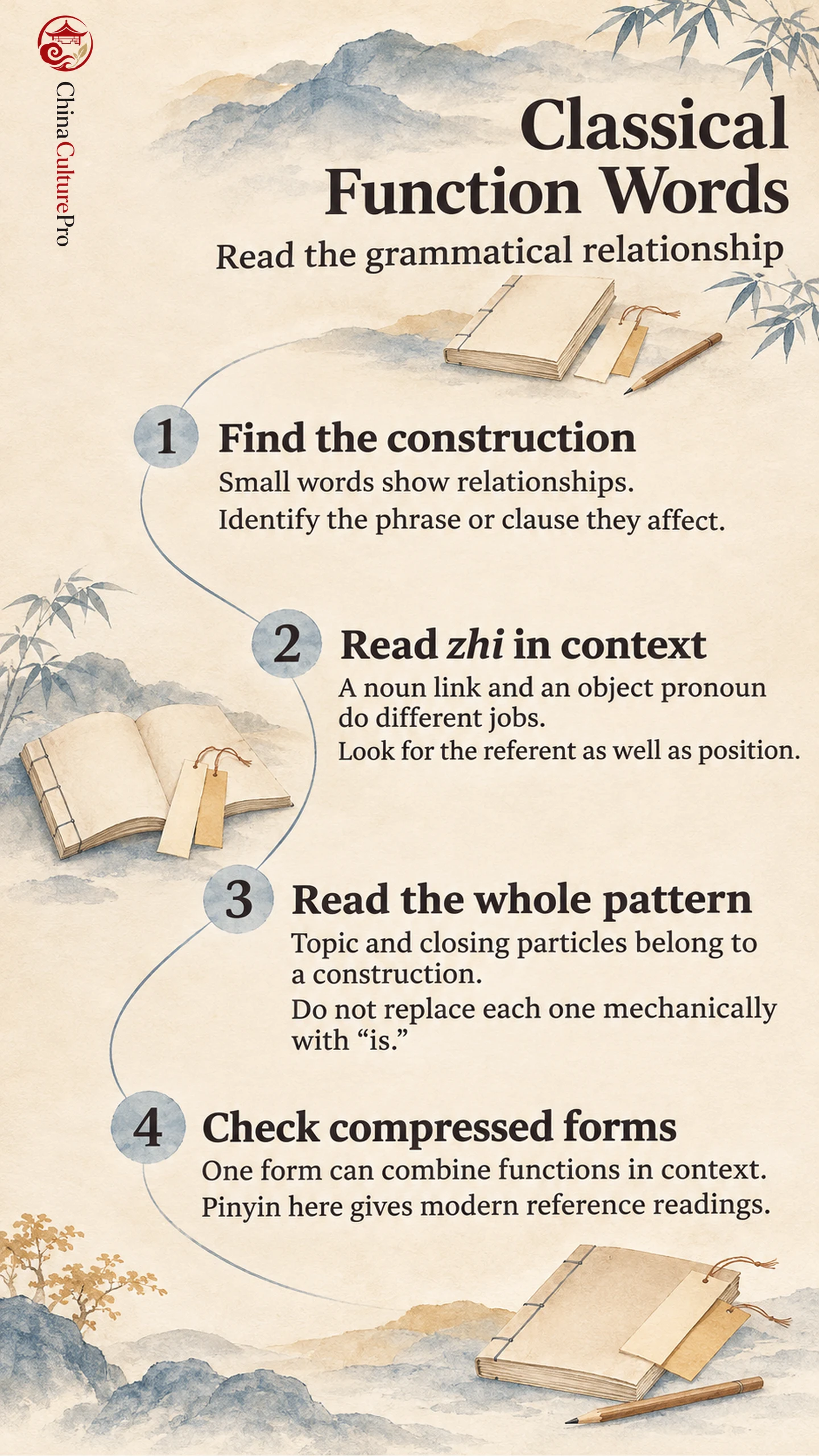
A sentence can contain familiar nouns and still be hard to understand. Check how those nouns connect, which phrase is being discussed and what a short pronoun refers to. Small grammatical words can supply those missing relationships, even when a smooth English translation gives them no separate word.
Treat Function Words as Structural Clues
Begin with the clause rather than a character-by-character translation. Locate the action or statement, then mark the phrases around it. A label such as “particle” tells you to examine the construction; it does not mean the character is disposable decoration.
For example, a link between nouns and a word referring back to a person perform different jobs. If both happen to be written with the same character, a single memorized gloss will conceal the difference. Keep a notebook entry for each observed use, including the complete phrase.
The Classical Chinese grammar introduction provides the wider sentence framework. Use this guide to focus on the small forms that help you recognize that framework in a passage.
Read Zhi by Its Position and Referent
The character 之, zhī, can link a modifying expression to a following noun. It can also serve as an object pronoun. The surrounding construction determines the reading; “of” is not a reliable translation everywhere. [1]
Compare these original practice fragments, supplied to illustrate structure rather than quoted as ancient sayings:
| Fragment | Modern Mandarin reading | Reading task |
|---|---|---|
| 師之言 | shī zhī yán | Read a noun relationship: the teacher’s words. |
| 從之 | cóng zhī | Read a verb followed by its object: follow him, her or it, as context determines. |
In the first fragment, ask which noun is being described. In the second, look backward for the referent. The pronoun does not supply an English gender by itself. [1]
Do not infer that these two functions exhaust the character’s uses. The historical pronouns guide develops the reference question; an annotated text is still needed for a difficult occurrence.
Read Zhe and Ye as Parts of a Construction
The form 者, zhě, can help make a phrase function as a noun and can mark the topic of an identification. In an equational pattern, 也, yě, often closes a statement identifying or classifying something. Neither should simply be replaced by the modern English verb “is” in every occurrence. [2]
An original miniature example is 此,書也, cǐ, shū yě: this is a book. The English sentence needs “is,” but that does not make 也 a word-for-word equivalent of an English verb. Read the relationship between the two noun expressions. [2]
As a working notation, label the topic, the description and the closing particle separately. That helps you avoid splitting a long noun phrase at the wrong point. Return to the full sentence when a short phrase admits more than one plausible analysis.
Check Compressed Forms before Translating
Some forms combine grammatical functions. In the appropriate construction, 諸, zhū, can be analyzed as 之於, zhī yú, or 之乎, zhī hū. The form 焉, yān, can carry a locative sense such as there. These are contextual analyses, not substitutions to apply to every appearance of those characters. [3]
The short phrase 有鳥焉, yǒu niǎo yān, occurs in a mountain description in the Classic of Mountains and Seas. In that context, it describes a bird there. The location belongs to the preceding description; keep that location tied to the surrounding passage. [3]
When a gloss seems awkward, compare the proposed function with the actual phrase boundaries. Preserve uncertainty until the surrounding passage supports a reading. The Chinese characters guide explains written units, while the Pinyin guide helps with the modern reference readings used here.
FAQs About Classical Chinese Function Words
Does every function word need a separate English word?
No. A relationship may be expressed through English word order or sentence structure. Your translation should preserve the relationship, not force one English token for every character.
Does knowing modern Mandarin remove the need to study these forms?
No. Familiar characters still need to be interpreted in the grammar and context of the older passage.
Are the Pinyin readings reconstructed ancient pronunciation?
No. They are modern Mandarin reference readings for identifying the characters in this guide.
Источники
[1] Robert Eno, Indiana University. Introduction to Literary Chinese, Part I
[2] Andrew Schonebaum and contributors. Introduction to Classical Chinese: Lessons and grammatical glossary
[3] Kai Li and James Erwin Dew, Cheng & Tsui. Classical Chinese: A Functional Approach, sample Lesson10