


Quick Answer: What Do Zhongguo, Cathay and Sina Mean?
Zhongguo(中國,Zhōngguó), Cathay and Sina are names associated with China in different linguistic and historical settings. They are not a sequence of three official national renamings.
- Zhongguo: A Chinese name commonly rendered “Middle Kingdom” or “central state.”
- Cathay: A name connected with the Khitan(契丹,Qìdān), familiar from medieval travel and later English literature.
- Sina: A Latin name whose related forms help explain words beginning with Sino-.
Their relationship becomes clearer when you identify who used each name, in which language, and for what geographical setting.
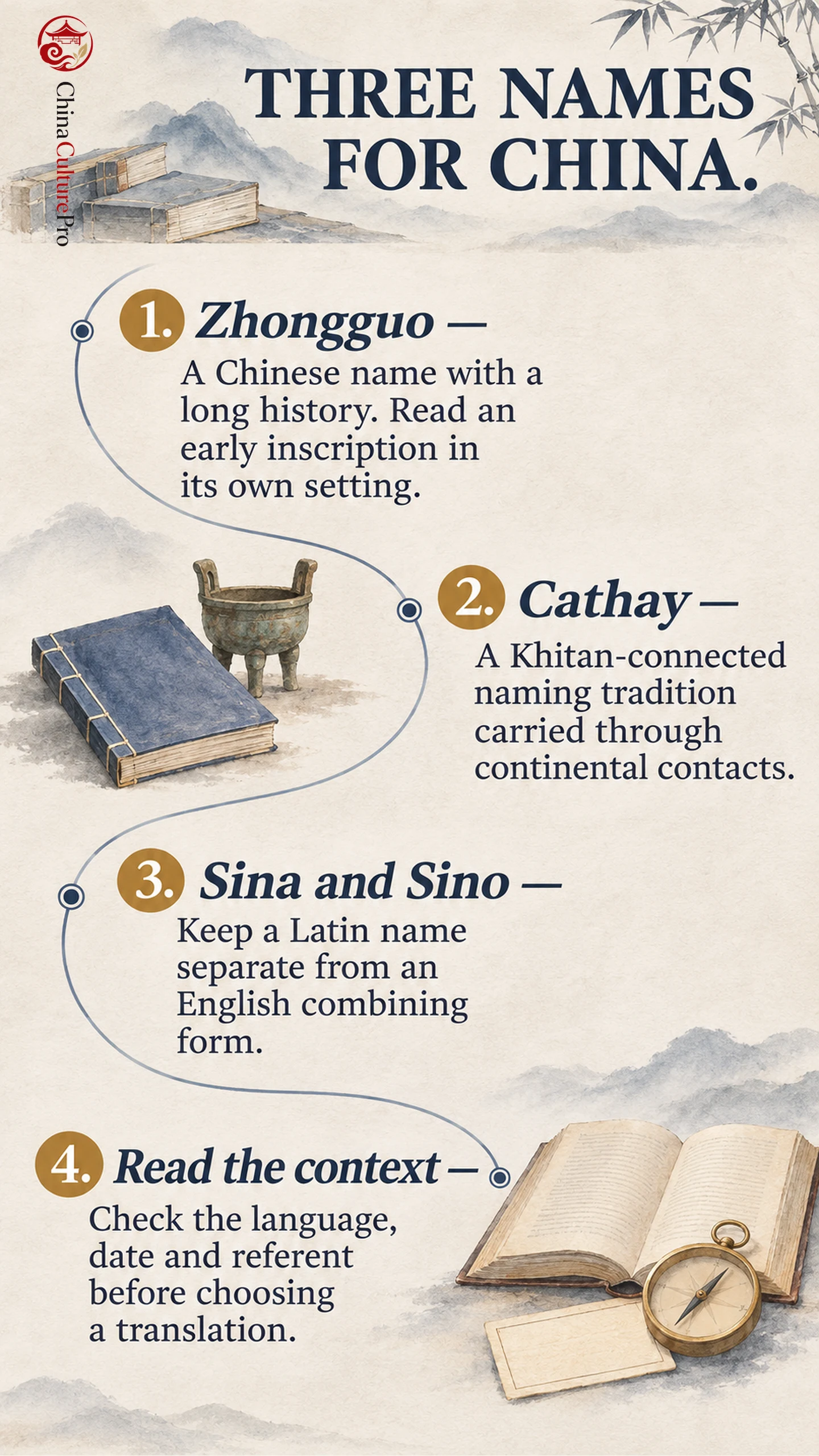
A museum label, a medieval travel account and a Latin dictionary may use different names for a place an English reader calls China. Those names carry different histories. Reading them as interchangeable labels can conceal the writer’s perspective; treating them as entirely separate countries can be equally misleading.
Zhongguo: A Chinese Name with a Changing Historical Scope
Zhongguo is the familiar Mandarin name for China today. Julian Wheatley’s language textbook explains its earlier association with a central or royal state, alongside the conventional translation “Middle Kingdom.”[1] The familiar English translation is useful, but the word’s historical referent needs the surrounding text.
An early example is the He zun(何尊,Hé zūn), a Western Zhou bronze vessel. Shanghai Museum’s curatorial account discusses its phrase 宅茲中國, transcribed as zhái zī Zhōngguó, in connection with the royal center at Chengzhou, present-day Luoyang. The museum renders the phrase as referring to residence in the capital city.[2]
This is evidence for an early written use of the expression. It does not mean that a modern country, with its present institutions and boundaries, was named in exactly the same sense. Nor does the earliest surviving record establish when people first spoke the term.
The two Chinese characters also invite overinterpretation. “Central state” tells you about the name’s components, not everything its users believed about the world. For an inscription from the Zhou period, start with the ruler, settlement and event mentioned nearby before choosing a translation. A short gloss cannot replace that historical setting.
Cathay: A Name Connected with the Khitan
Cathay belongs to a different naming tradition. It derives from names associated with the Khitan, who established the Liao dynasty, conventionally dated 907–1125. Lieu’s study traces how the name became associated with northern China among peoples communicating across continental routes.[3]
Medieval European travel writing carried forms such as Cataia into a wider readership. Marco Polo is one important example in that tradition, rather than the inventor of the underlying name.[3] The Silk Road’s history helps explain why a name could travel beyond the people and polity that originally supplied it.
Check the geographical scope: a medieval northern reference may be narrower than a later use of “China.”
Cathay later acquired a literary quality in English. Related forms remain ordinary country names elsewhere: Wheatley gives Russian Kitai as an example.[1] An old-sounding English word and a current word in another language can therefore belong to the same naming family. A literary English usage does not make the related Russian name obsolete.
Sina, Sinae and the English Form Sino
Sina is a Latin name for China. P. M. Eckel’s botanical Latin dictionary lists Sina as a feminine noun and gives related adjectives including sinensis and chinensis.[4] These are Latin word forms, not attempts to spell modern Mandarin.
Sina and Sinae need attention to grammar. The ending -ae can have more than one grammatical function. In a Latin passage, consult the entry and sentence before deciding how a form is being used; a changed ending does not by itself establish a different place.
English Sino- is a combining form meaning “Chinese.” Oxford’s dictionary connects it with Late Latin Sinae and Greek forms, and illustrates its use in “Sino-Japanese relations.”[5] Here it forms part of an adjective describing a relationship involving China. It is not normally a standalone English country name.
Lieu argues that the name China connects with Qin(秦,Qín)through transmission across languages.[3] A resemblance to modern Mandarin does not prove each borrowing step. Distinguish a word’s documented use from an argument about its remote origin.
Read the Name in Its Language and Context
When you encounter one of these names, keep the original spelling beside your translation. Three short settings show the different reading tasks:
| Ситуация | What to identify | Useful interpretation |
|---|---|---|
| A caption discussing 宅茲中國 | The bronze inscription and its royal settlement | Explain the early central-place context before using a modern country label |
| Cathay in a medieval journey | The author’s route and regional divisions | Establish which area the account means at that point |
| Sina or Sino- in a dictionary | The language, grammar and complete entry | Separate a Latin noun from an English combining form |
The examples rule out a false timeline: Zhongguo did not simply stop being used when Cathay began, with Sina replacing both afterward. The names belong to intersecting linguistic traditions.
For ordinary English prose today, “China” will usually be the clearest country name. Retain Zhongguo when discussing the Chinese expression, Cathay when its historical or literary use matters, and Sina when examining the Latin form. If quoting an older text, explain its usage rather than silently modernizing away a meaningful distinction.
A practical note should therefore contain three things: the original name, the document’s date and language, and a short explanation of its referent. That is more useful than memorizing a list of supposed synonyms without knowing when to use them.
FAQs About Zhongguo, Cathay and Sina
Are Zhongguo, Cathay and Sina three different countries?
Not as a general rule. They are names associated with China in different traditions; each text’s geographical scope still matters.
Does Zhongguo literally mean Middle Kingdom?
That is a conventional rendering. “Central state” also conveys its components; the historical meaning depends on context.
Is Cathay still used today?
Yes, particularly in literary or proper-name uses in English. Related forms remain ordinary country names in other languages.
Is Sina the Mandarin pronunciation of China?
No. Sina is a Latin form. The Mandarin name discussed here is Zhōngguó.
Источники
[1] Julian K. Wheatley. Learning Chinese: A Foundation Course in Mandarin, Introduction
[2] Shanghai Museum. The Making of China: The Civilizations of the Xia, Shang, and Zhou Dynasties
[3] Samuel N. C. Lieu. From Qin (Ch’in) to Cathay: Names for China and the Chinese on the Silk Road
[4] P. M. Eckel, Missouri Botanical Garden. A Grammatical Dictionary of Botanical Latin: Sina
[5] Oxford University Press. Sino-