

Quick Answer: What Is the Tianjin Dialect?
Tianjin speech(天津話,Tiānjīnhuà)is a northern Mandarin variety associated especially with urban Tianjin. It is closely related to Standard Mandarin, with a distinctive tonal system.[1]
- Sound: The low-falling first tone is an important listening clue.
- Meaning: Local words and familiar characters need to be read within an expression.
- Context: Everyday conversation, stage performance and older descriptions show different aspects of the variety.
This guide focuses on urban Tianjin speech. A municipal address alone does not establish that a speaker uses the same local variety.
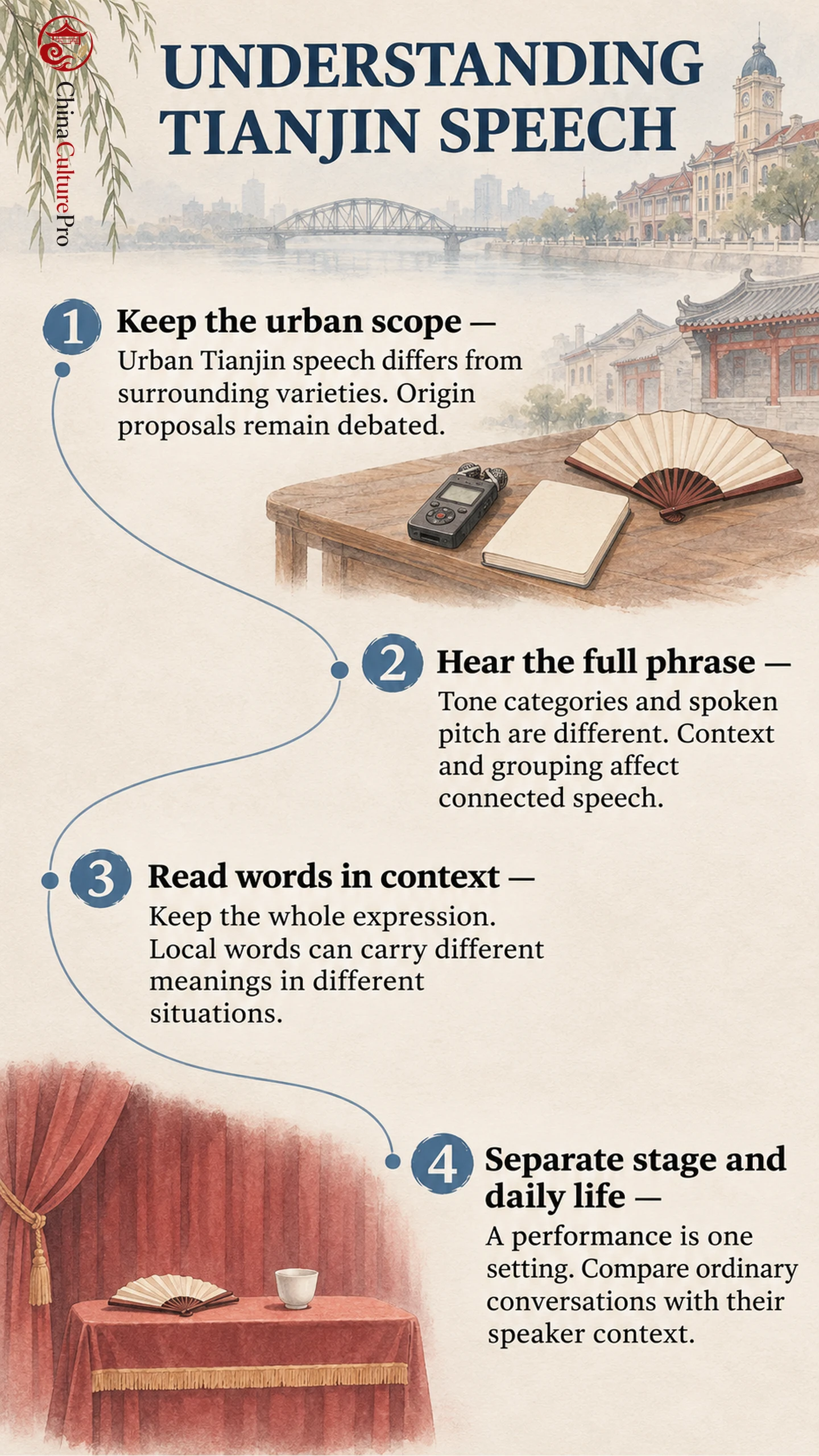
A Tianjin conversation may contain recognizable Mandarin words while following an unfamiliar melody. A comedy clip can make that difference especially noticeable, but it also selects and performs speech for an audience. To understand what you are hearing, separate the tone pattern, the local expression and the situation in which someone uses it.
Urban Tianjin Speech and the Question of Origins
“Tianjin Mandarin” describes urban speech, not every variety throughout the municipality.[1] Check a recording’s locality.
In a 2024 broadcast discussion, Nankai linguist Ran Qibin identified a core area covering Heping, Hexi, Hedong, Nankai, Hebei and Hongqiao districts. He described its contrast with surrounding speech as a dialect-island pattern.[2] This is a description of linguistic distribution, not a claim that residents outside those districts cannot speak urban Tianjin Mandarin.
The same discussion presented several origin proposals, including connections with northern Anhui. Researchers have compared speech in places such as Guzhen and Suzhou in Anhui with Tianjin speech, alongside migration history. The invited scholars emphasized similarity rather than complete identity, and the report left the origin question unsettled.[2]
For an introduction, the useful distinction is between a present-day description and a historical explanation. You can study a current speaker’s pronunciation without accepting a single migration story as the proven source of every feature. The Chinese languages and dialects guide supplies the wider classification context.
Four Tones, With Changes in Connected Speech
Li, Chen and Xiong describe four full tones, illustrated principally by a Nankai District man born in the 1980s.[1] Their contours are summarized below.
| Tone category | Broad contour in the description |
|---|---|
| T1 | Low, falling |
| T2 | Rising toward a high pitch |
| T3 | Low, dipping or rising |
| T4 | High, falling |
Tianjin’s low-falling T1 differs from Standard Mandarin’s high, level first tone.[1] Shared category labels do not guarantee identical contours.
Words also affect one another in connected speech. Tone sandhi names a systematic change conditioned by context; it is not simply a speaker sounding more animated. For background on the terminology, see Chinese tones.
A 2025 study by Siqi Lu, Hui Feng and Ziyu Xiong examined seven three-syllable tone patterns and six syntactic structures using data from 26 speakers. One result was T4–T4–T1 becoming T4–T2–T1.[3] The middle category changes in that reported pattern, so repeating each word’s isolated form would miss the connected result.
The study also distinguished expressions grouped as two syllables plus one from those grouped as one plus two. Grammatical structure affected how sandhi applied.[3] Learn the complete expression with its grouping. Use isolated syllables as a starting point, then study the phrase as spoken.
Everyday Words and Their Context
A few familiar examples make the difference between sound and meaning clearer. In Shi Jin’s discussion of Tan Ruwei’s work, 嘛 commonly shortens the meaning “what.” The same account identifies 浆子 as soy milk, 餜子 as youtiao, and 堆儿 as a local name for tanghulu, the skewered candied-fruit snack.[4]
These examples do different jobs. 嘛 can occupy a place in a question, while the food terms identify things someone may be offering or ordering. Read the surrounding words before trying to translate an isolated character. A local food name supplies meaning; it does not supply a complete pronunciation lesson.
Another prominent expression is genr(哏兒,génr). The 2024 broadcast illustrates it approving something done well, but also anticipating trouble or hinting at a relationship, depending on the situation.[2] Reducing it to “funny” in every sentence would lose those differences.
Keep the full utterance, who is speaking and what prompted the response. A teasing exchange and a sincere question can use a familiar word with different force. The Mandarin pinyin supplied beside formal terms on this page identifies their written names; it does not capture all the details of a local performance or conversational reading.
Crosstalk, Local Identity and Learning to Listen
Xiangsheng(相聲,xiàngsheng), or Chinese crosstalk, is one prominent setting for local speech. The broadcast brought linguists and performers together to discuss these connections.[2] Our xiangsheng guide explains the performance form.
A stage exchange is a useful cultural example, but an incomplete sample of ordinary speech. An audience-facing routine selects timing, character and delivery. Treat its language as part of that particular performance before applying it to a conversation with someone you have just met.
Local speech also changes. Xiaomei Wang’s 2017 research drew on 76 sociolinguistic interviews conducted in Tianjin in 2014–2016. Two studied sandhi variables moved in opposite directions: one local variant declined in apparent time while another increased. Wang proposed an interaction between standardization and local identity as an explanation for these patterns.[5]
That finding complicates the idea that every feature simply fades as Standard Mandarin spreads. It also discourages treating a single older recording as a test of whether younger speakers are authentic. The study examined particular variables in a particular sample, not every possible feature of Tianjin speech.
For listening practice, pair a short everyday recording with its meaning and speaker context. Compare it with a performance only after identifying the ordinary expression. Note where the tone changes, which word carries the meaning, and whether delivery adds humor or emphasis. Those separate observations are more useful than trying to imitate a whole city’s supposed personality.
FAQs About Tianjin Dialect
Is Tianjin dialect a form of Mandarin?
Yes. Urban Tianjin speech is a northern Mandarin variety, with local sound patterns and vocabulary.
How is Tianjin speech different from Beijing speech?
Its tonal system is especially distinctive, including a low-falling first tone and different connected-speech patterns.
Does ma always mean what?
No single translation covers every use of 嘛. Check its place in the question, the full expression and the speaker’s delivery.
Is every Tianjin speaker talking like a crosstalk performer?
No. Crosstalk is a performance setting. It cannot represent every resident’s ordinary conversation.
Источники
[1] Qian Li, Yiya Chen and Ziyu Xiong. Tianjin Mandarin
[2] CCTV News, republished by Nankai University. Exploring Tianjin Speech With Linguists and Performers
[3] Siqi Lu, Hui Feng and Ziyu Xiong. The Role of Syntactic Structures in Shaping Directionality in Trisyllabic Tone Sandhi: Evidence from Tianjin Mandarin
[4] Shi Jin, Nankai University. A Reading of Tan Ruwei’s Essays on Tianjin Speech and Culture
[5] Xiaomei Wang. Migration, Local Identity and Change in Tianjin Tone Sandhi