

Quick Answer: What Is Yangge?
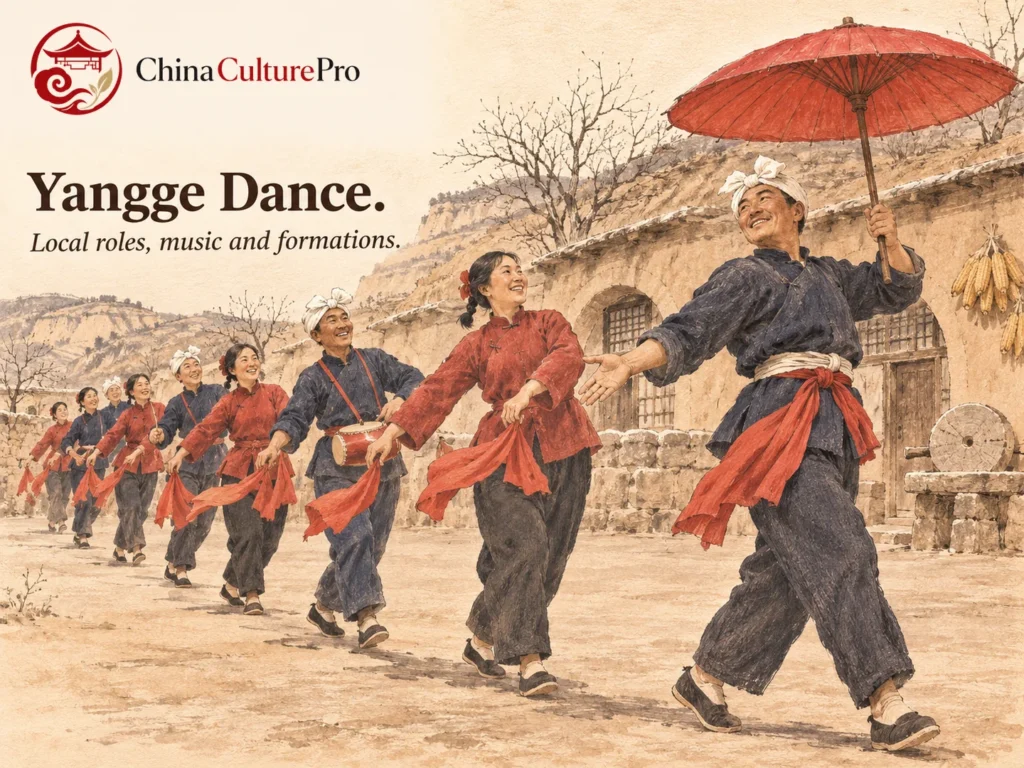
Yangge(秧歌,yānggē) is a family of folk performance traditions especially associated with northern China. Dancers can move in lines or changing formations to percussion and wind instruments. Depending on the local form and role, they may use drums, umbrellas, fans, handkerchiefs or other props.
A performance can move through a community or take shape in a set space. Regional examples from Shaanxi and Shandong use different roles, music and formations. Watch the group’s direction and look for the performer or sound that helps set its pace.

An umbrella can make a turn visible before the whole group changes direction. In another dance, a drummer’s movement or a fan can draw the eye. The objects give clues when you see how the troupe uses them.
A Family of Dances Rather Than One Routine
Some descriptions distinguish ground yangge, di yangge(地秧歌,dì yānggē), from stilt yangge, gaoqiao yangge(高跷秧歌,gāoqiāo yānggē). These labels describe whether the dancers perform on the ground or on stilts. The regional label gives further information about the troupe’s movements, characters and music. [1]
The name is often linked with farming imagery, while the documented performances cover several occasions and ways of moving. Northern Shaanxi’s entry describes different forms connected with village celebrations, processions and local ritual practice. The occasion helps explain why a troupe is dancing and which part of its repertoire it presents. [1]
Three Regional Yangge Traditions
Look for the county or community named in a programme. It can tell you what kind of leader, props or formation to expect. The examples below describe documented regional practices.
| Local form | Bidang | A clue to the performance |
|---|---|---|
| Northern Shaanxi yangge | Suide and other communities in northern Shaanxi | A leader with an umbrella can guide the troupe through a changing formation, accompanied by drums, gongs and reed pipes. [1] |
| Jiaozhou yangge | Jiaozhou, Shandong | The repertoire includes distinct roles, a fan-bearing part and short dramatic pieces. [2] |
| Shanghe drum yangge | Shanghe, Shandong | Umbrella, drum and stick roles can move through an approach sequence and then perform patterns in a defined space. [3] |
Jiaozhou and Shanghe show that the province alone may leave several possibilities. The named troupe and the roles you can see give more precise clues.
Music, Props and Formation Changes
In northern Shaanxi, the umbrella leader can be visible across a moving group. Watch when the leader changes direction and when dancers behind them follow. Drums, gongs and reed pipes can make the rhythm audible while the line changes shape. [1]
In Shanghe, a drum or stick can also help identify a particular role. [3] Jiaozhou’s fan movements are part of a different repertoire and can be understood alongside Chinese fan dance in other settings. The type of prop matters, along with who carries it and how it is used. [2]
Festivals, Community Participation and Stages
Yangge can bring a community into a shared event. In the Shanghe tradition, an approach sequence can lead into patterns performed once the group reaches its space. [3] In Suide, the local record describes several village practices and festival contexts. An excerpt recorded on a stage can select part of a larger local repertoire. [1]
China’s first national heritage list included several named yangge traditions in 2006. The listing groups them within a wider field of Chinese traditional dance while preserving their local names. Those names matter when one festival brings multiple troupes together. [4]
How to Watch a Yangge Team
Start with a wide view and choose one line of dancers. Follow the point where it turns or divides. Then watch one person in the group and see how their prop or movement signals a role. The two views help you see the group’s pattern and the work of a single dancer.
At a celebration, performers from different traditions may pass in succession. Compare the title or troupe name with the formation and sound. For example, Yingge uses its own local repertoires and commonly features paired wooden sticks. Details such as who holds a prop and how the group moves can help you distinguish the performances.
FAQs About Yangge
Does every yangge dance use stilts?
Ground and stilt forms are both documented. Many yangge performances take place on the ground.
Is yangge always a harvest dance?
It appears at many community occasions. Some performances are associated with seasonal festivals or local ritual, and others are staged for an audience.
Are all northern yangge routines alike?
Local traditions differ in roles, props and formation. A regional or troupe name helps identify the performance you are seeing.
Sumber
[1] Museum Digital Warisan Budaya Takbenda Tiongkok. Northern Shaanxi Yangge
[2] China Intangible Cultural Heritage Digital Museum. Jiaozhou Yangge
[3] China Intangible Cultural Heritage Digital Museum. Shanghe Drum Yangge
[4] State Council of China. First National Intangible Cultural Heritage List