


Quick Answer: What Is Chinese Traditional Dance?
Chinese traditional dance is a broad term for forms of movement associated with many communities, occasions and performance traditions. A group may dance in a festival procession, sing and step in a circle, or bring a lion figure to life. The music, formation and place of performance help explain what the dancers are doing.
Some forms are maintained locally, and some are adapted for stages and schools. Chinese classical dance is a modern stage and training discipline that draws on older movement traditions. It belongs to a different setting from a community dance learned for a local event.
A circle of singers stepping together and a troupe carrying a lion can both appear under the label “traditional dance.” Watching who sets the pace, what the dancers carry and how the group is arranged tells you more than the label alone.
Community Dance, Ritual and the Stage
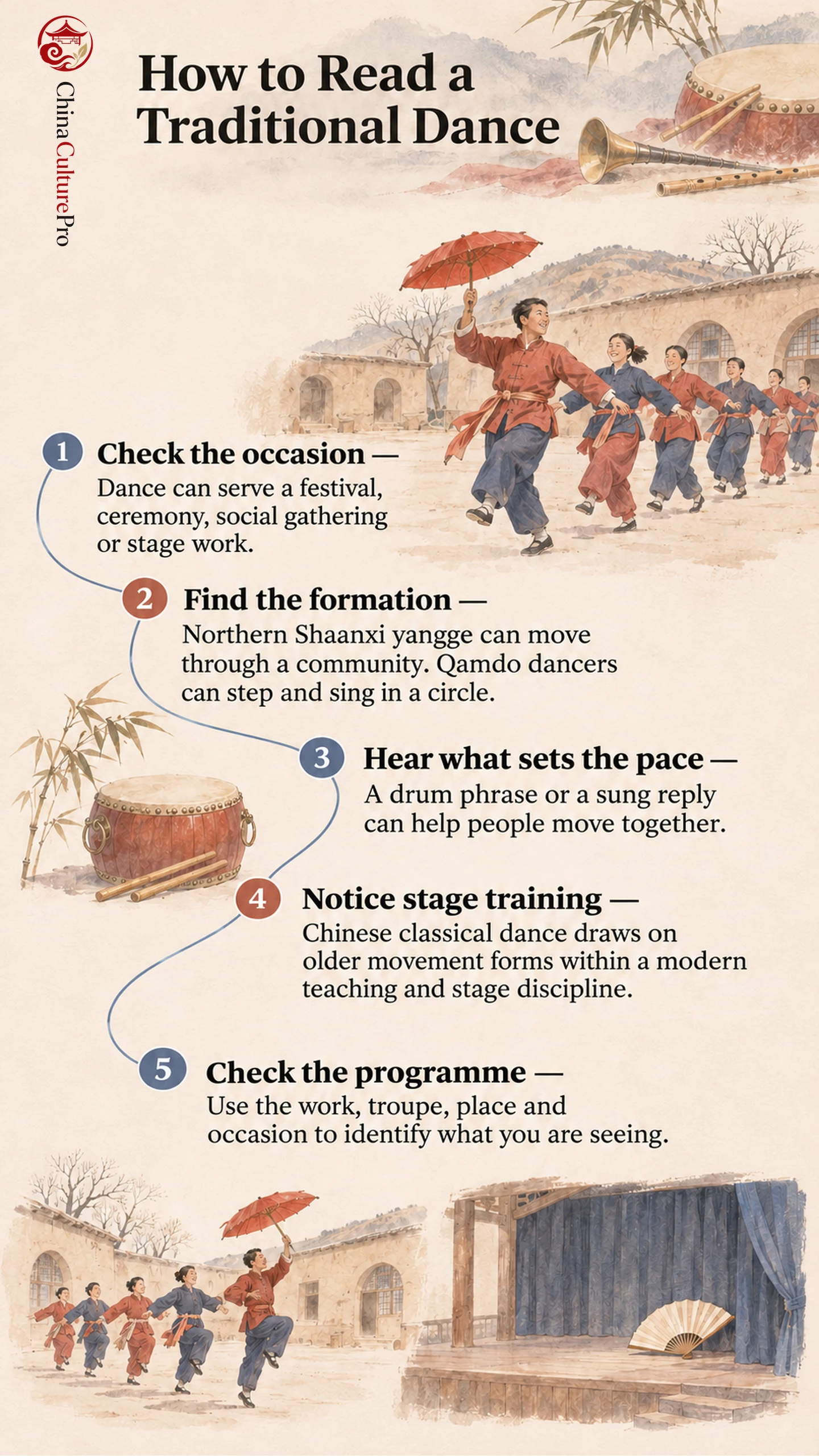
At a festival, dance can draw people into a shared occasion. In northern Shaanxi, dance groups may travel through a community and also perform set formations. The audience can gather where the troupe passes or watch a sequence in one place. The same tradition can have both a social function and a performance for spectators. [1]
In Qamdo, circle dancing can serve several purposes. Its heritage entry describes dancing in connection with celebrations, weddings and religious occasions. The event helps determine the size and pace of a performance. On a theatre stage, a group may select or rearrange movements for a particular work and audience. [2]
Regional Dance Forms at a Glance
The examples below have documented local settings. Use the clues to begin identifying a performance, then check the group or place named in its programme.
| Bentuk | Documented setting | Movement or sound to notice |
|---|---|---|
| Northern Shaanxi yangge(秧歌,yānggē) | Communities in northern Shaanxi, including Suide | A leader can guide a group through changing formations to drums, gongs and reed pipes. [1] |
| Qamdo guozhuang(锅庄,guōzhuāng) | Tibetan communities in and around Qamdo | Dancers can form a circle and sing in exchange as they step together. [2] |
| Farmers’ dance of China’s Korean ethnic group | Community festivals in Jilin and elsewhere in northeastern China | Dancers move to wind and percussion accompaniment, with some gestures based on farm work. [3] |
| Guangdong awakening lion | Guangdong, with performances in other communities as well | Two people can give one lion head and cloth body the appearance of shared movement. [4] |
The same object can turn up in different traditions. A drum can accompany a procession or be part of a dancer’s own movements. A fan can extend a gesture or become a visible marker as a group changes direction. Its placement and use matter more for identification than the word “ribbon.”
How Music, Props and Formation Shape Movement
Start by finding what the dancers move in relation to. In a sung circle, alternating voices can give the group a shared phrase. In a procession, percussion can coordinate steps and changes of direction. In a lion routine, changes in rhythm can help give the animal the appearance of a pause or a sudden reaction. [4]
A prop can extend a movement beyond the body. In one regional form, a leader’s umbrella can help make the group’s direction visible. In another, a cloth figure lets two dancers turn a step into the action of an animal. Watch the relation between the prop and the people moving it. [1]
Folk Traditions and Chinese Classical Dance
Chinese classical dance is an organized field of teaching and theatre. The Beijing Dance Academy traces its formal discipline to 1954 and describes drawing on older dance, opera movement and martial arts. Teachers and choreographers developed exercises and works from selected movements and aesthetic ideas. [5]
A work made for that setting may use a fan or long sleeve in carefully composed phrases. A community event may use similar objects within a procession, social gathering or ceremony. Identifying a stage genre therefore takes more than recognizing a costume or prop. A label such as fan dance can describe the object in use across more than one context.
How to Identify a Performance
Look for the name of the work, community or troupe first. Watch a wide view to identify the formation. Are people moving in a circle, passing along a route or facing an audience from a stage? Listen for the feature that sets the pace, such as a sung reply, a drum phrase or recorded accompaniment.
Then compare the label with what the video actually shows. A stage version can adapt a form associated with a local event, and a festival can include several unrelated dances. If you are comparing a dragon dance with another performance, watch how the dancers support the figure and what occasion brings the group together.
FAQs About Chinese Traditional Dance
Is Chinese traditional dance one style?
It covers many forms. Name the region, community or type of performance when you want to identify a particular dance.
Is Chinese classical dance the same as folk dance?
Chinese classical dance is a formal stage and training discipline. Folk forms can be community practices or material adapted for the stage.
Do fans or ribbons identify a dance’s region?
The prop is one clue. Check how it is used, along with the music, group and performance setting.
Sumber
[1] Museum Digital Warisan Budaya Takbenda Tiongkok. Northern Shaanxi Yangge
[2] China Intangible Cultural Heritage Digital Museum. Qamdo Guozhuang Dance
[3] UNESCO. Farmers’ Dance of China’s Korean Ethnic Group
[4] China Intangible Cultural Heritage Digital Museum. Guangdong Awakening Lion
[5] Beijing Dance Academy. Department of Chinese Classical Dance