
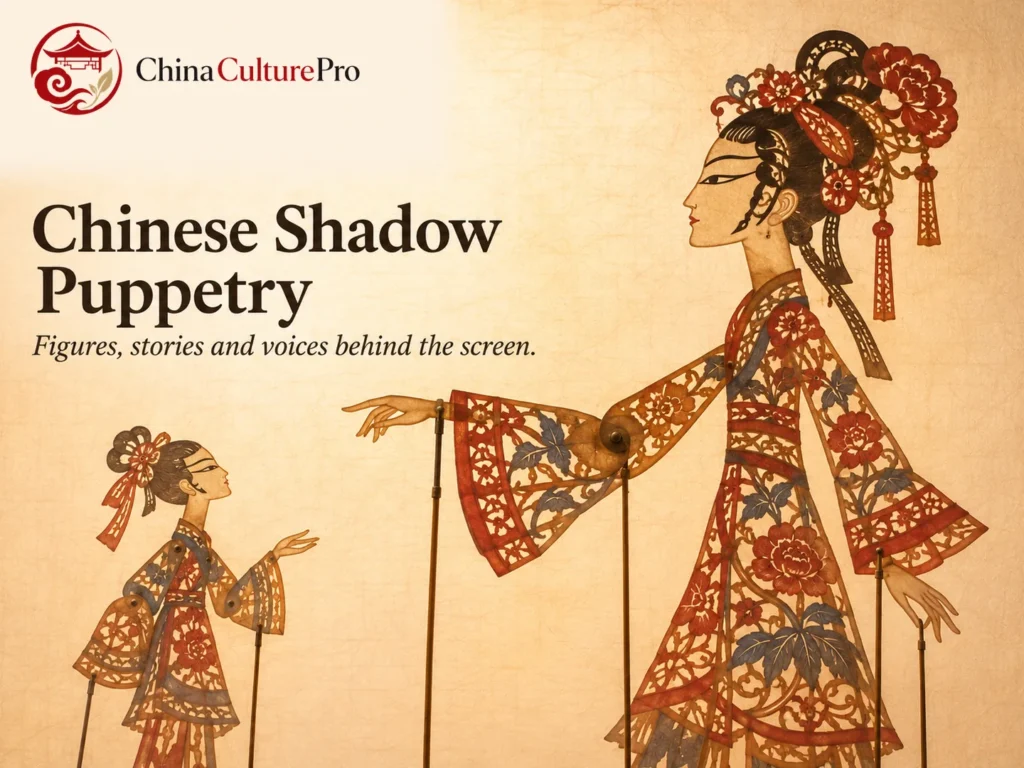

Quick Answer: What Is Chinese Shadow Puppetry?
Chinese shadow puppetry, or piyingxi(皮影戏,píyǐngxì), is theatre performed with flat figures, a lit screen and live sound. Puppeteers move the figures with rods from behind the screen. The audience sees silhouettes and, in many performances, color and cutout details.
The figures may be made from leather or paper. Music, speech and singing help distinguish characters and tell the story. Groups in different regions have their own singing styles, repertoires and ways of dividing the work.
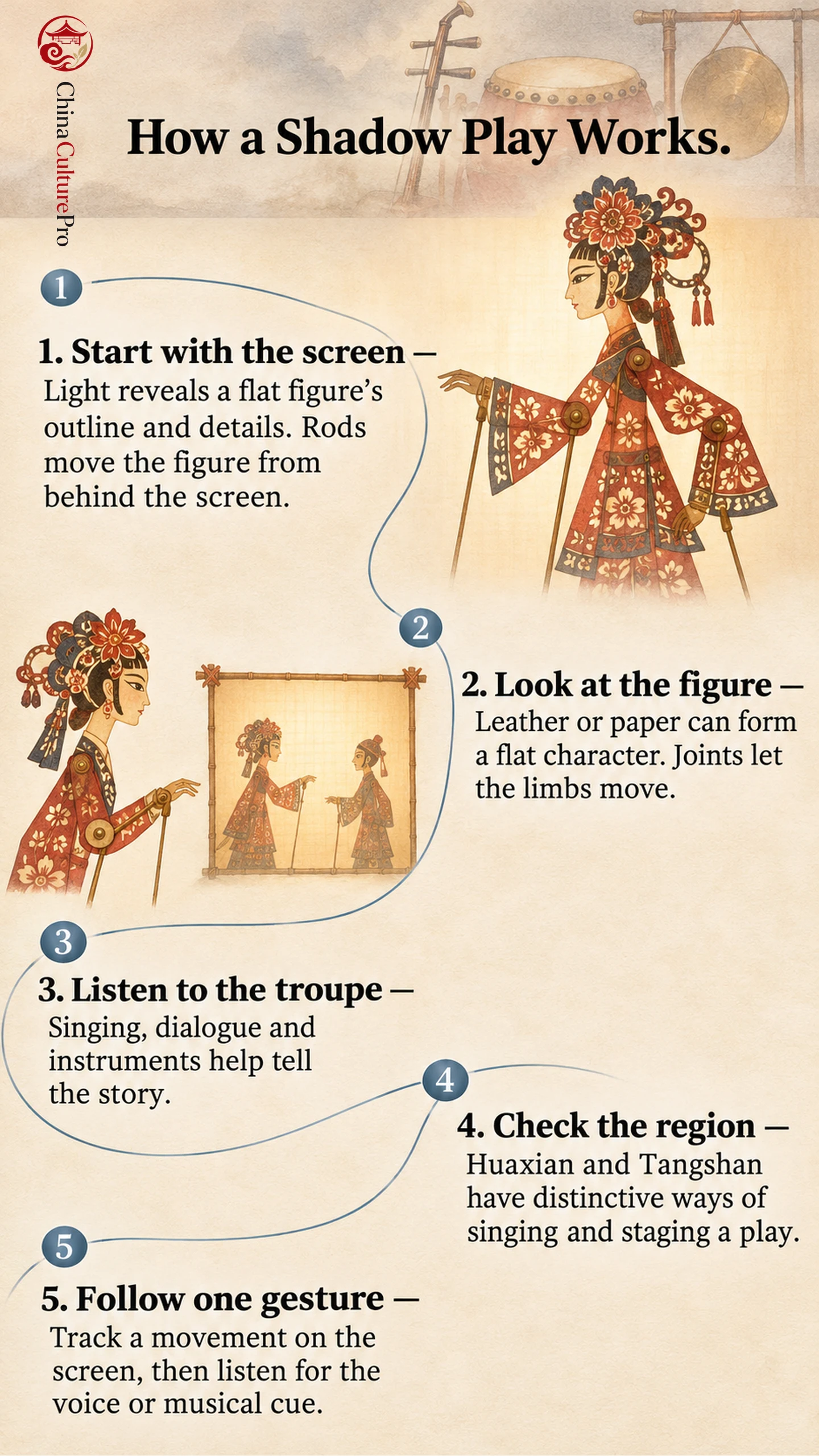
A flat figure can bow, gesture or ride into a scene. The puppeteer’s movement makes the gesture visible, while a voice gives the figure something to say. To follow a shadow play, watch how the two actions meet.
How Light, Screen and Rods Work Together
A light behind a translucent screen makes the outlines of the figures visible to the audience. Light passes through translucent colored areas and openings, making the figure’s details visible. The figure’s position against the screen helps determine how sharply its edges appear. The screen hides much of the physical work while showing its result. [1]
Puppeteers control the figures with rods. A shift of a main rod can change the position of a figure. Another rod can raise an arm independently, letting a hand point or move a prop. This way of presenting a figure distinguishes shadow plays from several other kinds of Chinese puppetry, where audiences can see the physical puppet directly. [1]
Figures, Materials and Character Design
Leather, including donkey hide, can be worked thin enough to transmit light. A nineteenth-century Chinese shadow figure in the Metropolitan Museum of Art is made of donkey skin and cord. A collection entry like this gives you a dated example of the material, while the stage gives you a view of what the figure does in motion. [2]
Puppets can have joined bodies and limbs with detachable heads. A profile, a headdress or the outline of a robe can help distinguish one character from another. Figures for scenery, furniture and animals can share the screen with human characters. The exact features and materials vary with the figure and the troupe. [3]
Voices and Stories Behind the Screen
A troupe may assign different people to manipulating figures, singing and playing music. In smaller groups, one performer may take on more than one job. A voice can introduce a figure, answer another character or carry a sustained passage of song. Percussion and other instruments can underline a pause or an entrance. [1]
Tangshan’s repertoire includes *The Second Bloom of the Plum* and *The Sword of the Blue Clouds*, alongside works designed to extend over multiple sessions. Those scripts give a troupe material for a single play or a story told over successive performances. Shadow theatre can share stories with Opera Tiongkok and other narrative forms while developing distinct ways to stage them. [3]
Regional Traditions and Heritage Records
In Huaxian, Shaanxi, a tradition known for wanwanqiang(碗碗腔,wǎnwǎnqiāng) singing developed in the eastern Guanzhong area. A performance from Tangshan in Hebei can sound different and organize the puppeteers’ work differently. Learn a troupe’s place or style before treating its singing or figures as typical of the whole genre. [4]
| Contoh | Tempat | One distinguishing feature |
|---|---|---|
| Huaxian shadow puppetry | Weinan area, Shaanxi | The local heritage entry describes a developed wanwanqiang singing repertory and small traveling groups. [4] |
| Tangshan shadow puppetry | Tangshan, Hebei | Its account describes specialized roles behind the screen and a three-rod arrangement for the figure and hands. [3] |
A Song-era account describes shadow play artists in the entertainment districts of the former capital at Bianliang. The account shows that the form was already established in the Song period. Its beginnings are harder to date. [4] UNESCO inscribed Chinese shadow puppetry on the Representative List in 2011. [1]
How to Watch a Shadow Play
Follow one character. First, see whether the body, head or arm moves first. Then listen for the voice or musical accent that marks the action. If you can find a view from behind the screen, look for the moment when the main rod changes the position of the body and the hand rod completes the gesture.
Compare excerpts that name the play and troupe. Record the location, the play and whether you are watching the screen or the performers. A difference in singing may come from the local tradition, while a difference in what you can see may come from the camera angle.
FAQs About Chinese Shadow Puppetry
Are Chinese shadow puppets always made of leather?
Leather is a common material. Paper figures are also documented in the Chinese shadow puppetry tradition.
Is Chinese shadow puppetry silent?
Speech, song and instruments can all contribute to the action. The exact musical and vocal parts vary by troupe and play.
When did Chinese shadow puppetry begin?
Written records document established shadow theatre by the Song period. Its precise beginnings are uncertain.
Sumber
[1] UNESCO. Chinese Shadow Puppetry
[2] Metropolitan Museum of Art. Shadow Player, Object 20.31.11
[3] China Intangible Cultural Heritage Digital Museum. Tangshan Shadow Puppetry
[4] China Intangible Cultural Heritage Digital Museum. Huaxian Shadow Puppetry