

Quick Answer: What Is Chinese Dragon Dance?
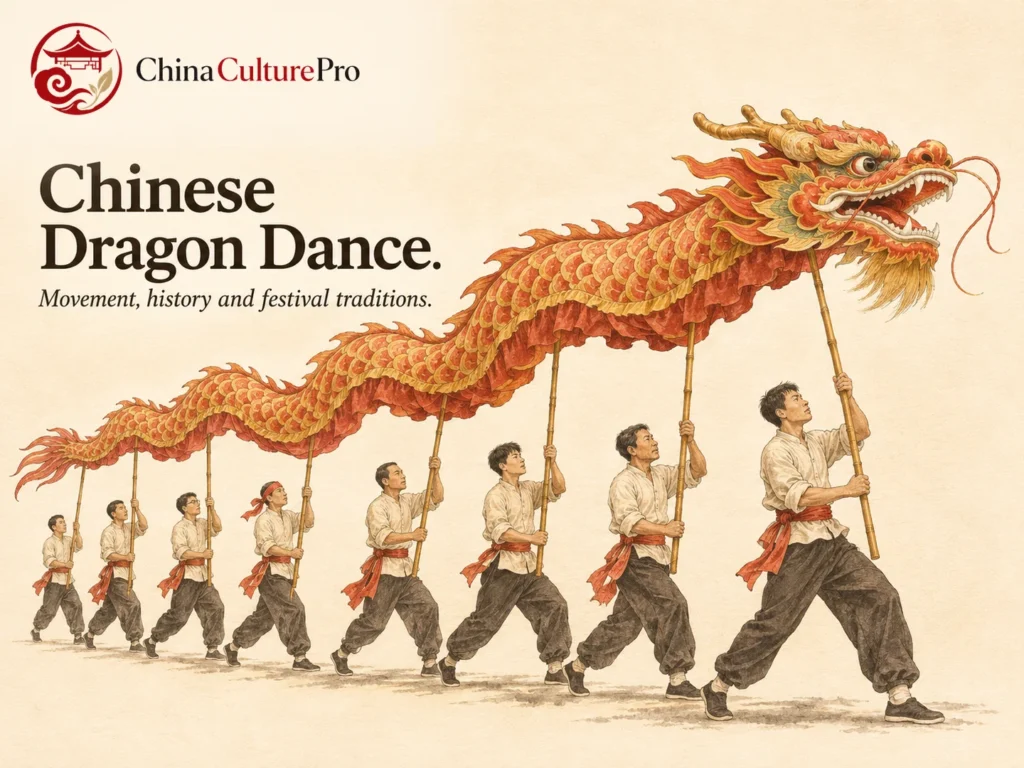
Chinese dragon dance, or wulong(舞龙,wǔlóng), brings a long dragon figure to life through coordinated movement. In a common form, dancers lift the head, sections of the body and the tail on poles. A rise or turn passes from one performer to the next and makes the figure appear to move as one animal.
Dragon dances appear at festivals, community ceremonies and staged events. The figure can be made of cloth over a light frame, assembled from linked lantern sections or built for a local fire-dragon tradition. The design and purpose vary with the community.

A dragon’s head can swing around a corner while its tail is still approaching. Follow the same motion through the middle of the figure and you can see how individual steps become a single turn.
How Dancers Move a Dragon
A typical cloth dragon has a sculpted head, a long flexible body and a tail. In a pole-supported version, each performer is responsible for part of the figure. Lifting adjacent sections at different moments sends a wave along the body. Changes in spacing allow the team to curve or coil. The performers need to see or anticipate what their neighbors are doing. Music can help coordinate their timing. [1]
You can often see the difference from Chinese lion dance before the animal turns toward you. Dragon dancers support a long figure from underneath with poles, while lion dancers usually occupy the head and cloth body of a more compact costume. The way the performers are arranged gives a more reliable clue than the color or shape of the head. [1]
Dragon Dance in Historical Records
Chinese heritage records connect some earlier dragon performances with prayers for rain. They cite the *Chunqiu Fanlu*, a text traditionally associated with the Han thinker Dong Zhongshu, in describing rain rites involving dragons. Later records describe dragon dances in ceremonial and festive settings. The evidence shows that people used dragon figures in different settings over a long period. [2]
Local styles also have their own histories. The Tongliang record in Chongqing documents several forms under one regional name, including straw dragons, bench dragons and fire dragons. Claims about one early rite cannot date all of these forms or account for the way each community developed its props and movements. [2]
Three Regional Dragon Dance Traditions
Construction affects the way a dragon can move and where the audience sees it. These examples pair a particular figure with a documented place and use.
| Tradisi | Tempat | What distinguishes the performance |
|---|---|---|
| Fenghua cloth dragon | Ningbo, Zhejiang | A light bamboo frame and cloth body let a team coil, turn and raise the sections in succession. [3] |
| Pujiang bench dragon | Pujiang, Zhejiang | Linked bench units carry the body lanterns, making a long moving formation associated with Lantern Festival and other celebrations. [4] |
| Tai Hang fire dragon | Tai Hang, Hong Kong | An incense-studded figure is carried through the neighborhood in a community tradition associated with Mid-Autumn Festival. [5] |
The Zhejiang examples show how even nearby places can use different construction. A cloth dragon flexes between its supports. A bench dragon creates a long line from linked lantern units. Tai Hang has a distinct place in the calendar and an organization devoted to preserving it. Its dance was added to China’s national intangible heritage list in 2011. [6]
Festivals, Ceremonies and Modern Stages
A dragon may appear in a neighborhood celebration, a parade or a ceremony. Hong Kong’s local inventory records dragon dancing for festivals, ceremonies and deity birthdays. A community may place a performance at a different point in the year from the dragons that appear at Chinese New Year celebrations. Pujiang’s lantern tradition and Tai Hang’s Festival Pertengahan Musim Gugur performance make that difference visible. [1]
Teams can also adapt pole-supported figures for stage work or competition. The Fenghua account describes formal competitions as well as a varied movement repertoire. A competition may foreground speed and coordination. In a neighborhood procession, how the team moves through familiar streets and gathers an audience can be as important as its movement patterns. [3]
How to Follow a Dragon in Motion
Watch the head start a turn. Pick one section halfway along the figure and wait for the motion to reach it. Then see when the tail follows. A wide view helps show the route, while a closer view makes it easier to see the small changes in height that create a wave.
If you compare two performances, identify the local form and the occasion first. The figure’s construction affects how sharply it can turn and how far apart the carriers can stand. Looking at the supports and the people carrying them gives you a clearer comparison than focusing on size alone.
FAQs About Chinese Dragon Dance
Is dragon dance the same as lion dance?
A pole-supported dragon usually has a line of people holding its sections. A lion usually has performers inside the costume.
Does every dragon dance use poles?
Many cloth dragons use poles. Some local traditions use other supports, such as the connected bench units of the Pujiang dragon.
Is dragon dance only performed at Lunar New Year?
It appears at other festivals and ceremonies. Tai Hang’s fire dragon is associated with Mid-Autumn Festival.
Sumber
[1] Hong Kong Intangible Cultural Heritage Office. Inventory of Intangible Cultural Heritage, Lion Dance and Dragon Dance
[2] China Intangible Cultural Heritage Digital Museum. Tongliang Dragon Dance
[3] Zhejiang Provincial Government. Fenghua Cloth Dragon
[4] China Intangible Cultural Heritage Digital Museum. Pujiang Bench Dragon
[5] Tai Hang Fire Dragon Heritage Centre. Cultural Heritage of Tai Hang Fire Dragon Dance
[6] Hong Kong Development Bureau. Tai Hang Fire Dragon Heritage Centre