


Quick Answer: How Are Tai Chi and Qigong Different?
Tai chi (太极拳, tàijíquán) is a Chinese martial tradition also widely practiced for health. Qigong (气功, qìgōng) is a broader category of practices coordinating posture or movement, breathing and attention. Health-oriented tai chi can fall within that category, so the labels overlap rather than name two opposites.[1]
- Tai chi curricula can include long and shorter solo forms, sabre and sword; a gentle public demonstration shows only part of an art.[5]
- Qigong includes different schools and purposes. A named practice tells you more than the umbrella label alone.[9]
- Health research concerns particular programs and populations, not a guarantee that every class produces the same result.[6]
For choosing a class, compare what is actually taught, how it is introduced and whether its demands fit your goals.
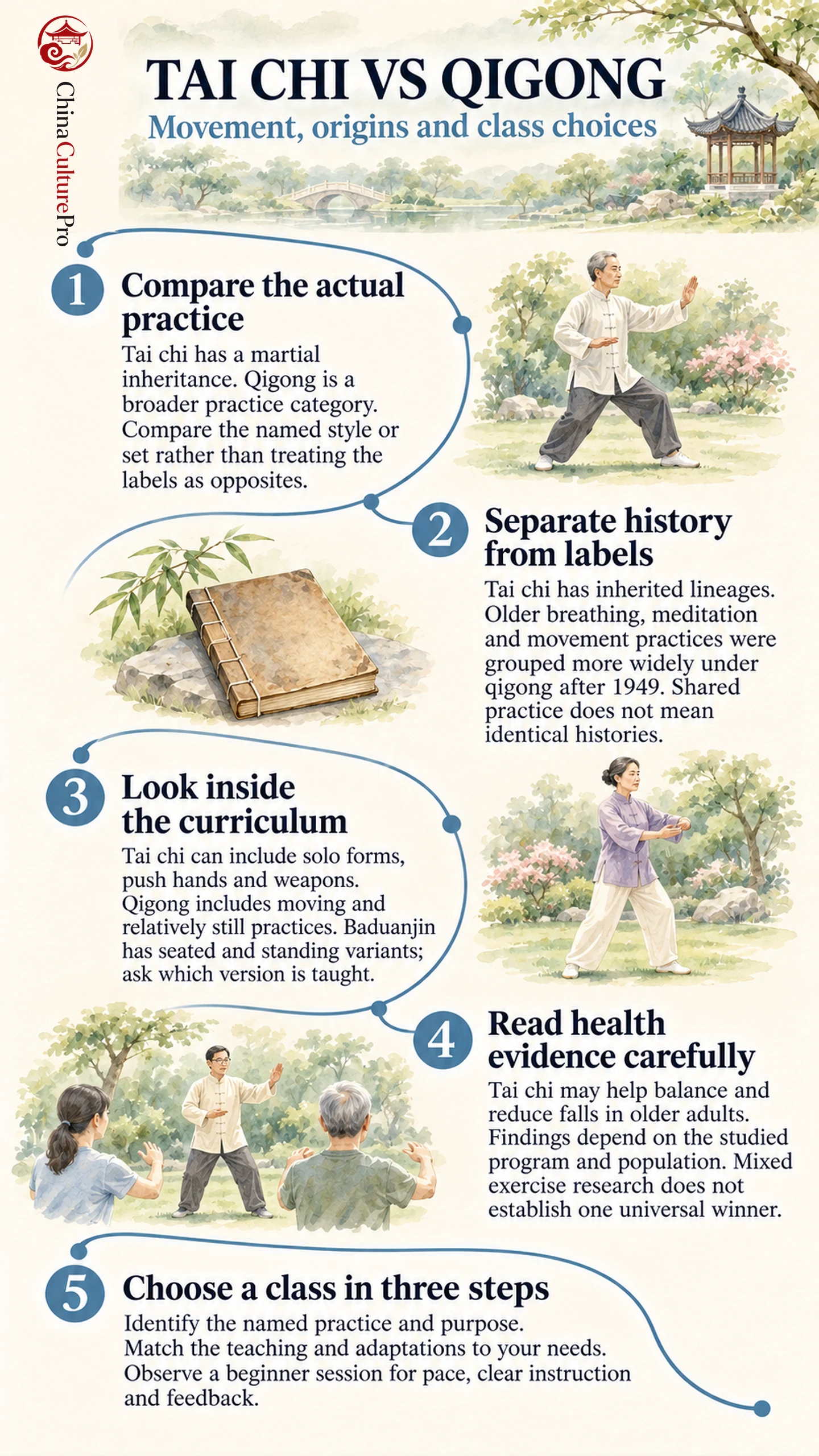
Two groups moving quietly in a park may look similar while learning different things. One may be rehearsing a martial sequence; another may be repeating a short exercise set. This comparison helps you interpret those differences before exploring the separate histories of tai chi and qigong.
Tai Chi and Qigong at a Glance
These are useful starting distinctions, not requirements that every teacher follows. Compare an actual tai chi curriculum with an actual qigong practice rather than an idealized version of either.
| Pertanyaan | Tai chi | Qigong |
|---|---|---|
| What does the name identify? | An inherited martial tradition with different lineages and modern settings.[2] | A broad category involving movement or posture, breath and attention.[1] |
| How might movement be organized? | Linked solo sequences can include changing direction and stepping.[5] | Moving exercises or sustained, relatively still postures.[1] |
| Is martial training central? | Martial roots matter, although a particular health class may teach no applications.[6] | Purposes differ across health, martial and spiritual contexts.[9] |
| What is the learning demand? | Following and refining a sequence may be a major task. | A short repeated exercise may be simpler to follow, but the label does not establish difficulty. Ask to see the actual lesson. |
Different Histories, Overlapping Categories
Within Chinese martial arts, tai chi has a specific social inheritance. Its UNESCO heritage account locates its emergence in mid-seventeenth-century Wenxian (温县, Wēnxiàn), Henan (河南, Hénán), and describes transmission through families, apprenticeships and formal education. That context is more precise than treating every slow Chinese exercise as tai chi.[2]
Qigong’s history requires a different distinction: older cultivation practices versus a modern umbrella category. Breathing, meditation and bodily training circulated in medical, religious, literati and martial settings before 1949. Their grouping and wider dissemination under qigong expanded after 1949. This history does not make the underlying practices newly invented, or establish one unchanged system stretching across millennia.[3]
The overlap is practical as well as terminological. Both can join mindful attention, breathing and coordinated movement. Calling health-oriented tai chi an expression of qigong describes this shared practice framework; it does not erase tai chi’s martial lineages or imply that all qigong descends from tai chi.[8]
What Practice Can Include
A tai chi syllabus may combine solo routines with push hands (推手, tuīshǒu), a partner practice, while some lineages also teach weapons. One published Wu-style curriculum includes long and shorter solo forms, sabre and sword. These are examples of an art extending beyond a single gentle sequence, not a checklist every beginner class must complete. For family-style differences, compare Chen and Yang tai chi; for equipment traditions, explore Chinese martial arts weapons.[2][5]
Qigong can be dynamic, with limb and body movement, or meditative, with little movement in a sustained posture.[1]
Baduanjin (八段锦, bāduànjǐn), often translated as Eight Pieces of Brocade, is a useful named example. Its textual history includes Song-period references and seated as well as standing versions. The modern Health Qigong version was developed using standing practices as its basis. A familiar exercise name therefore need not identify one identical historical sequence or teaching method.[4]
Teachers may explain qigong through qi (气, qì), a traditional concept often translated as vital energy. Treat that language as part of the practice’s cultural framework. It does not by itself explain a measured clinical effect; qi in Chinese thought provides broader context.[9]
Health Benefits and the Limits of Comparison
Tai chi may help balance and reduce falls in community-dwelling older adults, but the evidence concerns studied interventions with differing schedules and participants. It does not show that a class title alone predicts benefit, or that a result in one population applies to everyone.[6]
A 2026 umbrella review found benefits for musculoskeletal conditions, including high-certainty evidence for improved physical function in knee osteoarthritis. It grouped several traditional Chinese exercise modalities, including tai chi, Baduanjin and other qigong practices. A pooled finding across those categories cannot establish that every qigong class works equally well, or that one label is universally superior.[7]
Both appear generally safe, although minor muscle or joint aches can occur. If you have a condition affecting exercise, discuss suitable activity with your health care provider and tell the teacher about relevant limitations. Use either practice alongside appropriate care rather than delaying assessment or treatment.[1][6]
How to Choose a Class
Use the curriculum and teaching process to make the comparison concrete. Starting with basics and progressing with instruction is more useful than choosing from an impressive demonstration alone.[8]
- Identify the practice being taught: Ask for the tai chi style or named qigong set and whether the class emphasizes solo movement, martial skills or general exercise.
- Match the teaching to your needs: Ask how the teacher introduces sequences, corrects movement and adapts standing, stepping or sitting when appropriate.
- Observe a beginner session: Check the pace, clarity of instruction and opportunities for feedback before committing to a longer course.
A martial class should explain its partner-training aims. A general exercise class should make its beginner material and adaptations clear. These answers are more useful than assuming qigong is always simpler or tai chi always demanding.
FAQs About Tai Chi vs Qigong
Is tai chi a type of qigong?
Health-oriented tai chi can be classified as qigong because it combines posture, attention and breathing. That classification describes overlap; tai chi also has its own martial history and training traditions.[1]
Is qigong always easier to learn?
No. Compare the named set, sequence length, physical demands and teaching pace. A short repeated exercise and a long linked routine present different learning tasks; neither umbrella label establishes a universal difficulty level.
Can I practice both?
Yes, they can be studied together. Their shared attention to body, breath and awareness does not require choosing only one. Ask how the teacher distinguishes the exercises and what each contributes to the curriculum.[8]
Does tai chi practice automatically teach self-defense?
No. Learning a solo routine is not the same as learning to apply martial skills with a partner. Ask what the class teaches rather than inferring fighting proficiency from the art’s history.[2][5]
Sumber
[1] National Center for Complementary and Integrative Health. Qigong: What You Need To Know
[2] UNESCO. Taijiquan
[3] David A. Palmer. Modernity and Millenialism in China: Qigong and the Birth of Falun Gong
[4] Chinese Health Qigong Association. Origins and Development of Health Qigong Baduanjin
[5] International Wu Style Tai Chi Chuan Federation. Forms and Techniques
[6] National Center for Complementary and Integrative Health. Tai Chi: What You Need To Know
[7] Chen and colleagues. Efficacy and Evidence Certainty of Traditional Chinese Exercises for Musculoskeletal Disorders: An Umbrella Review of Meta-analyses
[8] U.S. Department of Veterans Affairs. Tai Chi and Qi Gong
[9] National Qigong Association. What Is Qigong?