


Quick Answer: What Defines Chinese Sword Culture?
Chinese sword culture combines changing weapons, skilled metalwork, social status and stories about character. Its two basic sword categories are jian (剑, jiàn), normally straight and double-edged, and dao (刀, dāo), single-edged blades whose shapes vary.[1]
- Blade type: the number of edges is more reliable than assuming that every dao is curved.
- Historical setting: bronze objects, later steel swords and modern practice equipment belong to different contexts.
- Cultural meaning: a sword could serve as military equipment, a status object or a literary symbol.
Identify the period and setting before interpreting the symbolism.
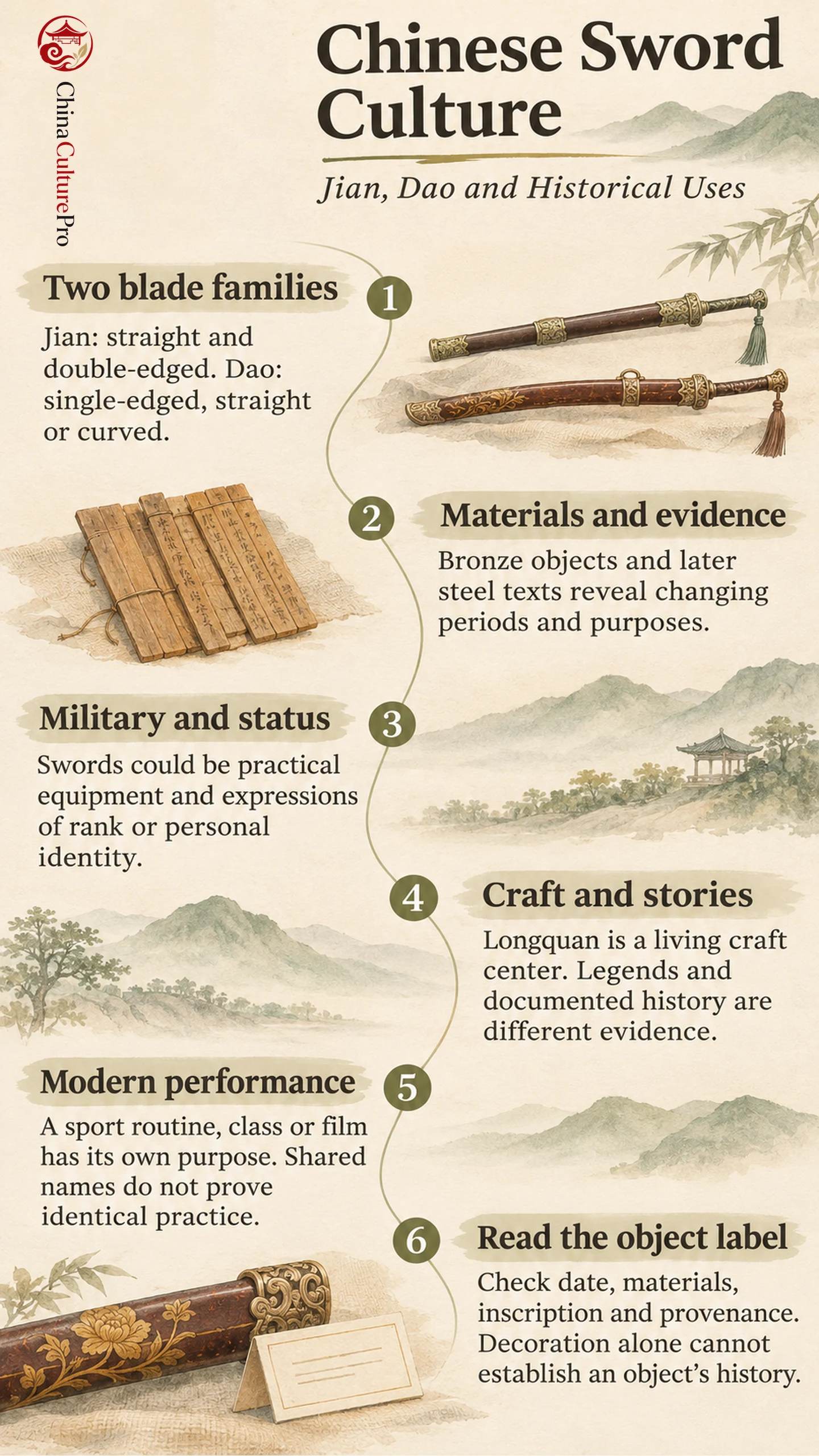
A museum sword can answer several different questions. Its blade concerns materials and use; its fittings concern display and ownership; its inscription may preserve a name. Separating those questions makes Chinese sword history easier to understand without turning every elaborate object into a legendary treasure.
Jian vs Dao: The Basic Distinction
Jian is usually translated as straight sword; dao is often translated as saber or broadsword. However, dao varied in width and could also be straight, so the English translation alone does not identify its shape.[1]
| Aspek | Jian | Dao |
|---|---|---|
| Basic classification | Straight, double-edged sword | Single-edged blade category |
| Outline | Normally straight | Straight or curved, with varied widths |
| Common interpretive trap | Treating every example as a scholar’s ornament | Treating every example as a curved broadsword |
These names describe broad families, not one fixed size or identical equipment across all dynasties. Notice the blade before relying on a decorative tassel or an English label.
From Bronze Swords to Iron and Steel
Bronze swords offer a firm starting point because surviving objects can be examined and dated. One surviving Chinese sword dated approximately to the fourth–third century BCE made of bronze with turquoise inlay. Its decorated appearance belongs to a real object and period, rather than an imagined universal “ancient Chinese sword.”[2]
The celebrated sword associated by inscription with King Goujian of Yue was excavated in 1965 from Wangshan Tomb No. 1 in Hubei. An interview with an excavator explains how scholars identified the owner from its inscription. How it reached a Chu tomb remains debated; proposed routes include diplomatic gifting and warfare. The royal name does not mean the tomb belonged to Goujian.[3]
Written evidence supplies a different perspective. A Han-Xin-period text from the Juyan region, translated by historian Charles Sanft, discusses evaluating steel swords by visual inspection. It shows that practical assessment of material quality existed alongside admiration for prestigious objects. The manuscript also presents interpretive difficulties, so a modern translation is scholarship rather than a transparent voice from antiquity.[4]
Together, the objects and text establish changing materials and concerns. They do not justify a single date on which every bronze sword vanished or every steel sword took the same form.
Military Equipment, Rank and Personal Identity
Single-edged swords gained prominence as functional weapons, while the jian retained associations with elite identity. These roles overlapped: a cultural association with gentlemen does not mean that double-edged swords had never been practical weapons.[5][10]
The 1760 portrait of imperial guard Zhanyinbao places a sheathed sword alongside archery equipment in a court-sponsored image of military service. Read such objects with the uniform and rank context rather than as isolated accessories. Traditional Chinese archery supplies another part of that martial setting.[11]
The later description of the jian as a gentleman’s weapon expresses an ideal attached to the object. It is not a personality test for its owner. A finely decorated sword may communicate wealth, office or aspiration; establishing its actual use requires more than its ornament.
Craft Traditions, Literature and Symbolism
Sword culture also survives through regional craftsmanship. Longquan in Zhejiang is a well-known sword-making center, and its sword-making techniques entered China’s national intangible cultural heritage list in 2006. Local accounts link the craft with the ancient master Ou Yezi. The legendary foundation story and the documented modern heritage recognition are different kinds of evidence.[6]
The craft concerns the whole object, including the scabbard and decorative fittings. A modern handmade sword can demonstrate a living tradition without being an archaeological artifact. Likewise, the age of a tradition does not establish the age of a particular example.
Literary sources add moral questions to material history. Scholar Ma Mingda reads Sima Qian’s accounts of swordsmen as reflections on character, courage and conduct, including contrasting figures in the biographies of assassins. These are narratives with judgments and purposes, not neutral instructions for reconstructing a fighting system.[7]
Later Chinese fantasy genres develop their own relationships between heroes and weapons. Enjoying a sword as a narrative symbol does not require treating a fictional scene as documentary evidence.
Modern Sword Practice and Screen Choreography
Today, swords appear in traditional schools and standardized performance sport. The International Wushu Federation lists jianshu (剑术, jiànshù), straight-sword routines, and daoshu (刀术, dāoshù), broadsword routines. Its description of tai chi straight sword connects the double-edged weapon with coordinated movement, concentration and breath.[8]
A competition routine has a different purpose from an excavated weapon or an old military portrait. Before comparing them, ask whether the example concerns sport, a named school’s practice, theatrical performance or historical interpretation. Shared terminology does not erase those differences.
Screen choreography adds camera placement, editing and dramatic storytelling. Chinese martial arts in film can introduce viewers to sword imagery, but a graceful sequence alone cannot establish historical technique. In a class, the useful first questions concern supervision, equipment and the school’s rules; martial arts etiquette provides the social context for asking them respectfully.
Reading a Sword in a Museum
Start with the label’s date, materials and object number. Then separate what the label establishes from what the appearance merely suggests. Is an inscription recorded? Is the findspot known? Does the description identify the object as paired, ceremonial or military?
A nineteenth-century Chinese double sword in one collection is catalogued with steel, wood, brass and leather, including its scabbard. That specific record is more informative than assuming that all Chinese swords were long, solitary weapons. Other collections preserve paired jian as well.[5][9]
A museum’s cautious date or attribution is useful information. A beautiful surface, royal-looking decoration or dramatic nickname cannot independently settle provenance.
FAQs About Chinese Swords
Does dao always mean a curved sword?
No. Dao identifies a single-edged blade category. Historical examples include straight forms as well as curved sabers, so curvature alone is an unreliable distinction between dao and jian.[1]
Was the jian only a scholar’s ornament?
No. Its later association with gentlemen and elite identity should not erase its earlier practical history. Particular objects must be interpreted through period, materials and documented context.[5][10]
Is every Longquan sword an antique?
No. Longquan has a living sword-making tradition. A contemporary work may belong to that tradition while remaining a modern object; regional origin is not proof of age.[6]
Can a film identify how a historical sword was used?
A film can suggest questions and cultural associations, but it is not sufficient evidence by itself. Compare the portrayal with dated objects, written sources and the stated purpose of the modern performance.
Sumber
[1] Philip M. W. Tom, Metropolitan Museum Journal. Some Notable Sabers of the Qing Dynasty at The Metropolitan Museum of Art
[2] The Metropolitan Museum of Art. Sword, ca. fourth–third century BCE, bronze with turquoise inlay
[3] Hubei Provincial Ethnic and Religious Affairs Commission. Sword of King Goujian of Yue: interview on discovery, inscription and historical context
[4] Charles Sanft, Early China. Evaluating Swords: Introduction and Translation of a How-To Guide from the Han-Xin Period
[5] Pitt Rivers Museum. Double jian, 1884.24.66
[6] Zhejiang provincial government, Lishui. Longquan Sword
[7] Ma Mingda. Sima Qian and the Way of the Sword in Ancient China
[8] International Wushu Federation. Taolu: competitive wushu event categories
[9] The Metropolitan Museum of Art. Double Sword with Scabbard, nineteenth century
[10] Royal Armouries. Chinese arms and armour: bronze and Ming examples in the collection
[11] The Metropolitan Museum of Art. Portrait of the imperial guard Zhanyinbao, dated 1760