
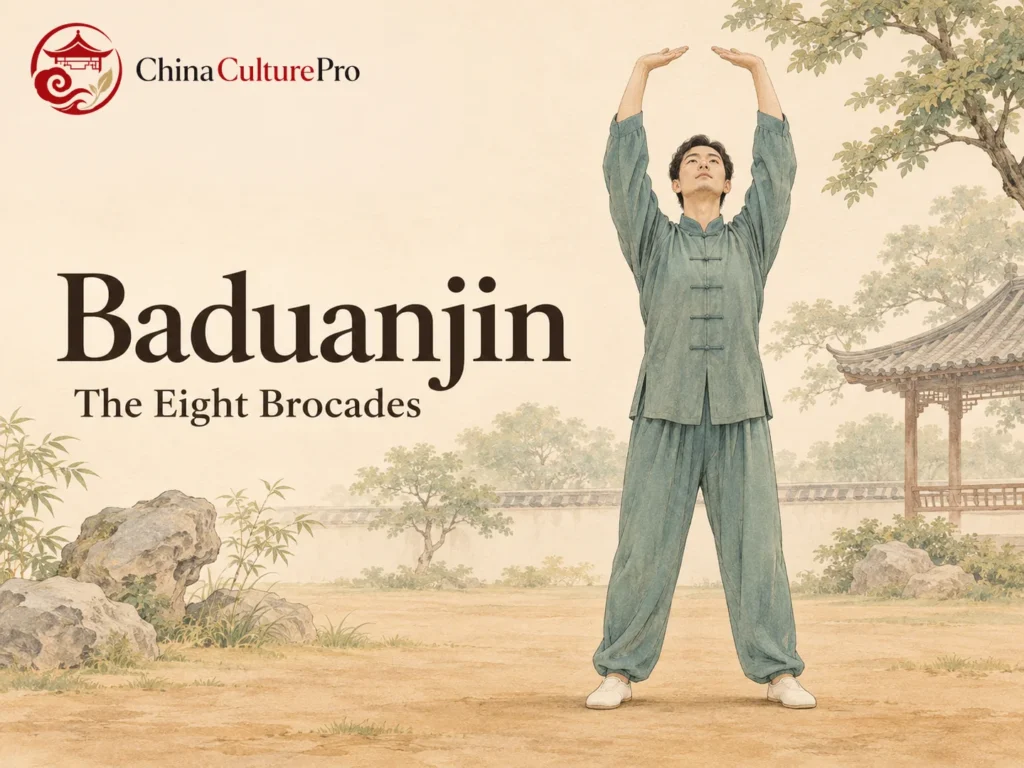

Quick Answer: What Is Baduanjin?
Baduanjin (八段锦, Bāduànjǐn), usually translated as Eight Brocades, is a Chinese exercise tradition organized into eight movement sections. It combines controlled movement, breathing and attention.
- Its written history reaches the Song period, while the routine continued to change afterward.
- The common standing set includes overhead reaches, bow-shaped arm movements, turns, bends, punches and heel lifts.
- Seated forms and different teaching versions also exist.
Traditional health phrases belong to the routine’s historical vocabulary. Modern research examines particular outcomes and does not establish the sweeping cures suggested by some movement names.[1][2][3]

If you have watched a park group move slowly through matching reaches and turns, you may have seen Baduanjin. Recognizing the Eight Brocades becomes easier when you separate the movements themselves from their poetic names and the stories told about their origins.
From Song-Era Records to Modern Practice
The name appears in Yijian Zhi (夷坚志, Yíjiān Zhì), a Southern Song collection by Hong Mai. One account describes an official’s breathing and self-massage practice in connection with an event dated to 1117. That date belongs to the reported event, rather than the writing of the whole collection. The passage establishes an early use of the name, but cannot prove that the official performed today’s standing sequence.[1]
The wider background is daoyin (导引, dǎoyǐn), a family of guiding and stretching practices. Baduanjin also belongs to the cultural history of yangsheng (养生, yǎngshēng), or nourishing life through cultivated habits. Older movement traditions help explain its context, while the named routine has its own later history.[1][4]
Seated and standing forms developed alongside one another. By the late Qing period, standing sequences resembled forms familiar today, and later teachers continued to reshape them. Accounts that name one founder compress this longer development into a single story. The available history supports transmission and adaptation across generations more securely than one documented inventor.[4]
The modern Health Qigong (气功, qìgōng) program also involved deliberate compilation and instructor training. A first training course for four new routines took place in August 2003, followed by a national trial-promotion meeting that October. Today’s common teaching format therefore includes a modern standardization layer.[9]
The Eight Movements in the Common Standing Set
The following order follows a widely taught standing sequence. The English labels describe recognizable actions, while the Chinese verses preserve their traditional names. Two traditional concepts appear in those verses, sanjiao (三焦, sānjiāo), or triple burner, and heart fire (心火, xīnhuǒ). Wording varies slightly between teaching materials.[2]
| Section | Traditional verse | Movement to recognize |
|---|---|---|
| 1 | 两手托天理三焦 — Liǎng shǒu tuō tiān lǐ sānjiāo | Raise both hands overhead, then lower them with control. |
| 2 | 左右弯弓似射雕 — Zuǒ yòu wān gōng sì shè diāo | Alternate a bow-drawing arm shape in a wider stance. |
| 3 | 调理脾胃须单举 — Tiáolǐ píwèi xū dān jǔ | Raise one hand while the other presses downward, then change sides. |
| 4 | 五劳七伤往后瞧 — Wǔ láo qī shāng wǎng hòu qiáo | Turn to look behind through a controlled range. |
| 5 | 摇头摆尾去心火 — Yáo tóu bǎi wěi qù xīnhuǒ | Coordinate the head and trunk in a side-to-side movement. |
| 6 | 两手攀足固肾腰 — Liǎng shǒu pān zú gù shèn yāo | Fold forward and return, with hands moving toward the feet. |
| 7 | 攥拳怒目增气力 — Zuàn quán nù mù zēng qìlì | Extend and withdraw the fists with a focused gaze. |
| 8 | 背后七颠百病消 — Bèi hòu qī diān bǎi bìng xiāo | Raise and lower the heels with a controlled settling action. |
The table is an identification guide. Learning the transitions, weight shifts and appropriate range requires demonstration and feedback. The fifth and sixth sections deserve particular attention because a deep version shown by an experienced demonstrator may exceed a beginner’s comfortable movement.[5]
Opening and closing movements may be counted separately in a video. A lesson can therefore display more than eight labeled segments while retaining eight core brocades.
How Body, Breath and Attention Work Together
Baduanjin is commonly taught within qigong, a broad category of practices coordinating posture or movement, breathing and mental focus. The visible shape is only one part of the exercise. A controlled return, an unforced breath and attention to balance all contribute to how a section is performed.[6]
The overhead reach, for example, asks you to coordinate the rising arms with the rest of the body. The bow-shaped movement adds a different relationship between the arms and stance. Looking backward introduces turning, while heel lifts bring attention to balance. Reading the sequence this way reveals changing movement tasks instead of eight interchangeable stretches.[2][5]
Baduanjin is also distinct from Yijinjing, another named Chinese exercise tradition. Both can appear under the modern qigong umbrella, but one routine’s names and sequence should not be used as instructions for the other.
Traditional Health Language and Modern Evidence
Some names draw on traditional Chinese medicine. The first verse mentions sanjiao, and the fifth mentions heart fire. Such phrases identify traditional medical concepts, rather than measurements showing that a movement changes an anatomical organ.[1][2]
The broader language of qi (气, qì) and meridians helps place the routine in its cultural setting. Translating a verse about eliminating illness into a promise to cure disease would change its evidentiary status.
Research gives a more specific picture. Studies have examined sleep, balance and other outcomes, sometimes finding improvements. A 2026 review of trials in older adults reported favorable results for sleep and several other measures, while noting differences between studies and methodological weaknesses.[7]
An October 2026 umbrella review found that the wider Baduanjin review literature often reused overlapping trials and offered low or very low certainty for the condition-outcome pairs assessed. Many publications therefore do not automatically amount to many independent confirmations.[3]
Safety reporting also has limits. A review of 47 trials found that only 22 described adverse-event monitoring. Reported problems included muscle or joint discomfort, dizziness and palpitations. Sparse reporting cannot establish that every version is suitable for every participant.[8]
Learning the Routine Without Forcing the Movements
Begin with a demonstrator who identifies the version being taught and explains adaptations. A university teaching demonstration can help connect names with movements, while an instructor can respond to your range, balance and questions. Familiarity with martial arts etiquette can also help when joining a school, although customs differ between groups.[5]
Useful questions before joining a class include these.
- Does the teacher explain each movement and its return, rather than asking beginners to copy a deep final pose?
- Can the teacher show a shallower stance or smaller bend when needed?
- Are traditional health explanations clearly distinguished from medical treatment claims?
- Can participants pause and ask for clarification without pressure to keep up?
Keep breathing comfortable while learning. Avoid treating a rigid breathing pattern or a dramatic stretch as proof that you are practicing correctly. Qigong is generally considered a low-risk activity, but people who are pregnant should discuss starting it with their health care provider because pregnancy-specific safety research is limited.[6]
If you have an injury, medical condition or recent surgery, discuss suitability with a clinician and tell the instructor about relevant limits. Stop a session if movement causes pain, dizziness or unusual breathlessness. Ask for an appropriate modification before trying that movement again.[6][8]
FAQs About Baduanjin
Is Baduanjin the same as tai chi?
They are different practices. Baduanjin centers on eight exercise sections. Tai chi developed as a martial art and includes its own forms and training traditions. Both can be taught with an emphasis on movement, breathing and attention.
Who invented the Eight Brocades?
A single founder is not securely established. Early records, seated and standing versions, and later changes point to development across generations.
How long does a Baduanjin routine take?
About 12 minutes is one common follow-along format, including the video used in a community research program. Teaching sessions can take longer because they include explanation and practice. Repetitions and pace also change the duration.[10]
Can Baduanjin replace medical treatment?
It should not replace necessary medical care. Research concerns specific outcomes in defined groups, and broad treatment claims exceed the current evidence.
Sumber
[1] British Health Qigong Association. Origin of Ba Duan Jin — One Set of Health Qigong
[2] General Administration of Sport of China. 八段锦定式动作
[3] Yuan and colleagues. Baduanjin Exercise Across Clinical Conditions: An Umbrella Review
[4] Cao and colleagues. On Origin of Baduanjin Exercise
[5] China Medical University. 中醫健身養生~中醫學院顏宏融副院長分享「八段錦」健身妙用!
[6] National Center for Complementary and Integrative Health. Qigong: What You Need To Know
[7] Zhao and colleagues. Effects of Baduanjin exercise on sleep quality, depressive symptoms, quality of life, and body composition in older adults: a systematic review and meta-analysis of randomized controlled trials
[8] Fang and colleagues. The Safety of Baduanjin Exercise: A Systematic Review
[9] General Administration of Sport of China. 健身气功·八段锦的编创与推广
[10] Chang and colleagues. A Content Analysis of African Americans’ Experience of Engaging in Qigong Exercise Intervention in a Community Setting