

Quick Answer: What Are Wudang Martial Arts?
The name Wudang martial arts (武当武术, wǔdāng wǔshù) refers to martial and cultivation traditions associated with the Wudang Mountains (武当山, Wǔdāng Shān) and Daoism (道教, dàojiào).
- The mountain’s religious history and a martial lineage’s history require different evidence.
- Traditions honor Zhang Sanfeng (张三丰, Zhāng Sānfēng), but origin accounts vary.
- Curricula can combine physical foundations, hand forms, weapons, partner work and cultivation.
Wudang identifies a cultural and teaching context; it does not guarantee one identical syllabus across all schools.
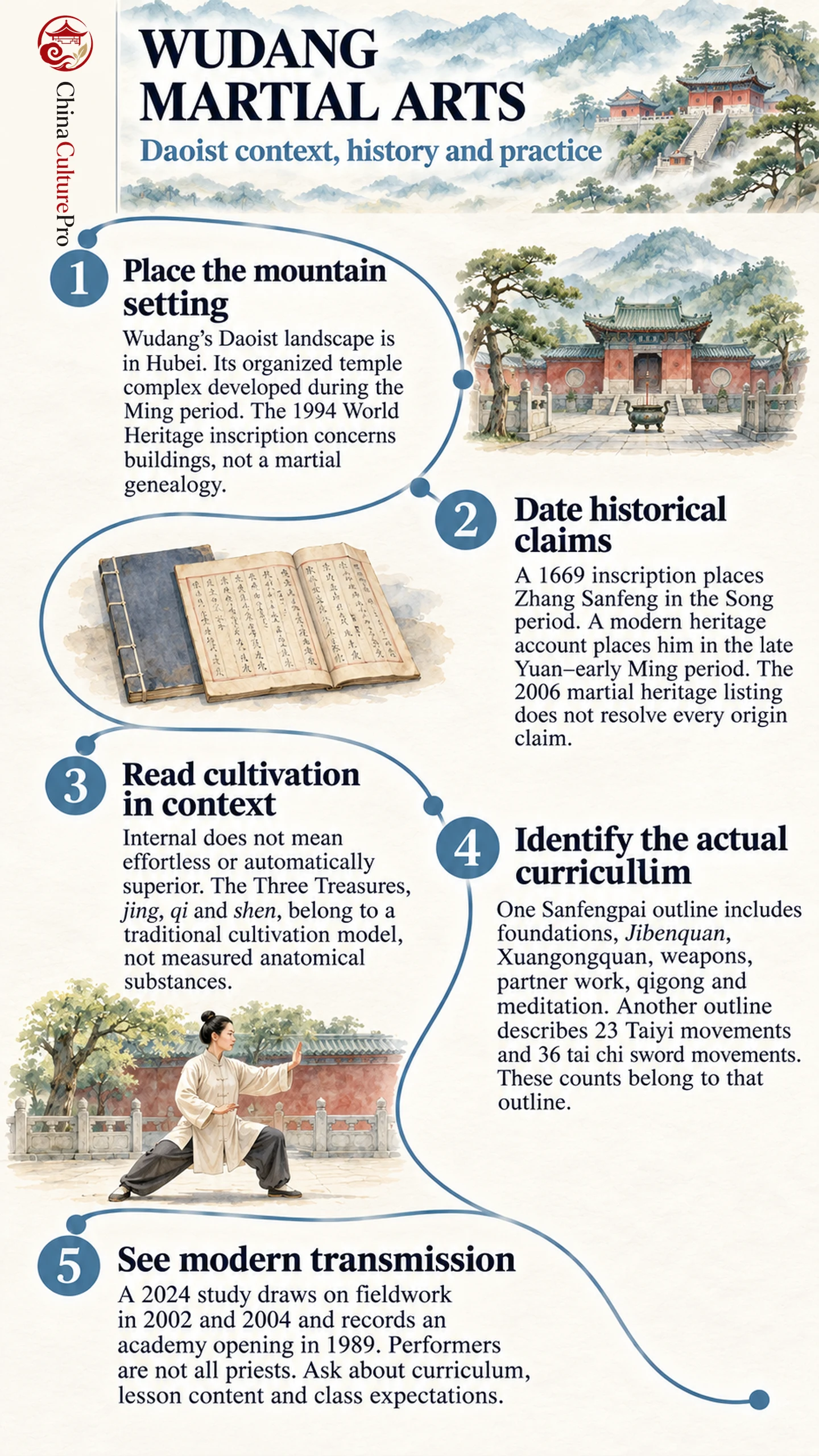
Religious institutions, dated texts, a teacher’s curriculum and modern transmission provide four different ways to understand Wudang within the wider Chinese martial arts landscape.
The Mountain and Its Daoist Setting
The Wudang Mountains lie in Hubei (湖北, Húběi). Their palaces and temples preserve a religious landscape shaped by successive dynasties, with an organized complex developed during the Ming period. The Ancient Building Complex entered the World Heritage List in 1994. That recognition concerns buildings and their cultural significance; it does not certify a martial school’s genealogy.[1]
The setting helps explain why martial practice can appear alongside other religious activities. A first-person account of a Daoist seminar describes ritual chanting and tai chi (太极拳, tàijíquán) as parallel teaching themes. This illustrates one religious programme, rather than a rule that every class must include chanting. Read the martial setting alongside Daoist temples and religious Daoism.[7]
Zhang Sanfeng and the Dates of Historical Claims
Huang Zongxi (黄宗羲, Huáng Zōngxī), writing a memorial inscription for Wang Zhengnan (王征南, Wáng Zhēngnán) in 1669, connected internal boxing with Zhang Sanfeng at Wudang. His account places Zhang in the Song period and includes instruction received in a dream. The text establishes that this narrative existed in the seventeenth century, not that the dream or the complete founding account is independently verified.[2]
A modern heritage entry instead places Zhang in the late Yuan–early Ming period. The contrast matters: these are different chronologies, not a single confirmed biography. The same entry records Wudang martial arts under Shiyan (十堰, Shíyàn) in the 2006 national heritage list and includes tai chi, xingyiquan (形意拳, xíngyìquán) and baguazhang (八卦掌, bāguàzhǎng) within its presentation of the tradition. Registration recognizes a cultural practice; it does not resolve every origin claim.[3]
This distinction lets readers value a founder tradition while still asking historical questions. Keep the date of a record separate from the date of the event it describes, as in other cases of history and legend.
What Internal and Daoist Mean in Practice
The label neijia (内家, nèijiā), or internal school, has a history of interpretation. Sun Lutang (孙禄堂, Sūn Lùtáng) challenged rigid divisions in a 1929 essay: Wudang versus Shaolin (少林, Shàolín), or Daoist versus Buddhist, did not provide a simple measure of technical worth. He discussed hardness and softness as qualities developed through training. Internal should not be taken to mean physically effortless or automatically superior.[4]
Daoist cultivation also uses the Three Treasures (三宝, sānbǎo): jing (精, jīng), usually glossed as essence; qi (气, qì), often rendered as vital energy; and shen (神, shén), spirit or mental vitality. These terms belong to a traditional model of cultivation. They should be understood in their religious and cultural setting rather than treated as measured anatomical substances.[7]
For the learner, the practical questions concern posture, attention, movement and the teacher’s explanation of those concepts. A philosophical label alone cannot show how a person trains. Observe the lesson before inferring its physical demands or spiritual commitments.
What a Wudang Curriculum Can Include
One published Sanfengpai (三丰派, sānfēngpài) outline distinguishes several kinds of work:
- Physical foundations: Stances, basic kicks, flexibility work and conditioning prepare the body for later material.[5]
- Empty-hand routines: The outline names Jibenquan (基本拳, jīběnquán), or Foundation Fist, and Xuangongquan (玄功拳, xuángōngquán) before later tai chi and more advanced forms.[5]
- Weapons and partner practice: Straight sword, sabre, staff and spear appear alongside push hands (推手, tuīshǒu) and application drills. Hand forms and weapon practice therefore have related but different tasks.[5]
- Cultivation practices: qigong (气功, qìgōng) includes breathing, standing and moving practices in this outline. It also identifies neidan (内丹, nèidān), Daoist internal alchemy or meditation, as advanced cultivation.[5]
This is one framework, not a compulsory syllabus for every Wudang school. Another published outline describes a Taiyi (太乙, tàiyǐ) form with 23 named movements and a Wudang tai chi sword form with 36. Those concrete counts belong to that outline; neither number defines Wudang martial arts as a whole.[6]
Modern Revival and Reading a Class
Fieldwork-based research published in 2024 draws on interviews and training observations at Wudang in 2002 and 2004. It records the opening of a Daoist martial arts academy in 1989 and distinguishes ordained teachers from performers selected for athletic ability. Its interview accounts also describe adapting performances for different audiences. A stage show and an ordinary lesson can therefore present different aspects of the same institution.[8]
The modern revival is part of the history, not a reason to reduce the tradition to either an untouched ancient inheritance or a recent invention. Schools, religious communities, public performance and international students all affect what is transmitted and how it is explained.[8]
When reading a school’s programme, ask:
- Curriculum: Which named forms and teaching line does it follow?
- Lesson content: How are foundations, partner work, weapons and contemplative practices introduced?
- Expectations: What language, physical demands, religious participation and progression does the actual class involve?
These questions connect training etiquette with a more precise reading of martial arts styles. Judge the described teaching rather than assuming a robe, mountain setting or lineage number explains it.
FAQs About Wudang Martial Arts
Did Zhang Sanfeng invent every form called Wudang?
The founder tradition does not establish that conclusion. Dated accounts contain different chronologies, and registration does not verify the authorship of every form.[2][3]
Is Wudang martial arts the same as tai chi?
No. Tai chi is prominent, but the curriculum example above also includes other hand routines, weapons, partner training and cultivation practices.[5]
Are Wudang arts always slow and gentle?
No. Published outlines include quick, agile weapon work as well as flowing practice. Internal does not mean effortless.[4][6]
Does World Heritage status certify a martial lineage?
No. The 1994 inscription concerns the ancient building complex and its cultural value, rather than certifying a martial genealogy.[1]
Sumber
[1] UNESCO World Heritage Centre. Ancient Building Complex in the Wudang Mountains
[2] Huang Zongxi; translated by Paul Brennan. Memorial Inscription for Wang Zhengnan, 1669
[3] China Intangible Cultural Heritage Network. Wudang Martial Arts heritage entry
[4] Sun Lutang; translated by Paul Brennan. Discussing Distinctions Between the Internal and External Schools, 1929
[5] Wudang Academy. What Is Wudang Martial Arts? A curriculum outline
[6] Wudang Research Association. Wudang Martial Arts: named forms and movement counts
[7] Slovenian Daoist Temple. Wudang martial arts and Daoist culture
[8] Jean DeBernardi and Wu Xu. The Revival of Wudang Daoist Martial Arts, 2024