


Quick Answer: What Is the History of Judaism in China?
Judaism (犹太教, Yóutàijiào) in China includes the long history of a Jewish community in Kaifeng and quite different modern experiences in cities such as Shanghai.
- **Kaifeng:** Inscriptions and surviving religious manuscripts document a community with both Jewish learning and Chinese cultural forms.
- **Shanghai:** Baghdadi merchants, Russian Jewish migrants and European refugees arrived in different historical circumstances.
- **Identity:** Family descent, communal memory and active religious observance need separate consideration.
These histories belong within religion in China, but they do not establish one uninterrupted congregation linking every Jewish presence in the country.[5]
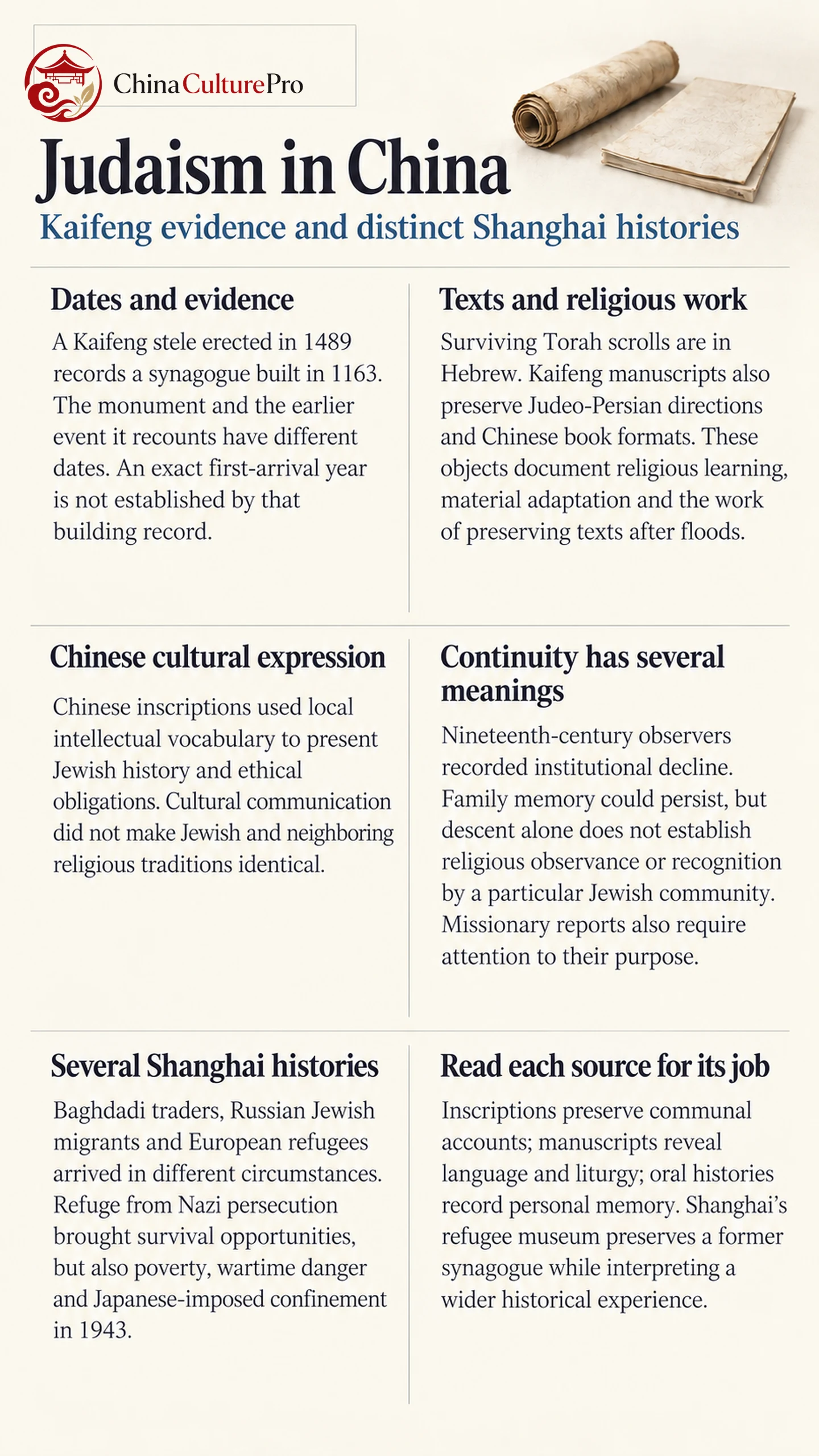
A Chinese commemorative inscription and a Hebrew Torah scroll preserve different sides of Kaifeng’s Jewish history. Shanghai’s refugee records tell another story. The evidence becomes clearer when places, dates and kinds of religious or family continuity are kept distinct.
Kaifeng: What the Stones Establish
The Kaifeng Jews (开封犹太人, Kāifēng Yóutàirén) are especially well known through commemorative stones. The Royal Ontario Museum holds a rubbing from a stele erected in 1489 that recounts the community’s history.[1]
That inscription records the first synagogue’s construction in 1163. The distinction is essential: 1489 dates the surviving account; 1163 is the earlier building date it transmits. The community’s origins belong in the setting of long-distance commerce and the Song-era world, but an exact first-arrival year is not established by that building date. Later traditions projecting arrival into much earlier antiquity should not be presented as securely dated settlement evidence.[2]
Torah Scrolls, Hebrew and Religious Life
Religious practice depended on texts, teachers and a congregation, not merely ancestry. A seventeenth-century Kaifeng Torah scroll in the British Library is written in Hebrew. Its script resembles Persian Jewish square Hebrew, while its parchment strips were sewn with silk thread. Material adaptation did not make its language Chinese.[3]
Hebrew Union College’s seventeenth-century manuscripts include liturgies and weekly Torah portions in codex and accordion formats. Judeo-Persian words appear in headings and ritual directions. Some pages show recopying after water damage, connecting textual preservation with the Yellow River’s repeated flooding. These objects reveal sustained religious work rather than a community defined only by exotic origins.[4]
Chinese Language and Jewish Cultural Adaptation
The Chinese inscriptions explain Jewish religious history through vocabulary familiar to Chinese readers. They draw connections with Confucian language and emphasize ethical and social obligations. This was an active presentation of Jewish tradition in a Chinese setting, rather than proof that every doctrine or ritual was identical to those of neighboring communities.[2]
Family remembrance belongs in this broader negotiation of belonging. Chinese ancestral traditions provide relevant context, but shared concern for forebears does not establish a single ritual system used by all Chinese Jews. Xu Xin’s study treats local Jewish practices as part of a changing diaspora history.[5]
Institutional Decline, Descent and Religious Identity
By the mid-nineteenth century, the Kaifeng synagogue and religious learning had suffered serious decline. The British Library’s account identifies an important source of observations: diaries from two Chinese Christian visitors dispatched in 1850 by a missionary society. Their reports preserve valuable details, but also arose from a particular religious mission. Manuscripts and Torah scrolls were purchased during a return visit in 1851.[3]
Institutional decline does not automatically erase family memory. Equally, a claim of descent does not demonstrate that a household maintained every historical practice. Ancestry, self-identification, religious learning and recognition by a particular Jewish community answer different questions. None should be inferred solely from a surname or photograph.
Shanghai: Merchants, Migrants and Refugees
Modern Shanghai’s cultural history involved multiple Jewish populations. They should not be described as one migration from Kaifeng.
| Community history | Circumstances | Hal yang perlu dibedakan |
|---|---|---|
| Baghdadi Jewish families | Nineteenth-century commercial migration, including traders from Iraq | An established Sephardic community preceded the Nazi-era refugees. |
| Russian Jewish migrants | Movement connected with revolution and persecution in Russia | Ashkenazi communities developed their own institutions. |
| European Jewish refugees | Escape from Nazi persecution, especially in the 1930s and 1940s | Many arrived impoverished and depended on organized relief. |
The US Holocaust Memorial Museum documents the refugees’ struggle for housing, employment and support. Shanghai offered an escape route, but refuge did not mean freedom from poverty or wartime danger.[6]
Japanese occupation authorities imposed confinement on designated stateless refugees in 1943. After the war, much of the refugee community dispersed. The Bates oral-history collection preserves individual experiences within these larger changes.[7]
Reading Museums, Manuscripts and Community Memory
The Shanghai Jewish Refugees Museum centers on the former Moshe Synagogue, built through Russian Jewish fundraising in 1927 and restored as part of the museum project in 2007. A museum’s historical role and a building’s former religious function are related but different facts.[8]
Read each source for what it can establish: inscriptions communicate communal history; manuscripts document language and liturgical use; oral histories preserve individual memory. Museum displays organize these records for later audiences. Combining them is more informative than treating any one object as a complete account of Jewish life across China.
FAQs About Judaism in China
When did Jews first arrive in China?
No single first-arrival year is securely established here. The 1489 Kaifeng inscription records a synagogue built in 1163; that is evidence for an earlier institution, rather than an eyewitness record of its founding.
Were Kaifeng Jews and Shanghai’s Jewish refugees one community?
No. Their histories differ in period, migration and institutions. Shanghai’s merchant, Russian and Nazi-era refugee communities should also be distinguished from one another.
Were Kaifeng’s Torah scrolls written in Chinese?
The surviving Torah scrolls discussed here are in Hebrew. Chinese cultural forms and Persian Jewish linguistic connections shaped the community without turning its Torah into a Chinese-language text.
Does Jewish ancestry alone describe religious practice?
No. Descent and family memory matter, but they do not establish a person’s beliefs, observance or recognition within a particular religious community. Those questions require their own evidence.
Sumber
[1] Royal Ontario Museum. Rubbing from a Stele at the Synagogue of Kaifeng
[2] Chinese Jewish Institute. The 1489 Stone Inscription
[3] British Library. The Kaifeng Torah Scroll: A British Library Treasure
[4] Jordan Finkin, Hebrew Union College. The Diaspora Jews of Kaifeng, China
[5] Xu Xin, Journal of the Interdisciplinary Study of Monotheistic Religions. Tracing Judaism in China
[6] United States Holocaust Memorial Museum. German and Austrian Jewish Refugees in Shanghai
[7] Steve Hochstadt, Bates College Muskie Archives. Shanghai Jewish Community Oral History Collection
[8] Shanghai Jewish Refugees Museum. About the Museum and Moshe Synagogue