

Quick Answer: What Are Chinese Temple Festivals?
Chinese temple festivals bring religious observance and community gathering together. A temple’s special day may include offerings, liturgy, performances and public celebrations, with different arrangements in different places.
- **Occasion:** Some festivals commemorate a deity’s birthday; others mark communal renewal or another religious observance.
- **Activities:** Worship, opera, music, processions and markets can have distinct functions.
- **Organization:** Temple managers, local associations, religious specialists and performers contribute different kinds of work.
This guide explains the cultural forms within local religious life; no single festival supplies a national template.[6]
An opera stage, a procession and a busy temple courtyard may all belong to one celebration. Understanding the occasion requires looking beyond the spectacle: who is being honored, who organizes the event, and how religious observance connects the community.
What Different Festival Names Mean
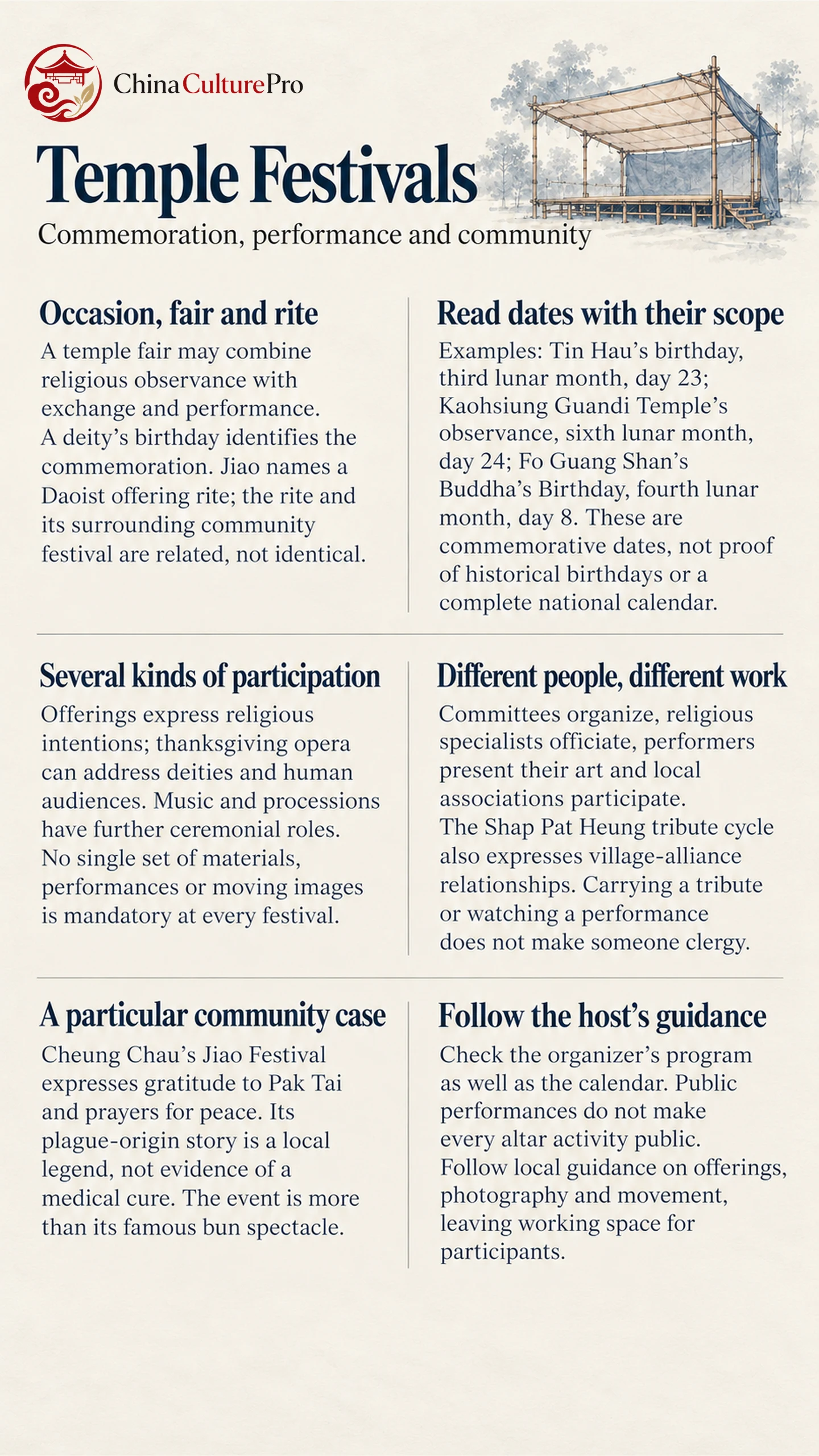
Miaohui (庙会, miàohuì), usually translated as “temple fair,” describes a gathering that may combine religious observance with performances, exchange and recreation. A deity’s birthday identifies the occasion being commemorated; it does not prescribe every activity at the fair.
Jiao (醮, jiào) refers to a Daoist offering rite, and a community festival may be organized around it. Hong Kong’s heritage record includes jiao festivals among Zhengyi ritual services. The rite and the surrounding public festival are connected, but not identical.[8]
Chinese New Year temple fairs are one seasonal form. The religious calendar extends beyond the New Year, and a temple celebration need not include a large market.
Deity Birthdays and the Traditional Calendar
Many commemorations follow nongli (农历, nónglì), the traditional Chinese lunisolar calendar. A “third-month” birthday therefore does not mean March in the Gregorian calendar. Lunar months and the solar year are coordinated through a system that includes leap months.[4]
Mazu (妈祖, Māzǔ) is also honored as Tin Hau (天后, Tiānhòu). Tin Hau is the familiar Cantonese rendering of the title; Tiānhòu is its Mandarin pronunciation. The following are documented observance examples, not a complete or universally binding calendar.[5]
| Commemoration | Traditional date in this example | Cakupan |
|---|---|---|
| Mazu / Tin Hau | Third lunar month, day 23 | Tung Wah’s Hong Kong temple tradition description.[1] |
| Guan Gong (关公, Guān Gōng) | Sixth lunar month, day 24 | The Kaohsiung Guandi Temple’s own calendar.[2] |
| Buddha’s Birthday (佛诞, Fódàn) | Fourth lunar month, day 8 | Fo Guang Shan’s Chinese Buddhist festival account.[3] |
The Buddha’s Birthday belongs to Buddhist temple life and should not be flattened into an identical category with every local deity birthday. Commemorative dates also should not be presented as independently verified historical birthdays.
Offerings, Opera and Processions
Offerings express reverence, gratitude or petitions within the participants’ tradition. Materials may include food, flowers or incense, but the particular temple and occasion determine what is appropriate. Offerings should therefore be understood through the local practice, rather than a universal list of required objects.
In Hong Kong’s Tin Hau celebrations, thanksgiving opera can be staged for deities as well as human audiences. A committee may ceremonially invite a deity’s image from the temple to a temporary venue. The stage is therefore part of a religious relationship, not simply entertainment placed beside a shrine.[5]
Ritual sound and deity processions add other forms of participation. A procession moves a ceremonial focus through a neighborhood or onto water; it is one possible part of the festival, not a compulsory feature of every observance.[5]
Communities, Committees and Religious Specialists
A festival committee’s organizational role differs from a priest’s ritual role or an opera troupe’s performance. Hong Kong’s Zhengyi heritage record describes specialist rites for community occasions, while the Tin Hau records also document committees and tribute associations. Not everyone carrying a tribute or watching a performance is clergy.[5][8]
The Shap Pat Heung example makes the social connections concrete. A university exhibition describes village teams returning and redistributing ceremonial floral tributes at the Tin Hau celebration. The annual cycle helps articulate relationships within a village alliance. This is a local institutional arrangement, rather than proof that every Chinese festival uses the same associations or selection procedure.[6]
Cheung Chau: A Festival of Community Renewal
The Cheung Chau Jiao Festival (长洲太平清醮, Chángzhōu Tàipíng Qīngjiào) in Hong Kong offers a specific example of communal thanksgiving and renewal. Cheung Chau is the Cantonese place-name used in English. The heritage record describes gratitude to Pak Tai (北帝, Běidì), another Cantonese rendering, and prayers for peace and safety.[7]
Its plague-related origin story is explicitly presented as legend. It explains how the community understands the festival’s protective purpose; it is not medical evidence that a ritual ended an epidemic. The religious event also encompasses more than the bun-related spectacle by which many outsiders know it.[6][7]
Observing a Temple Festival Respectfully
Identify the host community and the kind of occasion before assuming what participation involves. A public performance does not make every altar action public, and watching does not require copying rites whose meaning or access conditions are unclear.
Follow local guidance about photography, movement and offerings, leaving working space for officiants and participants. Temple etiquette explains those boundaries. For any particular year, use the organizer’s program to confirm the event dates; calendar conversion alone cannot establish when every activity will occur.
FAQs About Chinese Temple Festivals
Are all temple festivals held at Chinese New Year?
No. Deity birthdays and other religious observances occur through the traditional calendar. New Year temple fairs are one category, rather than the whole festival system.
Is every temple festival a Daoist ritual?
No. A festival may center on local deity worship, a Buddhist commemoration, Daoist rites or a combination of activities. Identify the particular institutions and ritual specialists involved.
Does a deity’s birthday prove a historical birth date?
No. A sacred birthday is a date of religious commemoration. It may belong to a devotional or textual tradition and does not by itself verify an individual’s historical date of birth.
Are temple festivals always on the same Gregorian date?
No. Many follow the Chinese lunisolar calendar, so the Gregorian date changes. Organizers may also arrange public activities separately from the principal commemorative day.
Sumber
[1] Tung Wah Group of Hospitals Temple and Cultural Services. Tin Hau
[2] Kaohsiung Guandi Temple. Deities and Their Sacred Birthdays
[3] Fo Guang Shan Buddha Museum. Museum of Buddhist Festivals
[4] Hong Kong Observatory. The Chinese Agricultural Calendar
[5] Hong Kong Memory, Leisure and Cultural Services Department. Rituals and Activities Related to the Tin Hau Festival
[6] Hong Kong University of Science and Technology Library. Celebrating Traditional Festivals: Intangible Cultural Heritage in Hong Kong
[7] Hong Kong Intangible Cultural Heritage Office. Cheung Chau Jiao Festival
[8] Hong Kong Intangible Cultural Heritage Office. Taoist Ritual Tradition of the Zhengyi School