
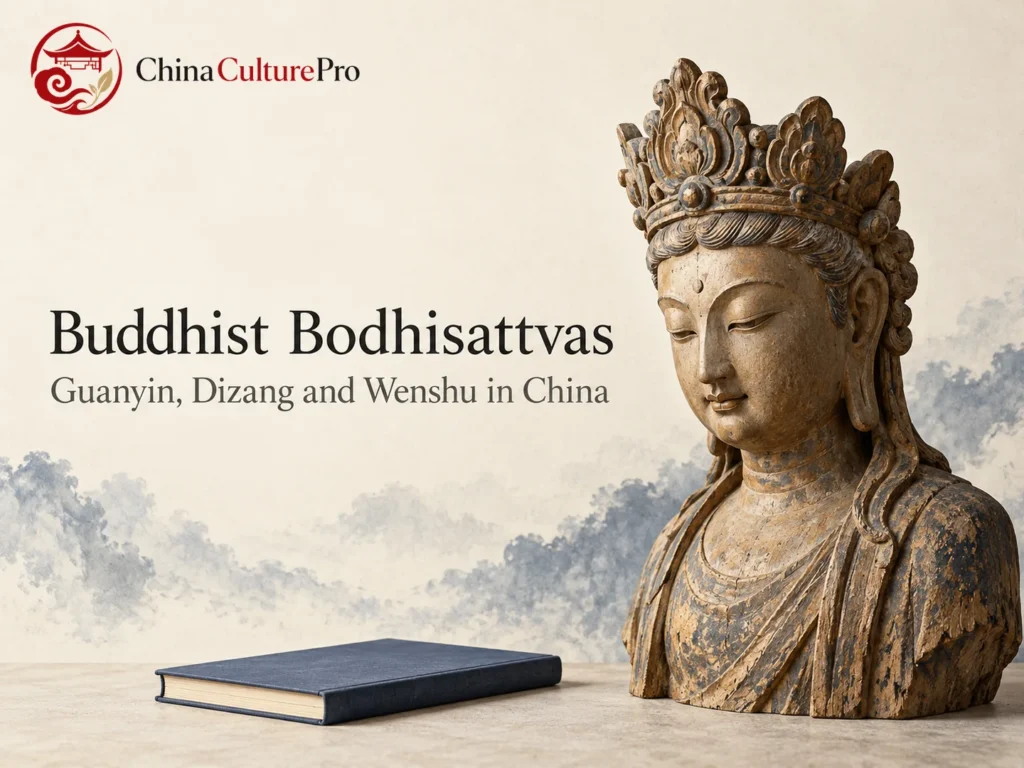

Quick Answer: Who Are the Main Chinese Buddhist Bodhisattvas?
A bodhisattva (菩萨, púsà) is associated in Mahayana (大乘, Dàchéng) Buddhism with pursuing Buddhahood for the benefit of sentient beings. Chinese Buddhist traditions honor many such figures, with different names, vows and images.[1]
- Compassion: Guanyin (观音, Guānyīn) is especially associated with compassion.
- Great vows: Dizang (地藏, Dìzàng) is associated with great vows to help suffering beings.
- Wisdom: Wenshu (文殊, Wénshū) is associated with spiritual wisdom.
These are three prominent examples, not an exhaustive pantheon. Their religious roles, images and devotional settings need to be considered together.[2][4]

A jeweled figure, a monk-like figure and a rider on a lion can all represent bodhisattvas. Their differences are meaningful, but appearance alone is not enough. Names, attributes and religious context help connect an image with the figure it represents.
What Bodhisattva Means in Chinese Buddhism
In Chinese Buddhism, particularly the Mahayana tradition, the bodhisattva ideal combines awakening with concern for others. It is more than a label for statues. Practitioner explanations describe a path directed toward Buddhahood and benefiting sentient beings; they also distinguish ordinary aspirants from advanced figures honored in scriptures and devotion.[1]
A Buddha signifies complete awakening. The bodhisattva category emphasizes the path, vows and activity for others, although accounts of advanced figures can be theologically complex. Saying simply that every bodhisattva has rejected enlightenment misses the aspiration toward Buddhahood that is central to the path.[1][2]
Nor does calling a statue “pusa” identify every local deity as a Buddhist bodhisattva. A common Chinese grouping also includes Samantabhadra, known as Puxian (普贤, Pǔxián), alongside the three discussed here. That group is useful for orientation without exhausting Buddhist sacred figures.[4]
Guanyin, Dizang and Wenshu: Names and Religious Roles
The Chinese and Sanskrit names below refer to corresponding figures, rather than separate deities. Their associations identify prominent themes, not exclusive powers.[2][4]
| Nama Tionghoa | Sanskrit name | Prominent religious association |
|---|---|---|
| Guanyin | Avalokiteshvara | Compassion and responding to suffering |
| Dizang | Kshitigarbha | Great vows and assistance to suffering beings, including those in hell realms |
| Wenshu | Manjushri | Wisdom and insight into Buddhist teaching |
These associations are emphases, not exclusive departments. Guanyin traditions include many images and forms of devotion. Chinese representations can appear masculine, feminine or ambiguous; one familiar feminine portrayal cannot stand for every historical depiction.[3]
In a practitioner account, Dizang’s vow expresses a commitment not to attain Buddhahood while beings remain in hell. This is a religious vow, not a claim that every deceased person faces the same destiny. His role is compassionate assistance, rather than simply presiding over punishment.[4]
Wenshu personifies wisdom. Texts, lions and other attributes can make that association visible, but different works emphasize different features. The next section uses identifiable objects to show why a short list of visual clues needs context.[2]
Reading Images Without One Universal Template
A Northern Song wooden Wenshu figure holds a scroll, which the object record identifies with spiritual wisdom. An eleventh-century Chinese marble relief instead presents Manjushri with a text and a lion mount. These documented works support particular identifications without requiring every Wenshu image to repeat the same pose, material or complete set of attributes.[5][6]
A Chinese painting of Dizang shows the figure holding a staff and jewel, with the Ten Kings (十王, ShíWáng) separately depicted around him. The image distinguishes the bodhisattva from those judging figures. Monk-like clothing, a staff or a jewel can be useful clues in appropriate contexts, but a shaved head alone does not identify every Buddhist image as Dizang.[7]
Guanyin’s varied forms offer another caution. The Water-Moon image in one museum collection has a relaxed seated pose; other representations differ. Read an inscription, hall name, object record or host institution’s explanation alongside visual attributes. A missing hand, replacement accessory or shared motif can make a one-feature guess unreliable.[3]
Devotion, Sacred Places and the Bodhisattva Path
Bodhisattvas belong to religious life as well as art history. In Buddhist temple settings, images can be approached through offerings and acts of devotion rather than viewed only as sculpture. The same named figure can appear in different arrangements and materials; a museum object and an active altar have different immediate settings.[2]
Sacred geography supplies another context. Mount Wutai (五台山, WǔtáiShān) in Shanxi is an important center of Manjushri worship. That association connects Wenshu with pilgrimage and a religious landscape, without confining the bodhisattva to one mountain. Other sacred mountain traditions need their own historical and devotional explanations.[8]
The path also concerns living practitioners. Dharma Drum Mountain (法鼓山, FǎgǔShān) reported a lay bodhisattva-precepts ceremony in March 2025, whose participants undertook commitments to avoid evil, cultivate virtue and benefit beings. This institutional example gives a concrete meaning to practice beyond recognizing a statue; it does not make every visitor a precept taker.[9]
When observing devotion, follow the host temple’s guidance. Learning a name does not confer permission to touch an image, handle implements or join a service. The beliefs described here explain traditions without guaranteeing a particular response to prayer.
FAQs About Chinese Buddhist Bodhisattvas
Are these the only three Chinese bodhisattvas?
No. They are three prominent examples. Puxian, or Samantabhadra, appears alongside them in a common grouping of four, and many other bodhisattvas occur in Buddhist traditions.
Is Guanyin always represented as a woman?
No. Chinese art includes masculine, feminine and ambiguous representations across different periods and forms. A familiar feminine image cannot define every Guanyin depiction.
Is Dizang the ruler who judges the dead?
He is not simply one of the underworld judges. His vows concern helping suffering beings; some Chinese images distinguish him from the Ten Kings surrounding him.
Must every Wenshu image show a sword and lion?
No. Different images use different attributes. A documented Chinese wooden figure carries a scroll, while another Chinese relief combines a text and a lion.
Can an ordinary practitioner follow the bodhisattva path?
Yes, in Mahayana practitioner accounts the path is open to aspirants, including laypeople. Following it involves commitments and practice; it is different from claiming the status of a revered advanced figure.
Sumber
[1] Dharma Drum Mountain Singapore, practitioner explanation. Who Is a Bodhisattva?
[2] Denise Patry Leidy, Metropolitan Museum of Art. Chinese Buddhist Sculpture
[3] Asian Art Museum, own collection interpretation. The Bodhisattva Avalokiteshvara (Guanyin)
[4] Venerable Zhi Sheng, Fo Guang Shan English Dharma Services. The Bodhisattva in Action
[5] Metropolitan Museum of Art. Bodhisattva Manjushri (Wenshu) (object 42.25.5)
[6] Metropolitan Museum of Art. Bodhisattva Manjushri with Attendants (object 2002.440)
[7] British Museum. Painting of Kshitigarbha and the Ten Kings (object 1919,0101,0.23)
[8] UNESCO World Heritage Centre. Mount Wutai
[9] Dharma Drum Mountain, own ceremony report. Lay Practitioners Received Bodhisattva Precepts at DDM