
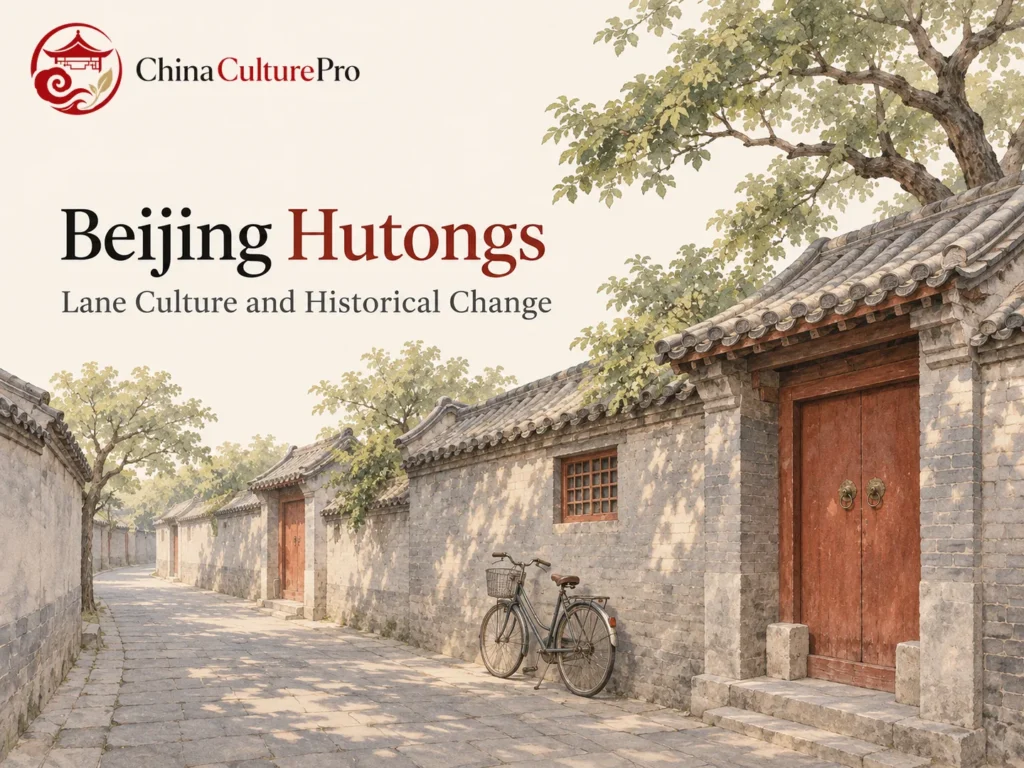

Quick Answer: What Are Beijing’s Hutongs?
A hutong (胡同, hútòng) is a lane in Beijing’s traditional street network. Hutongs connect house entrances with other lanes and wider streets. Many are associated with courtyard homes and small businesses. [1][2][3]
- The lane is the connection. A siheyuan (四合院, sìhéyuàn) is the courtyard compound behind a gate. A hutong links multiple compounds. [1][2]
- The network has a long history. Planned streets and residential blocks developed in the Yuan capital and continued to change in the Ming and Qing periods. [2][4]
- Use has changed over time. Courtyards became shared housing in parts of the old city. Some lanes later took on more commercial or visitor-oriented uses. [5][6][3]
Two lanes can have similar walls and gates but different patterns of life. The buildings and the people using them both matter.
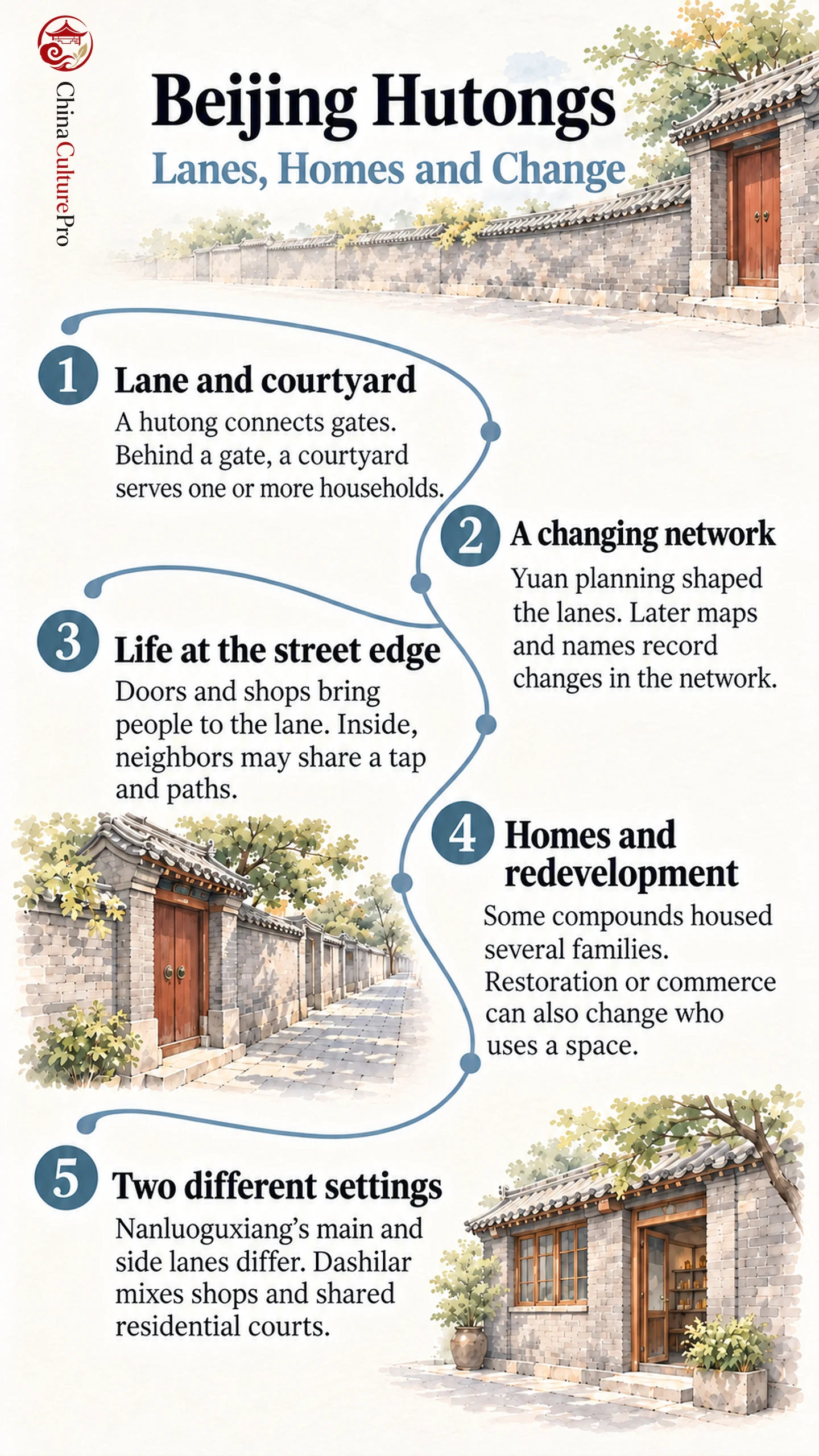
A lane may look quiet where a courtyard wall runs uninterrupted. A few steps farther on, a gate or shop brings people to the street edge. Those small changes in access help explain how Beijing’s old blocks worked and why the same lane can feel different after the buildings change use.
The Lane and the Courtyard
Narrow lanes extend from wider roads into the old-city blocks. A house meets a lane at its perimeter wall and gate. A gate can open onto a turning passage. A screen wall (影壁, yǐngbì) helps keep the private court from being visible from the street. Inside, household rooms face the open space. [1][2]
This arrangement shows how traditional Chinese architecture organizes access at more than one scale. The lane can carry through traffic and local access. Inside one gate, several households may share a courtyard as part of their home. The gate sets a boundary between the two kinds of shared space. [1][7]
How Beijing’s Lane Network Took Shape
Many of the patterns associated with Beijing hutongs trace back to planning in Yuan-era Dadu (大都, Dàdū). Wider routes connected major areas, and narrower lanes gave access to the residential blocks. Ming and Qing development modified the earlier pattern. Qing maps record relationships between lanes and compounds at the time of mapping. The age of a surviving wall or gate has to be established separately. [1][2][4]
The name is often traced to Mongolian. One account connects it to a word for a well and the settlements that gathered around water. Other explanations connect it with terms for streets or settlements. A well can be part of a neighborhood’s history, while the origin of the word remains uncertain. [8][9]
A map shows relationships that are hard to see at street level. Looking across several blocks reveals which lanes connect two major roads and which give local access or end inside a block. In historical Chinese maps, that network can survive on paper long after the street edges and buildings have been altered. [2]
Names can preserve another layer of the neighborhood. Some refer to landmarks or families, and others changed as routes were altered. In one documented example, a wider street absorbed part of Jinyu Hutong (金鱼胡同, Jīnyú Hútòng), while the remaining segment kept the older lane name. A name found on two maps can therefore survive even where the route it describes has shortened. [9]
Everyday Life at the Doorway
A gate can be a point where neighbors meet on their way home. A shop facing the lane can open directly to passing customers. A wall without an entrance makes a quieter stretch of street. The spacing of gates, corners and storefronts influences where people pause. [1][3]
Inside a shared compound, the court and passage can serve several households. Households can share a tap and a path while using them at different times. Leaving a passage clear for another family is one way residents manage a space that everyone inside the gate needs. [1][7]
What Changed in the Twentieth Century
Some old blocks were cleared for larger streets and buildings. Other blocks changed through new uses of the houses that remained. From the mid-twentieth century, many surviving compounds that had housed one extended family came to accommodate several households. These shared courtyards are often called dazayuan (大杂院, dàzáyuàn). Later residents added or divided rooms to meet needs the original plan did not anticipate. [1][5]
Redevelopment took several forms. Some properties were restored or refurbished and occupied differently. A restored street front can hide changes in occupancy. New businesses can replace household rooms, and changes in property use can affect whether existing residents stay. A street with conserved walls and tiled eaves can therefore have a different social life from an older account of the same place. This difference between building form and use matters across regional house types. [5][6]
Two Neighborhoods, Different Experiences
Nanluoguxiang (南锣鼓巷, Nánluógǔxiàng) is both the name of a north–south lane and a way of referring to the area around it. Side lanes branch off the main street. Studies of the area describe a contrast between visitor activity along the busy route and the different rhythms of adjacent residential spaces. A central commercial lane can give an incomplete picture of the surrounding blocks. [6]
In Dashilar (大栅栏, Dàshílànr), connected streets and small-scale commerce coexist with shared residential courtyards. Changes along the street edge can be incremental. What happens inside a compound can follow separate rules about which neighbors share access, maintenance and use. A street study can explain why shops open along particular routes. A courtyard study shows how neighbors share space behind the gates. [7][3]
FAQs About Beijing Hutongs
What does hutong mean?
In Beijing, a hutong is a lane or alley, often associated with old-city residential blocks. The term describes the route between places, whether it is busy with shops or mainly provides access to homes. [1][8][3]
How is a hutong different from a siheyuan?
A hutong runs outside individual gates. A siheyuan groups buildings around a court behind one of those gates. The lane connects houses, while the court connects the rooms inside a compound. [1][2]
Are hutongs still residential?
Some hutongs continue to serve homes. Others have many shops or visitor-oriented businesses, and the mix can vary from a main lane to nearby side lanes. [6][3]
Sumber
[1] Tibet Heritage Fund. Beijing Hutong Conservation Plan
[2] Yuyang Wang, Andrew Crompton and Asterios Agkathidis. The Hutong Neighbourhood Grammar: A Procedural Modelling Approach to Unravel the Rationale of Historical Beijing Urban Structure
[3] Yao Lu, Takashi Ariga and Mei Komatsu. Dynamic Adaptability and Street Vitality in Hutong Neighborhoods of Beijing’s Old City
[4] Yinhui Mao and Yan Sun. Preservation of Cultural Heritage in China: A Case Study of Beijing Hutongs
[5] Shuishan Yu. Courtyard in Conflict: The Transformation of Beijing’s Siheyuan During Revolution and Gentrification
[6] Marina Svensson. Walking in the Historic Neighbourhoods of Beijing: Walking as an Embodied Encounter with Heritage and Urban Developments
[7] Alin Li. Public Space Without the Public: State and Individuals in Courtyard Space in Dashilar, Beijing
[8] Beijing Municipal Bureau of Culture and Tourism. Definition of Hutong
[9] Weiqin Cao. Changing Place Names and Chinese Society: A Sociolinguistic Analysis of Beijing’s Hutong Place Names