

Quick Answer: What Is Chinese Memorial Architecture?
Chinese memorial architecture includes places and structures built to remember people, deeds or events. A temple can provide space for rites. A stele (碑, bēi) can preserve a written record. A tomb complex can connect a burial site to a ceremonial route. Some sites bring several of these forms together. [1][2][3][4][5]
- A shrine gives remembrance a place. A hall can be used for ceremonies honoring a historical figure or a lineage. [1][2][6]
- An inscription puts memory into words. A stone can record a ceremony, an honor or the reasons for building a monument. [3][7][5]
- The approach matters. A road lined with archways or sculptures changes how people encounter a memorial. [7][4][8]
Look at who or what the site commemorates, where the written record stands and how people move through the place. Those clues distinguish forms that may share materials and decoration. [1][3][7][4]
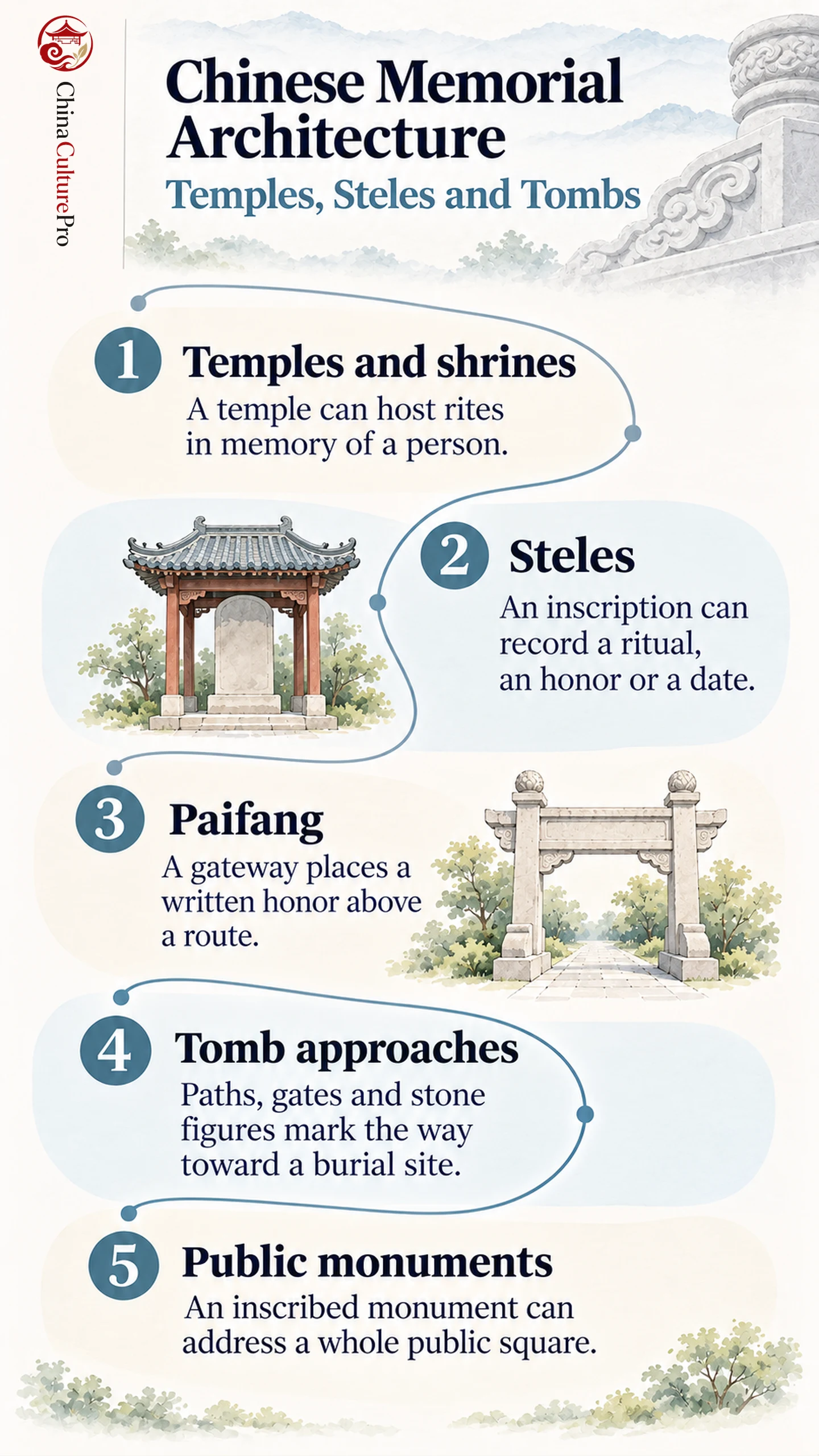
One inscription at Qufu (曲阜, Qūfù) records a request to fund rites in memory of Confucius (孔子, Kǒngzǐ). In a village in Anhui, archways record family honors above a road. The distance from the reader to the inscription, and the place where it stands, change how each record is encountered.
Temples and Shrines for Remembering People
At Qufu in Shandong, the Temple of Confucius was built to commemorate the teacher. Its history extends back to the fifth century BCE, and it was rebuilt and expanded many times. The associated cemetery contains his grave, while the Kong family mansion was a residence. One World Heritage property therefore includes a site of remembrance, a burial ground and a former residence. [1][3]
The Wuhou Shrine (武侯祠, Wǔhóu Cí) in Chengdu honors Zhuge Liang (诸葛亮, Zhūgě Liàng), Liu Bei (刘备, Liú Bèi) and other Shu Han figures. The site developed around adjoining commemorative places and Liu Bei’s mausoleum. The museum dates the reconstruction of the surviving shrine to 1671, after wartime destruction. It is one example of how Chinese temple architecture can serve remembrance of historical people. In ancestral halls such as the Tang hall in Ping Shan, the dedication is to a lineage’s ancestors. [2][6]
Steles and the Buildings That Shelter Them
A stele is an upright slab, often inscribed with a text. The words may explain a donor’s role, record a rite or give a date. The Shi Chen (史晨, Shǐ Chén) stele at Qufu dates to 169 CE. It records actions by the official Shi Chen, including his request for regular funding for rituals honoring Confucius. A nineteenth-century rubbing in the Metropolitan Museum of Art reproduces the lettering on paper, centuries after the stone was carved. [3]
A roofed structure can shelter a stele and mark its position within a temple or tomb complex. Thirteen stele pavilions at Qufu are documented by the World Heritage Centre. In this context, Chinese pavilions give permanent inscriptions a place in the arrangement of a larger site. [1][9]
Paifang and Honors in Public View
A paifang (牌坊, páifāng) can carry an inscription above a route. At Tangyue (棠樾, Tángyuè) in Anhui, seven stone gateways along a village road record honors associated with the Bao lineage. Their subjects include official standing, charitable giving and family virtues. The repeated gateways make the inscriptions part of the route through the village. [7]
The inscription stands where people pass through the village. This is one way Chinese paifang make a commemoration visible in public. It also connects the archways to the houses, halls and roads of Huizhou architecture, where the setting is part of what the memorial communicates. [7]
Tombs and the Sacred Way
A tomb is a burial place, and an imperial tomb complex can include halls, gates and paths above ground. The Sacred Way (神道, shéndào) of the Ming Tombs near Beijing provides an approach toward Changling (长陵, Chánglíng), the tomb of the Yongle emperor. Branches of the route lead toward other tombs. The sequence passes a stele pavilion and pairs of stone figures, putting commemorative objects along the approach to the burial landscape. [4][8]
Landscape also matters. UNESCO describes the setting of imperial tombs in relation to traditional geomancy, or feng shui (风水, fēngshuǐ). Major halls and gateways can share forms with Chinese palace architecture, while their arrangement serves a funerary purpose. [4][8]
A Modern Monument in a Public Square
The Monument to the People’s Heroes (人民英雄纪念碑, Rénmín Yīngxióng Jìniànbēi) in Beijing was completed in 1958. A tall inscribed stone body rises from broad platforms, and relief panels on the base depict episodes from modern Chinese history. Inscriptions and sculpture communicate the memorial’s purpose in a public square. [5][10]
The monument’s silhouette is visible at a distance. At the base, the reliefs give people details to read more closely. Its vertical inscribed surface can be compared with steles in traditional Chinese architecture, while the scale and setting address a much larger public square. [3][5][10]
FAQs About Chinese Memorial Architecture
Is a memorial temple the same as a tomb?
A memorial temple can contain places to honor someone through rites. A tomb is a place of burial. Both can occur in one complex, as at Qufu or the Wuhou Shrine site in Chengdu. [1][2]
What does a Chinese stele record?
An inscribed stele can record a date, dedication, donation or ritual. The Shi Chen stele at Qufu records arrangements for ceremonies honoring Confucius. [3]
How does a paifang differ from a stele?
A paifang is a gateway or gateway-shaped monument that can place a plaque above a route. A stele is an upright slab carrying text. Both can record honors, but they put the inscription in different places. [3][7]
Sumber
[1] UNESCO World Heritage Centre. Temple and Cemetery of Confucius and the Kong Family Mansion in Qufu
[2] Chengdu Wuhou Shrine Museum. About Chengdu Wuhou Shrine
[3] The Metropolitan Museum of Art. Rubbing of Stele for Shi Chen
[4] UNESCO World Heritage Centre. Imperial Tombs of the Ming and Qing Dynasties
[5] Tiananmen Area Administrative Committee. Monument to the People’s Heroes
[6] Hong Kong Antiquities and Monuments Office. Tang Ancestral Hall
[7] Huangshan University. Tangyue Memorial Archway Group
[8] Beijing Municipal Government. Exquisite Stone Carvings Along the Sacred Way
[9] UNESCO World Heritage Centre. Thirteen Stele Pavilions of Confucius Temple
[10] UNESCO World Heritage Centre. The Monument to the People’s Heroes and Its Reliefs