
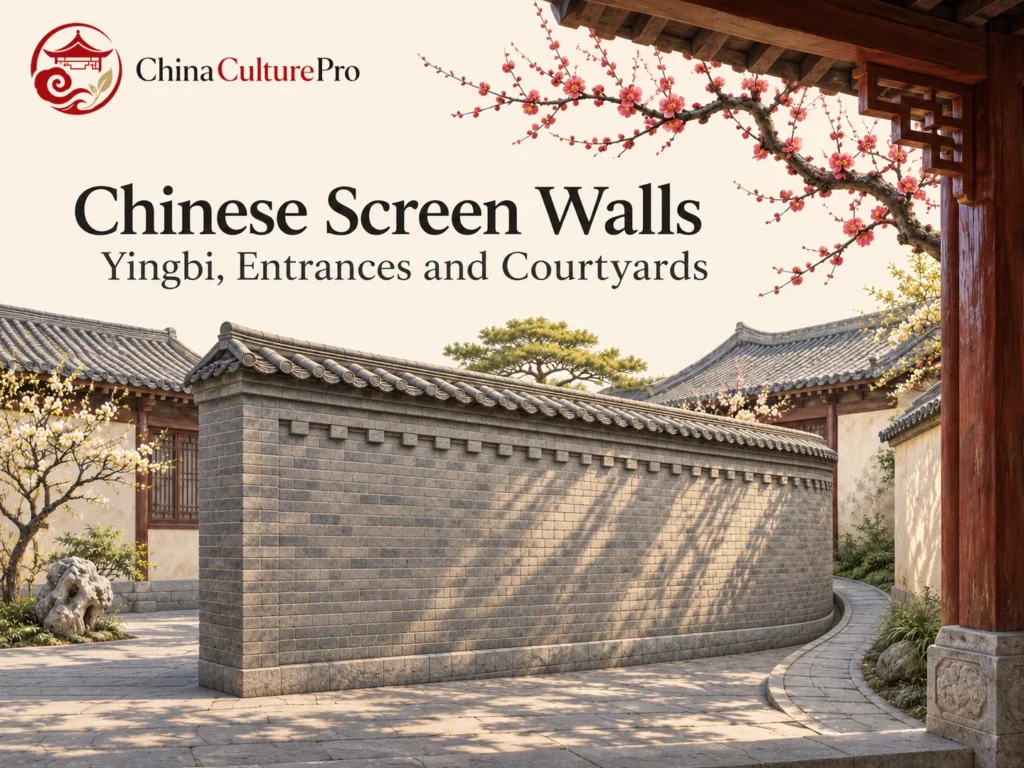

Quick Answer: What Is a Chinese Screen Wall?
A Chinese screen wall is a wall that interrupts a view or defines an approach, often near a gate. It is called an yingbi (影壁, yǐngbì) or a zhaobi (照壁, zhàobì). The wall may be freestanding, attached to another wall or built as one side of a courtyard. [1][2][3][4][5]
- At an entrance, it can shield the interior. From the street, someone looking through the gate sees the wall before the courtyard behind it. [1][2][6]
- In a courtyard, it can serve another purpose. A pale wall facing the main rooms can reflect light, as in some Bai homes. [4][5]
- The wall face can carry decoration. It might display family inscriptions, brick relief or colored glazed tiles. [3][7][8]
Its position explains much of what it does. The surface and inscriptions can tell you more about the people who built or used it. [2][3][7]
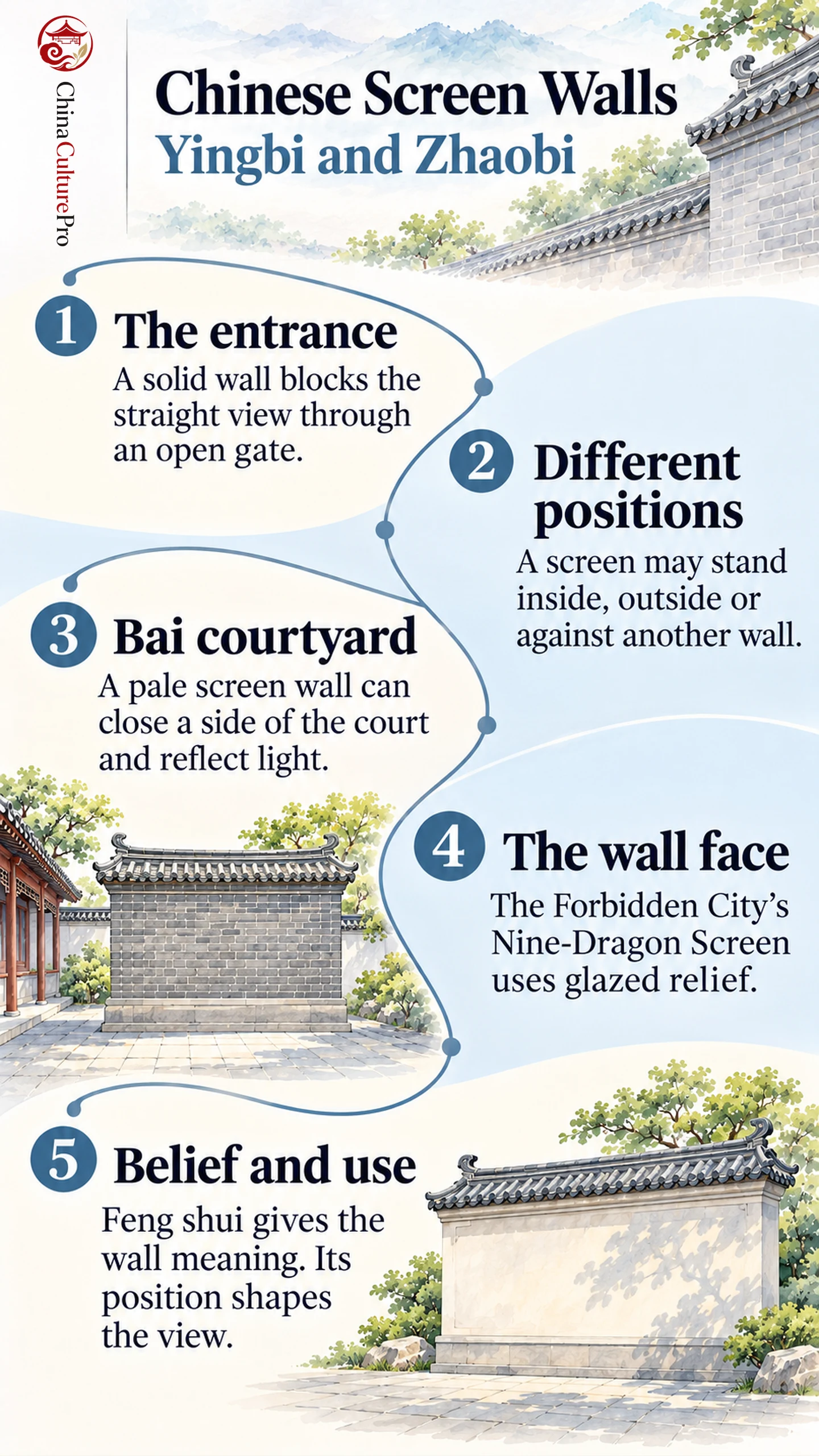
At a Beijing courtyard gate, a screen wall can hide the rooms beyond. In a Bai courtyard near Dali (大理, Dàlǐ), a wall can occupy an entire side of the open space and face the main rooms. The difference starts with where each wall stands.
How a Screen Wall Changes an Entrance
A screen wall in line with a gate can block the direct view even when the gate is open. When the wall stands inside the entrance, someone entering can move around its edge. The courtyard comes into view from a different angle as the route turns. [1][2][6]
A Beijing siheyuan often has an off-center main gate. A screen just behind it can give the household privacy and shape the approach. Standing on the street, you see the wall through the gate. Once you pass the wall’s end, a second view opens sideways into the court. The wall’s width matters in relation to the opening it screens, rather than in relation to the size of the whole courtyard. [2][6]
Inside, Outside and Attached Screen Walls
A screen can stand inside a compound or outside across from an entrance. Some examples form a straight wall, while others have angled side sections. A freestanding screen has its own base, body and cap. An attached example uses the end wall of a building, with added details to frame the screen on the façade. From the gate, that face can read as a separate object even where it uses an existing building wall. A row of small tiles across the top is one way to mark its outline. [1][2][3]
An outside screen meets the approach before a person enters. An inside screen affects the first turn after the threshold. The principle also helps explain how garden paths and windows reveal and conceal views. In traditional Chinese architecture, the effect can come from where the pieces stand in relation to each other. [1][2]
Screen Walls in Bai Courtyard Houses
In Xizhou (喜洲, Xǐzhōu) near Dali, a documented Bai house plan is called “three buildings and one screen wall” (三坊一照壁, sān fāng yī zhàobì). Three building ranges occupy three sides of a courtyard. The wall forms the fourth side and often faces the main rooms. This is one way traditional Chinese houses can enclose a court without putting rooms on all four sides. [4][5]
A whitewashed surface can reflect light toward the court and the rooms facing it. Paint and written phrases can also give the wall a social role. An example is “pass integrity down through the family” (清白传家, qīngbái chuánjiā), a phrase documented on Bai screen walls. Someone in the court can see the family message on the same surface that reflects daylight. [4][5][7]
Glazed Tiles and the Nine-Dragon Screen
The Nine-Dragon Screen (九龙壁, Jiǔlóng Bì) in Beijing’s Forbidden City was made in 1772 during work on the Palace of Tranquil Longevity. It stands against a palace wall outside Huangji Gate (皇极门, Huángjí Mén). Its decorated face carries nine dragons in glazed relief above a pale stone base. The scene is divided by rocks and set against clouds and waves. A yellow glazed cap outlines the top like a shallow roof. These details make the side that faces the approach very different from the back of the wall. [8]
Domestic screen walls may use brick, plaster or other traditional building materials. The palace screen has ceramic roof and bracket details modeled on timber structures. This use of glazed material at a prominent threshold is a distinctive example of Chinese palace architecture. [1][3][8]
Feng Shui and the Practical Role of the Wall
Accounts of feng shui (风水, fēngshuǐ) sometimes explain the wall in terms of avoiding a straight flow into the entrance. These accounts express beliefs about orientation and movement. The physical effect on the view is visible from the gate. In some compounds the wall also turns the route or closes a side of a court. [2][4][5]
FAQs About Chinese Screen Walls
Are yingbi and zhaobi the same thing?
They are often used for the same broad architectural feature. Its materials and placement can differ, so the name alone does not tell you whether a wall is freestanding or attached. [1][2][3]
Is a screen wall always inside the gate?
No. Examples stand inside or outside entrances. Others can be attached to a building or form one side of a courtyard. [1][2][3][4]
What does a Bai courtyard screen wall do?
In a common plan from the Dali area, it closes the fourth side of the courtyard. Its pale surface can reflect daylight, and its painted or written decoration may express family values. [4][5][7]
Sumber
[1] ChinaCulture.org. Chinese Unique Architectures: Yingbi
[2] Prince Kung’s Palace Museum. Courtyard Architecture at Prince Kung’s Palace
[3] Shanghai Landscaping and City Appearance Administration. Details of Historic Chinese Architecture
[4] Dali Municipal Government. Painted Decoration in Bai Houses in Dali
[5] Mengbi Li. The Evolution of the Zhaobi
[6] State Council Information Office. Traditional Culture: The Courtyard House
[7] Yunnan Provincial Publicity Department. Family Traditions on the Screen Wall
[8] The Palace Museum. Nine-Dragon Screen