
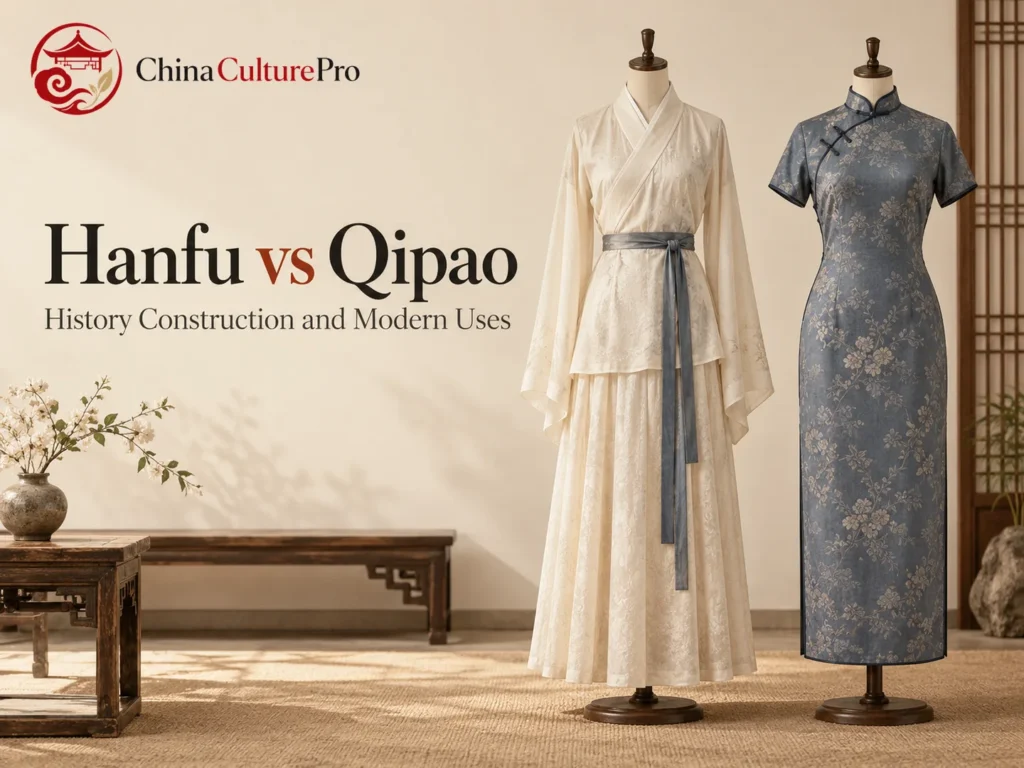

Quick Answer: How Are Hanfu and Qipao Different?
Hanfu(汉服,hànfú)is a broad category associated with historical Han Chinese clothing and its modern revival. Qipao(旗袍,qípáo)usually names a particular dress family whose familiar modern forms developed through twentieth-century fashion.
- Scope: Hanfu can include several separate garments or a robe; qipao usually presents as one principal dress.
- Construction: Compare the actual collar, opening, closures and shaping. “Loose versus tight” is only a rough visual shortcut.
- Modern use: Both can be contemporary clothing, formalwear or expressions of cultural interest, depending on the particular design and setting.
Neither name identifies one fixed fabric, sleeve width or level of historical accuracy.
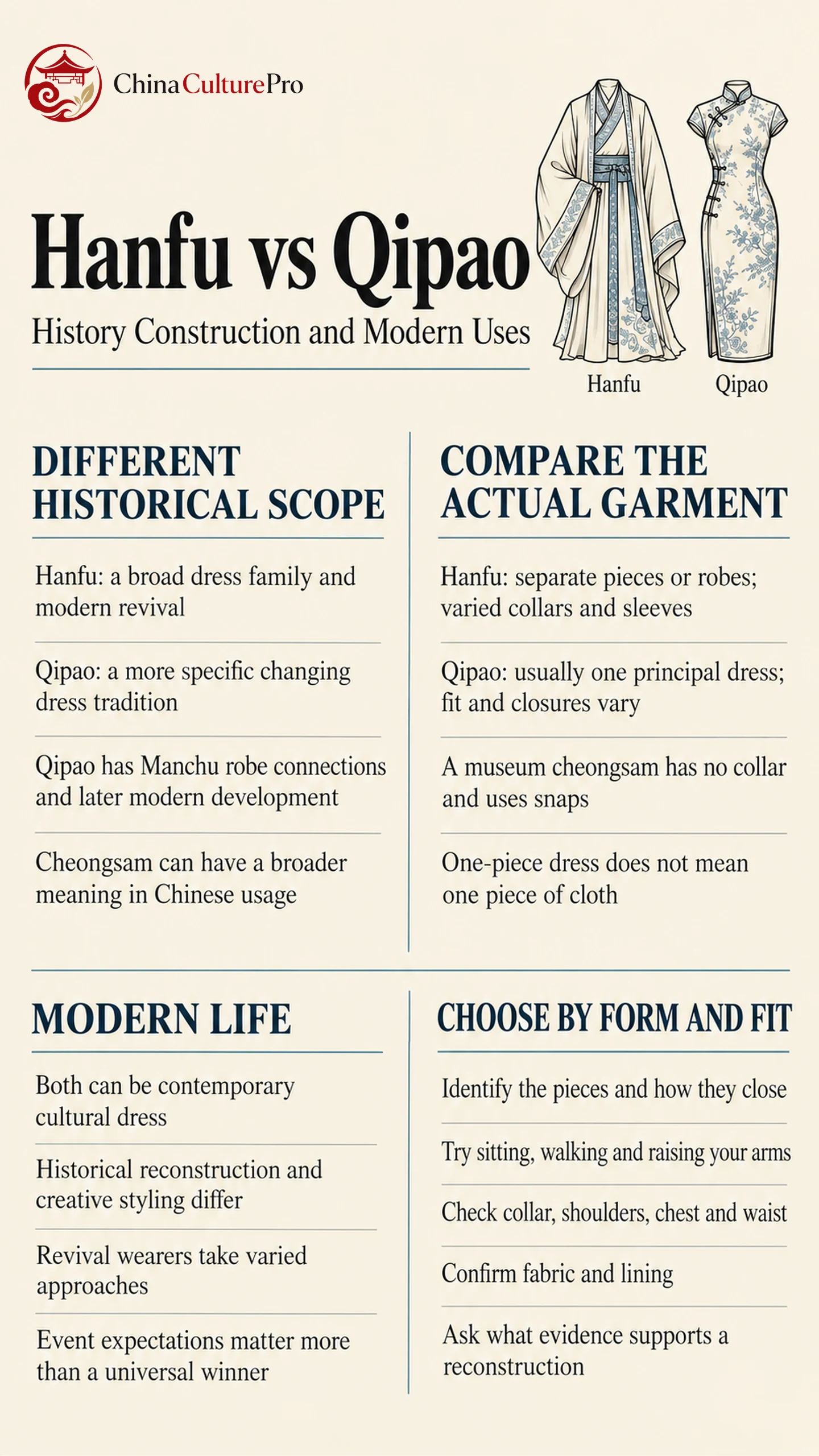
A layered outfit and a slim cheongsam can look very different, yet photographs often label both simply as “Chinese dress.” The useful comparison starts with how the clothes are assembled and what their names include. The broader traditional clothing guide places them alongside other Chinese dress traditions.
Different Histories, Different Kinds of Name
Hanfu is not the name of one dress invented at one moment. Historical dress research examines changing combinations of upper and lower garments, robes, headwear and textiles, using objects, images and written evidence together.[1] Modern usage also encompasses revival styles, which may draw on different periods or combine historical inspiration with contemporary choices.
Consequently, “Han” in Hanfu should not be taken to restrict every outfit to the Han dynasty. The Hanfu overview explores that wider field. To identify a particular ensemble, a form name and period reference are more informative than the umbrella term alone.
The qipao name connects it to Manchu robe traditions, but the familiar twentieth-century dress developed through later changes in fashion and tailoring.[7] Its modern chronology is therefore essential to the comparison. In Hong Kong it was already worn in the 1920s, later supported by an influx of Shanghai tailors and strong fashion demand in the 1950s and 1960s.[2] Its lengths, proportions and social uses changed; an early, straighter dress and a later closely shaped version should not be treated as one timeless silhouette.
The qipao and cheongsam guide follows that dress history. In common English usage the two names often identify the same women’s garment, but cheongsam has a broader linguistic history: in some Chinese contexts it can also refer to a man’s long gown.[5]
The comparison places a wide clothing category beside a more specific dress family. A historical clothing overview is useful when the question concerns which forms belonged to the same period.
Comparing Construction Beyond the Silhouette
Look at the whole garment before identifying it from one detail. A crossed collar is a useful clue for some Hanfu forms, but the category includes different structures. A standing collar is familiar on qipao, but a documented collarless cheongsam shows that it is not compulsory.[4]
| Criterion | Hanfu | Qipao |
|---|---|---|
| Garment arrangement | May combine a top and skirt, trousers and outer layers, or a robe | Usually one principal dress extending from shoulders to hem |
| Collar | Varies with the particular form; an overlapping crossed front is common in some styles | A standing collar is familiar, but low or collarless variations exist |
| Opening and closures | Ties, belts and other fastenings depend on the garment | Shaped front or side openings may use knotted closures, snaps or other fittings |
| Body shaping | Varies by garment structure and modern interpretation | Can range from straighter shaping to a closely fitted waist and torso |
| Sleeves | Narrow and broad forms both occur | Length, shape and presence of sleeves vary |
| Lower portion | May be a separate skirt, trousers or the lower part of a robe | The skirt portion belongs to the principal dress; slit design varies |
These are comparison criteria, not an automatic identification test. The Hanfu styles guide helps when a photograph needs a more precise garment name.
“One-piece dress” also needs care. It means one main garment, not necessarily one uncut piece of cloth. Qipao tailoring involves pattern pieces, shaping, sewing and fitting. Traditional cheongsam craft can use both hand and machine sewing, with fitting before decorative additions.[3]
One museum cheongsam has three-quarter sleeves, a collarless neckline, metal snap fastenings and only slight waist shaping.[4] That single object is enough to challenge the claim that every qipao must have a high collar, visible knot buttons and a very tight waist. It does not establish a replacement rule for every dress.
Modern Uses and Shared Cultural Meaning
Both clothing traditions can be meaningful without being exact historical reproductions. Among Hanfu wearers studied in Shanghai, approaches ranged from close attention to historical forms and conventions to freer arrangements.[6] A modern outfit can therefore be part of revival practice while still incorporating new choices.
Qipao likewise continues as occasion wear and an inspiration for designers.[2] Its twentieth-century development does not make it less culturally significant than a style inspired by an earlier period. “Traditional” can describe a continuing practice that changes, rather than a design frozen at its first appearance.
For a cultural gathering, family celebration or portrait session, choose by the event’s expectations and the effect you want from the outfit. A dress code, performance brief or historical reconstruction project can impose much more specific requirements than the broad category names suggest.
Accessories do not turn one garment into the other. A fan, hair ornament or embroidered motif can accompany many designs; the garment’s structure and context remain the better starting point for identification.
Choosing Between Hanfu and Qipao
Choose an actual outfit rather than the promise of a category. If you want several visible layers or a particular historical silhouette, identify the relevant Hanfu form first. If you want a continuous dress silhouette, compare qipao designs with the length, sleeves and shaping you prefer.
Then check four practical points:
- Arrangement: Find out which pieces belong to the set and how they close. The Hanfu wearing guide explains that task in more detail.
- Movement: Try sitting, walking and raising your arms. A narrow hem, long skirt or broad sleeve affects movement differently.
- Fit: Check the collar, shoulders, chest and waist rather than relying on a size label. Traditional cheongsam making takes several individual body measurements.[5]
- Fabric: Ask what the garment and lining are made from. A shiny surface does not identify silk; the silk clothing guide separates material from appearance.
Historical accuracy calls for an additional question: which object, image or documented form supports the outfit? For everyday or creative use, explain the inspiration plainly instead. A modern interpretation and a reconstruction serve different purposes; describe which you are choosing.
FAQs About Hanfu vs Qipao
Is a qipao a type of Hanfu?
In the usual modern comparison, no. Qipao has its own modern dress history, while Hanfu is a broader category of historical Han dress and revival forms. Both can belong within the wider subject of Chinese clothing.
Does every Hanfu outfit have wide sleeves?
No. Sleeve width depends on the garment and its inspiration. Wide sleeves alone cannot identify every Hanfu form or establish historical accuracy.
Must a qipao be tight or high-slit?
No. Fit and hem details vary by design and period. Choose the specific dress and check its movement rather than assuming the category requires one extreme silhouette.
Is cheongsam exactly the same word as qipao?
They often name the same women’s dress in English, but their linguistic scope is not identical in every context. Cheongsam can also refer to a man’s long gown in some Chinese usage.
Sumber
[1] Wang Fang. The Formation of Hanfu
[2] Hong Kong Museum of History. A Century of Fashion: Hong Kong Cheongsam Story
[3] Hong Kong Memory. Cheongsam Making: Steps Two
[4] Museum of Vancouver. Cheongsam Side-Fastening Dress
[5] Cultural Affairs Bureau of Macao. Making of Chinese Cheongsam
[6] Tianyue Tang and Yasuhisa Abe. Hanfu Revival Inspired Activities and Their Venues in Shanghai, China
[7] Hong Kong Conservation Office. Hong Kong Cheongsam Story Exhibition