


Quick Answer: What Are Chinese Hairpins?
Chinese hairpins are objects used to secure arranged hair, attach headwear or decorate a hairstyle. Their names can describe different features, so shape, function and material should be considered separately.
- Form: A single shaft, a forked body and a long flat pin solve different fastening problems.
- Decoration: Suspended or flexible elements can move, while carved or mounted ornaments remain comparatively fixed.
- Context: Historical examples range from simple fasteners to elaborate jewelry; age, community, social role and occasion affect their interpretation.
A traditional name is a starting point for identification, not a complete description of an object’s construction, material or meaning.
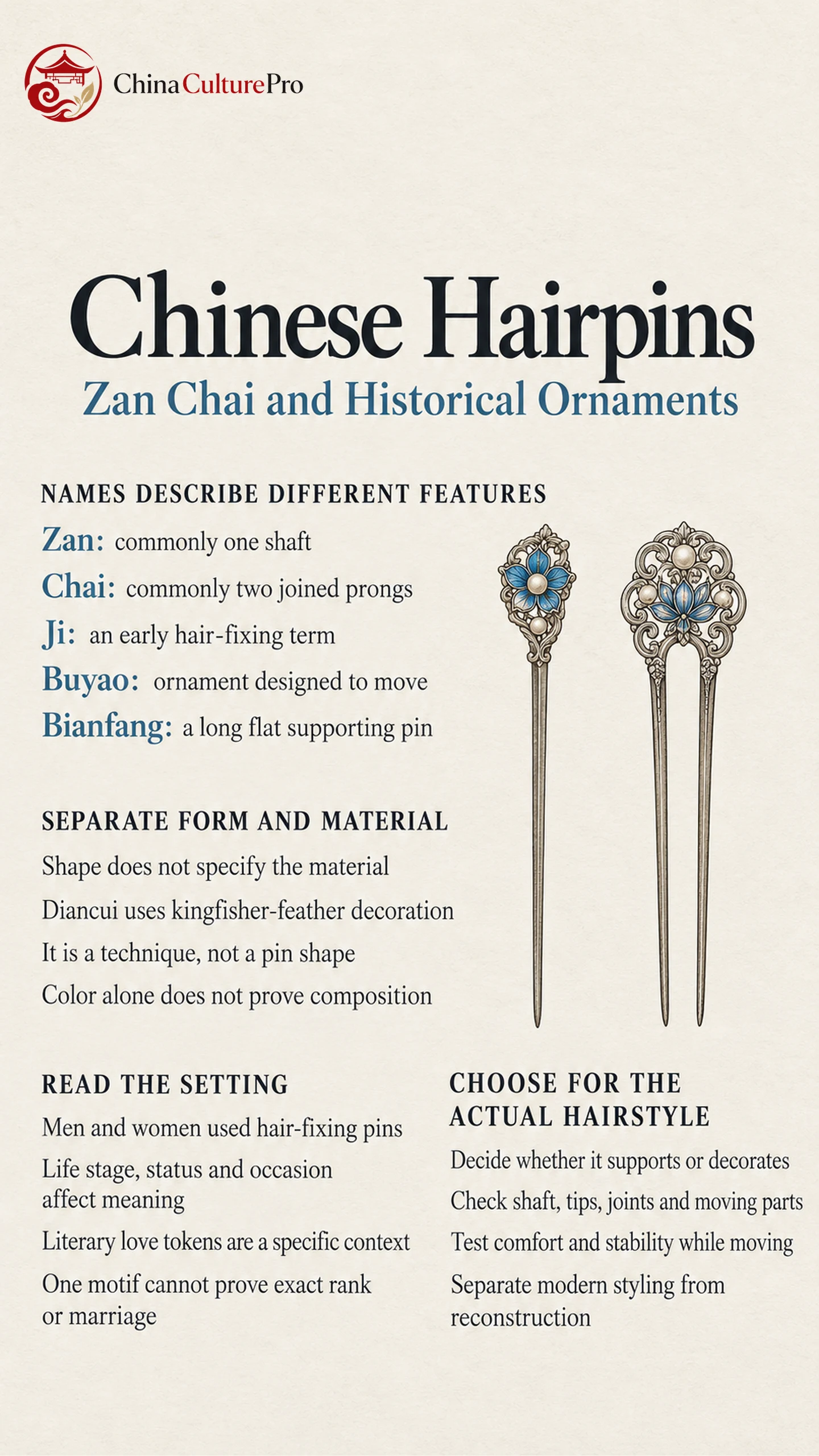
A plain pin and an elaborate ornament with moving drops may both appear beside a Hanfu(汉服,hànfú)outfit. Yet they need not do the same job. Understanding Chinese hairpins within traditional Chinese clothing begins with the part that enters the hair, then the decoration and historical setting.
Zan, Chai, Ji, Buyao and Bianfang
These terms are useful together, but they do not form five mutually exclusive boxes. Some describe the pin body; another emphasizes movement; a broader historical term can overlap with later vocabulary.
| Nama | Basic identification | Perbedaan penting |
|---|---|---|
| Zan(簪,zān) | Commonly a single-shaft hairpin | Can secure hair or work with headwear; its upper end may be plain or ornamented.[1] |
| Chai(钗,chāi) | Commonly a forked, two-pronged pin | Two joined prongs are different from simply wearing two independent single pins.[1] |
| Ji(笄,jī) | An early term for a hair-fixing pin | Important in the history of hairpins; it should not be treated as a universally separate modern product class.[1] |
| Buyao(步摇,bùyáo) | An ornament designed to sway or tremble with movement | The moving element, rather than a fixed prong count, is the key characteristic.[3] |
| Bianfang(扁方,biǎnfāng) | A long flat pin associated with Manchu women’s hair arrangements | It could support the hairstyle as well as decorate it; its role differs from that of a small ornamental pin.[4] |
A group of six gilt-silver ornaments makes the single- versus double-pronged distinction concrete: two-pronged examples include paired phoenix and pointed fan forms, while a pair of flat fan-shaped pins uses single shafts.[1] The decorative theme alone does not establish the pin type.
The traditional hairstyles guide explains how such objects relate to hair arrangements. Manchu clothing supplies context for the bianfang, whose long flat body helped secure a divided hairstyle rather than merely adding a jewel to its surface.
Materials and Decorative Techniques
Historical hairpins were made in varied materials, including bamboo, horn, metals and jade.[1] A group of white-jade, double-pronged chai from the Sui tomb of Li Jingxun offers a specific stone example. Crystal pins of a similar form were also found there.[2] The jade identifies the material; the joined prongs identify the form.
Decoration can add another layer of terminology. Kingfisher-feather inlay(点翠,diǎncuì)uses feathers attached within a metal framework. It is a decorative technique, not a pin shape or a kind of blue enamel. A Qing gold hairpin combines a long pin body with wirework, set gems, a pearl and feather decoration on the ornamental head.[5] One object can therefore have a structural name, several materials and multiple techniques at once.
Movement also depends on construction. Suspended components can sway as the wearer moves; other ornaments use flexible elements such as springs.[7] A group of Tang-period gold accessories with bird and plant forms is cautiously interpreted as likely having belonged to a buyao set.[3] The proposed set identification remains qualified.
When examining a modern ornament, check the described base material, surface finish and attachments. A gold-colored surface does not establish solid gold, and a vivid blue area alone does not establish feather inlay. Product labels and construction details provide better evidence than color.
What Hair Ornaments Could Communicate
Pins were used by men as well as women, and their forms and materials differed with the hairstyle and wearer. More elaborate ornaments could express wealth and social position, while the specific hair arrangement affected what the pin needed to support.[6] This history includes functional tools as well as conspicuous jewelry.
Putting up the hair and adding pins could also be associated with a transition toward adulthood in particular customs. Hairpins carried emotional meanings in literature, including stories in which the ornament stood for its wearer or a relationship.[7] The coming-of-age ceremonies guide explains the ritual setting; a literary association should not be converted into a rule that every pin is a love token.
Ornate headwear could form part of a bridal trousseau, too.[6] The guide to Chinese wedding jewelry places those choices within wedding customs. A phoenix, flower or gemstone on an isolated pin cannot by itself establish the wearer’s exact rank or marital status.
Choosing and Wearing a Hair Ornament Today
Choose the function before the decoration. A supporting pin must suit the amount and arrangement of hair. A decorative piece may need an already secure bun or an additional fastening; a large ornamental head should not be assumed to bear the whole hairstyle’s weight.
Inspect the shaft, tips and joints. Check for rough edges that catch hair, loose fittings and moving parts that strike the face or snag clothing. Try the piece with the hairstyle you intend to wear, then turn your head and move normally. Reconsider the weight or placement if it pulls painfully or becomes unstable.
For historical reconstruction, start with a dated reference and match its form and context. For modern styling, a simpler contemporary pin can be a deliberate choice without claiming to reproduce an ancient object. The Hanfu wearing guide covers fitting the outfit before adding accessories. There is no need to combine every named ornament in one hairstyle.
FAQs About Chinese Hairpins
Is a chai simply a pair of separate hairpins?
Usually the term identifies a forked object with joined prongs. A pair of separate single-shaft pins describes quantity, not the same construction. Check the actual object when a catalogue uses a broad label.
Does every buyao have long dangling chains?
No. The defining idea is movement. Suspended elements or flexible attachments can create swaying or trembling without a required chain length or one fixed decorative arrangement.
Can men wear Chinese hairpins?
Yes. Men used hair-fixing pins historically, including with headwear. For modern wear, suitability depends on the hairstyle and intended use; an elaborate women’s historical example is not the model for every pin.
Is a blue hair ornament necessarily kingfisher feather?
No. Blue is a color, not a material test. Historical feather inlay has a particular construction; a modern blue ornament needs its own material description rather than identification from appearance alone.
Sumber
[1] National Museum of China. Gilt-Silver Zan and Chai
[2] National Museum of China. Jade Chai from Li Jingxun’s Tomb
[3] MIHO Museum. Hair Accessories
[4] Tie Qi; Palace Museum. Jade Bianfang
[5] Yang Jie; Palace Museum. Gold Hairpin with Pearls, Gems and Kingfisher-Feather Decoration
[6] Pitt Rivers Museum, University of Oxford. Chinese Hairpins
[7] Sarah Cheang. Flowers, Feathers and Fashions, in China’s 1800s: Material and Visual Culture