

Quick Answer: What Are Traditional Chinese Hairstyles?
Traditional Chinese hairstyles include many ways of gathering, coiling, looping, braiding and supporting hair. A hair bun(髻,jì)is a broad arrangement, not one hairstyle restricted to a single dynasty.
- Period and wearer: Men’s and women’s styles changed across regions, communities, ages and settings.
- Construction: The visible shape may combine natural hair, added hair, pins, a support or a separate piece of headwear.
- Meaning: Hair could communicate social identity or political allegiance, but its significance depends on the historical context.
Identify the arrangement, its supporting objects and its date separately before treating a portrait or reconstruction as evidence of everyday dress.
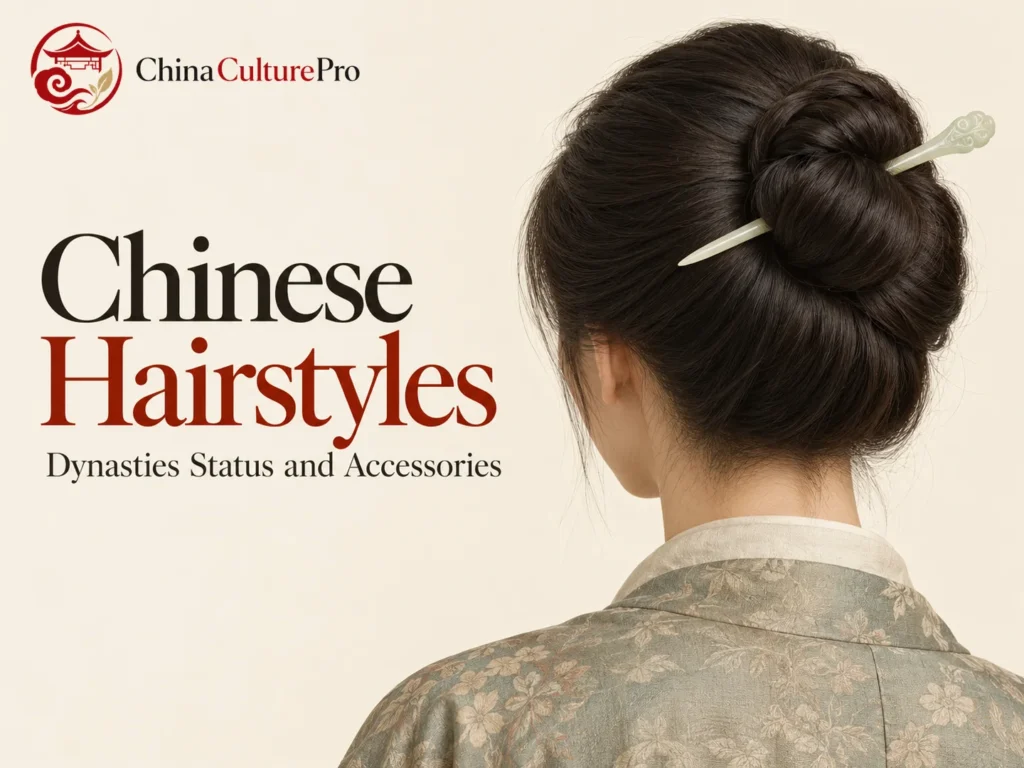
A high bun, a pair of loops and a broad black headdress can create very different silhouettes. They also involve different relationships between hair and accessories. Whether you are reading a portrait or planning a Hanfu(汉服,hànfú)interpretation, hairstyle belongs within the wider context of traditional Chinese clothing.
Hairstyles Through Specific Historical Examples
Historical names do not always correspond neatly to one surviving image. The following examples begin with observable forms and documented objects rather than a claim that each dynasty had one standard hairstyle.
| Period or setting | Form to recognize | What the evidence shows |
|---|---|---|
| Han women in figures and images | Buns at different positions on the head | Examples include lower arrangements and higher buns, alongside other variations. Position and volume changed; “Han hairstyle” is not one fixed outline.[1] |
| Tang female figures | Raised, looped or otherwise elaborately arranged hair | A specific sancai figure has hair framing the face and a bun falling toward the forehead. Other representations show considerable variety within Tang dress.[2] |
| Song men of elite status | A topknot held within a small crown or cover | A jade lotus-shaped crown has openings for the pin that secured it. The object combines hair arrangement with separate headwear.[3] |
| Qing Manchu women | Liangbatou(两把头,liǎngbǎtóu) | Hair divided into two sections was arranged and fixed with a long flat pin; later versions also used constructed forms.[4] |
| Late-Qing court and related fashion | Dalachi(大拉翅,dàlāchì) | A large supported form could incorporate a textile-covered shell and be attached above a hair base. It should not be imagined as entirely the wearer’s natural hair.[5] |
| Qing men and the dynasty’s political setting | A shaved front with a long braided queue | Hair requirements were bound to Qing authority and allegiance. A surviving late-nineteenth-century skullcap with an attached queue also records an artificial version of the visible form.[6] |
The Chinese clothing history guide provides the broader sequence, while Manchu clothing supplies context for Qing examples. Neither a Tang hair arrangement nor a Qing queue represents the hair of every Chinese person across history.
Age, Status, Community and Political Meaning
Hair arrangement and ornament could mark life stages. In documented Qing customs, putting up the hair and using decorative pins could mark the transition toward marriageable adulthood. The quality, materials and elaboration of ornaments also communicated social position.[7] These meanings belong to particular customs; a raised bun alone cannot establish marital status.
Chinese coming-of-age ceremonies place changes in headwear and hair arrangement within ritual settings. A ceremony, a fashionable portrait and an ordinary working hairstyle need to be read differently. The presence of a pin alone cannot establish the wearer’s exact age or marital status.
Community also matters. In late-Qing examples, Han women’s arrangements may concentrate hair at the back or sides, while Manchu examples emphasize height and volume. The relationship between the ornament and the hairstyle is therefore more useful than treating all decorated updos as the same category.[8]
For Qing men, the queue also carried political meanings connected to the ruling dynasty and, later, to its rejection. The surviving cap with an artificial queue demonstrates why even a convincing outward appearance does not necessarily reveal how much natural hair lay beneath it.[6] This is a distinct historical setting, not an explanation for every Chinese braid.
Hair, Supports and Decorative Accessories
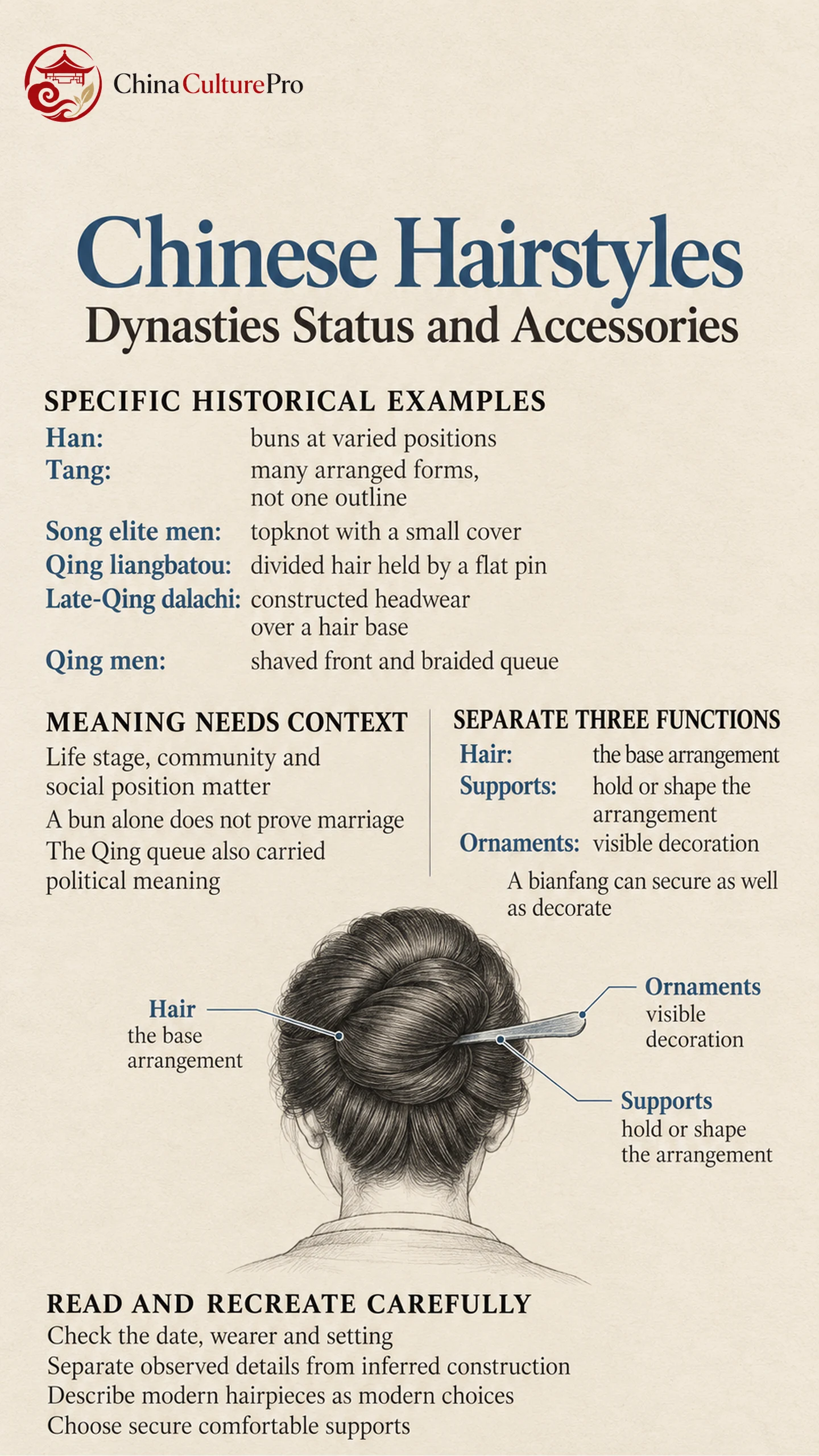
Separate three functions when looking at an elaborate head arrangement: hair forms the base; a fixing object holds or supports it; ornament supplies a visible decorative element. One object can perform more than one function, but they remain different questions.
The bianfang(扁方,biǎnfāng)is a clear example. This long flat pin helped secure the two-part liangbatou arrangement. Surviving versions include different materials, and its practical role extended beyond surface decoration.[4] By contrast, the larger late-Qing dalachi could be a removable, textile-covered structure fixed over the hair base.[5] A portrait’s broad shape may therefore belong partly to headwear.
Smaller ornaments also vary in their role. A plain pin can help hold a bun; a more elaborate piece may project outward or carry moving attachments. The Chinese hairpins guide distinguishes those forms. A visible jewel does not show every hidden pin or support used in the completed arrangement.
Reading Images and Recreating a Look Today
Start with the date, community and setting of an image. Check whether it represents a court occasion, a posed studio scene, everyday activity or a theatrical role. Some nineteenth-century studio photographs were posed to emphasize contrasting hair structures and ornaments.[7]
For a reconstruction, keep a reference image beside the plan and distinguish observed details from inferred ones. A modern stylist may use a hairpiece or hidden support to reproduce a silhouette, but that choice is not proof of an identical historical method. Likewise, two ornaments that look similar may differ greatly in weight and fastening.
For contemporary wear, adapt the arrangement to your own hair and the activity. Choose secure, comfortable supports, and reconsider a heavy ornament if it pulls painfully or catches when turning your head. The Hanfu wearing guide covers fitting clothing before adding accessories. Historical reference and a wearable modern interpretation can be described clearly without treating them as interchangeable claims.
FAQs About Chinese Traditional Hairstyles
Did men use hairpins too?
Yes. Men as well as women used pins in historical hair arrangements. The Song jade crown example also shows how a pin could work with male headwear rather than appear as a large decorative jewel.
Does a bun always mean a woman was married?
No. Hair could mark life stages within specific customs, but a bun alone cannot establish marital status across every period and community. The date, wearer and context must be known.
Were elaborate hairstyles made entirely from natural hair?
Not necessarily. Added hair, supports and separate headwear could contribute to the outline. The late-Qing dalachi is a particularly clear example of a constructed form over a hair base.
Can a modern drama hairstyle identify a dynasty?
It can suggest a historical reference, but screen styling also serves performance and character design. Compare it with dated images and objects before assigning an exact period or social meaning.
Sumber
[1] Guangdong Daguan Museum. How Did Han-Dynasty Women Dress?
[2] Zhao Yong; National Museum of China. Tang Women in Chang’an: A Sancai Figure
[3] National Museum of China. Celadon Jade Lotus Crown
[4] Tie Qi; Palace Museum. Jade Bianfang
[5] Zuo Yuanbo; Palace Museum. Interpreting Photographs of the Empress Dowager Cixi
[6] Powerhouse. Chinese Skullcap with Hair Queue
[7] Sarah Cheang. Flowers, Feathers and Fashions, in China’s 1800s: Material and Visual Culture
[8] Pitt Rivers Museum, University of Oxford. Chinese Hairpins