
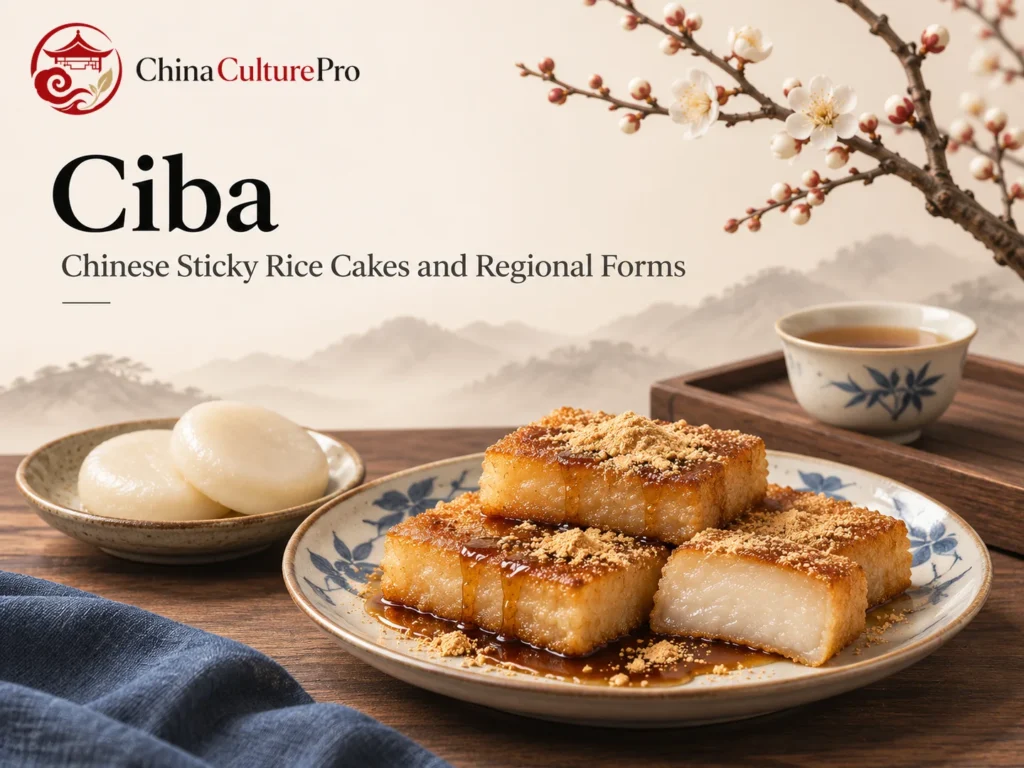

Quick Answer: What Is Ciba?
Ciba (糍粑, cíbā) is a family of sticky rice cakes, traditionally made by steaming glutinous rice and pounding it into a cohesive mass before shaping. The name covers several regional shapes and serving styles.[1][4][6]
- Base: Cooked sticky rice worked into a dense, cohesive cake.
- Texture: Often soft and chewy; some dried, fried forms are crisp.
- Flavor: Plain rice, sweet toppings or savory seasonings, depending on the version.
Brown-sugar fried ciba is one well-known serving style. It does not define every cake sold under this name.[2][4][6]
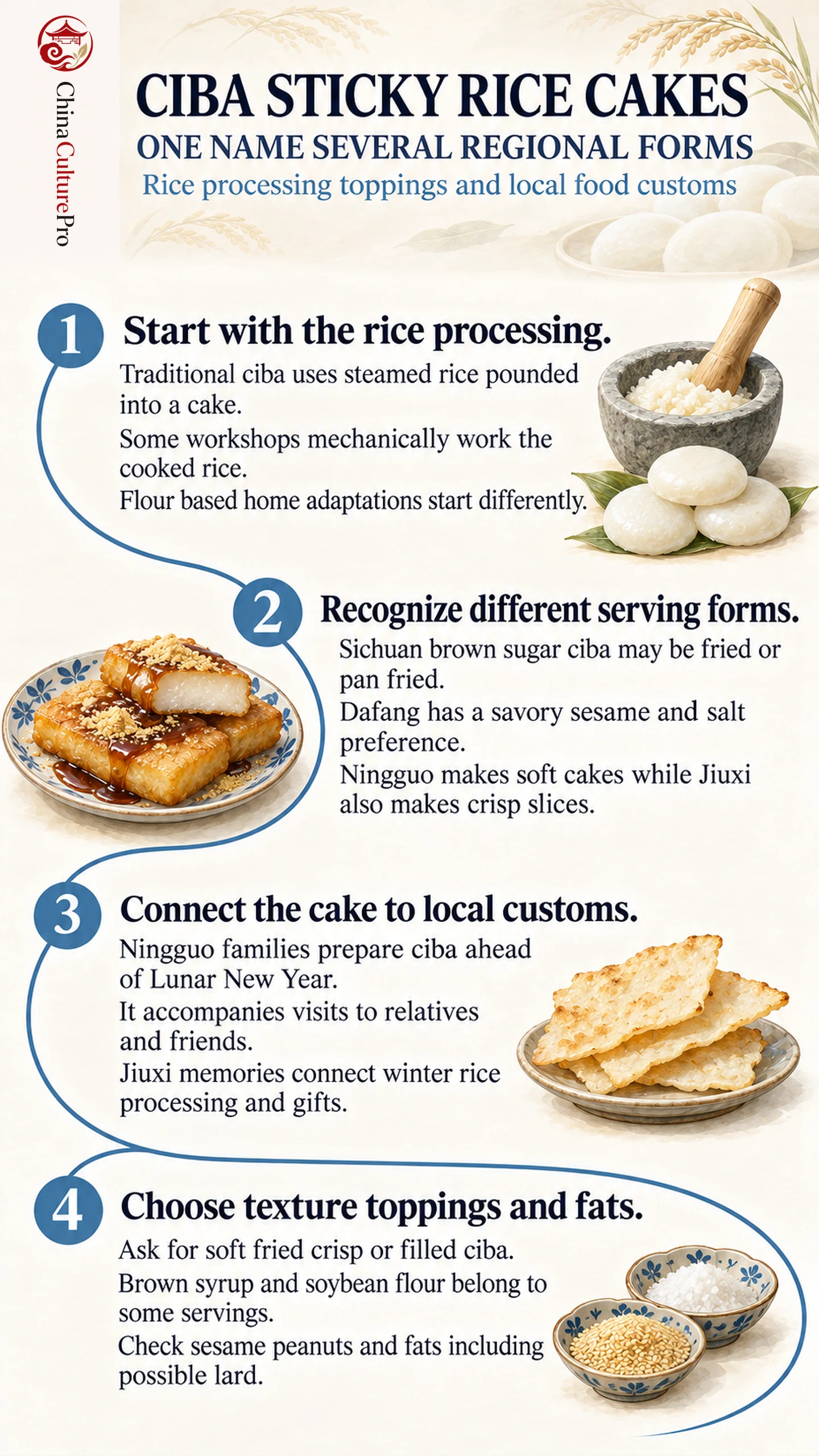
Ciba may arrive as a soft white cake, a golden piece dressed with syrup or a crisp rice slice. The shared name covers different local foods and finishes. Start with the rice and its processing, then look at the coating and serving style.
From Whole Sticky Rice to a Cohesive Cake
Traditional preparation starts with whole glutinous rice. Steaming softens the grains; pounding then breaks them down into a sticky mass that can be pressed and shaped. A Ningguo craft account describes a smooth, firm but pliable cake, rather than a pile of separate grains.[1]
A Jiangchuan workshop mechanically works cooked rice before molding it. A contemporary home adaptation instead starts with glutinous rice flour, cooked and worked into a stretchy mass. These methods start at different stages of rice processing.[2][5]
Regional Forms: Soft Cakes, Brown Sugar and Crisp Slices
Hong tang ci ba (红糖糍粑, hóngtáng cíbā) is the brown-sugar version familiar from Sichuan dessert menus. Fried or pan-fried pieces can have a crisp surface with a chewy interior, finished with brown sugar syrup and toasted soybean flour.[4]
| Documented place or style | Form or seasoning | Eating character |
|---|---|---|
| Ningguo, Anhui | White round cakes with several possible cooking methods; sugar, sesame or crushed peanuts may accompany them. | A pliable rice cake, with texture changing after further cooking. |
| Dafang, Guizhou | A local savory preference for sesame and salt. | Rice flavor with savory seasoning rather than compulsory syrup. |
| Jiucheng, Shidian, Yunnan | Pounded cakes; purple rice, salt or perilla may be used. Honey accompanies some roasted or fried servings. | Several local flavor options. |
| Jiuxi, Jiangchuan, Yunnan | Molded rice cakes dried as slices and fried. | A crisp snack rather than only a soft, chewy cake. |
These Yunnan examples and the other local forms illustrate variation within the name. [1][2][3][6]
Pounding Rice for Visits and Festivals
In Ningguo, within Anhui’s food traditions, families prepare ciba during the last lunar month ahead of Lunar New Year. The cakes also accompany visits to relatives and friends. Pounding and shaping are part of the seasonal household activity.[1]
A Jiuxi maker recalls villagers queueing to process their rice during the winter lunar months. The workshop now uses machines and offers fruit-flavored versions, while ciba remains a gift food locally. [2]
How to Choose and Eat Ciba
Ask what the full menu or product name means: a fresh soft cake, a fried syrup-covered portion, a crisp slice or a filled version. Some ciba can contain red bean filling, so a rice exterior does not establish an unfilled center.[6]
The broad English term Chinese rice cakes covers further preparations; filled sticky rice balls have their own forms and serving context. Choose by the specific name and texture.
For vegetarian or vegan choices, check fats as well as toppings. One Dai preparation includes lard. Soybean flour, sesame and peanuts are possible accompaniments, not ingredients you can rule out from a plain-looking cake.[1][3][4]
FAQs About Ciba
Is ciba always fried?
No. It can be served soft or cooked in other ways; frying is one finish.
Is ciba always sweet?
No. Savory sesame-and-salt ciba is documented in Dafang.
Must ciba be hand-pounded?
No. Machine-worked cooked rice and flour-based home adaptations also exist, alongside traditional hand-pounded forms.
Does ciba have a filling?
Some versions do, including a red bean option. Others are unfilled cakes served with separate toppings.
Sumber
[1] Ningguo Culture and Tourism Bureau, original craft profile. 宁国市县级非遗:打糍粑
[2] Yuxi Integrated Media Center, original reported workshop visit. 糍粑酥脆藏匠心:探寻江川非遗美食之一
[3] Jiucheng Township, original local culture account. 傣族舂粑粑
[4] Elaine, original China Sichuan Food recipe. Ci Ba: Sticky Rice Cake
[5] Jing Gao, original cookbook excerpt published by Best Health. Brown Sugar Mochi: An Excerpt from The Book of Sichuan Chili Crisp
[6] Goldthread, original reported Dafang workshop feature published by SCMP. Ciba: A Chewy, Sticky Chinese Rice Cake