


Quick Answer: What Is Chinese Sticky Rice?
Chinese sticky rice, nuomi(糯米,nuòmǐ), is glutinous rice: a group of rice varieties that become cohesive and chewy when cooked. Its starch contains very little amylose, helping explain that characteristic texture.[1]
- Names: Sticky rice, glutinous rice and sweet rice commonly label the same ingredient family.
- Types: Both long-grain and short-grain forms exist; dark glutinous varieties are also available.
- Uses: Whole grains, milled flour and pounded cooked rice become different savory meals, cakes and festive sweets.
“Chinese sticky rice” can also name a prepared dish. Check whether a menu or package means the raw ingredient or a seasoned meal.
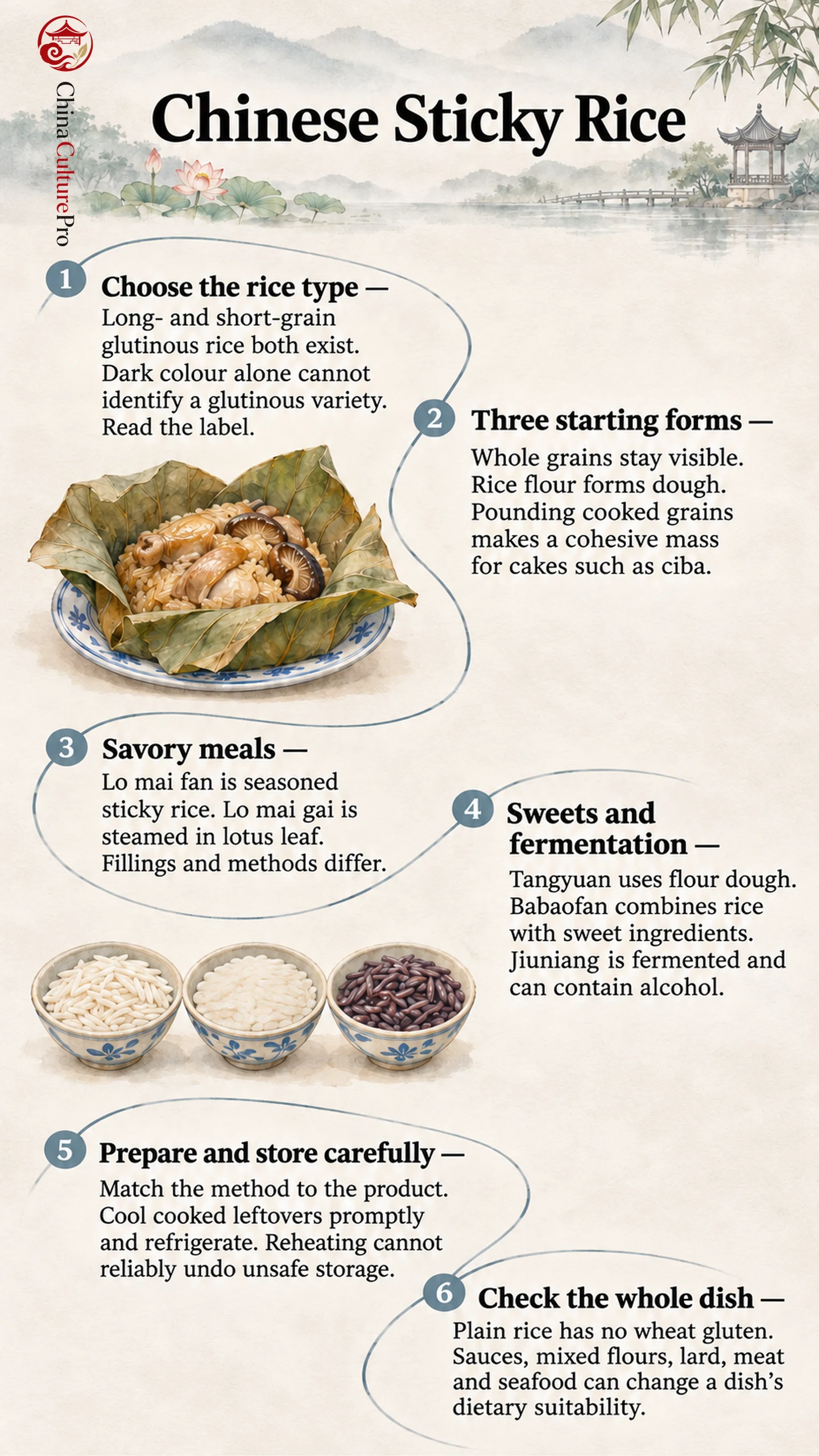
Unwrap a leaf parcel and sticky rice may hold its shape around a savory filling. In a dessert bowl, rice flour becomes smooth, chewy balls with no visible grains. Across Chinese rice dishes, recognizing the ingredient’s form explains more than simply calling everything “sticky.”
Long-Grain, Short-Grain and Dark Sticky Rice
Glutinous rice includes indica-type xiannuo(籼糯,xiānnuò)and japonica-type jingnuo(粳糯,jīngnuò). The former generally has longer, slender grains; the latter is typically shorter and rounder. Uncooked polished glutinous rice often looks opaque or milky white.[2]
Grain shape helps identify a product, but it cannot establish the rice’s type by itself. Ordinary short-grain rice can cling together after cooking without being a glutinous variety. Look for “glutinous,” “sticky” or “sweet rice” on the label.
| Product description | Useful distinction when choosing rice |
|---|---|
| Long-grain white glutinous rice | Often chosen for savory steamed rice and leaf parcels; it still belongs to the sticky-rice family |
| Short-grain white glutinous rice | Often used for cohesive cakes and flour-based sweets; it can also enter savory preparations |
| Dark glutinous rice | A pigmented glutinous variety; dark colour alone does not identify its starch type |
These sweet and savory uses are tendencies; either grain form can serve other preparations.[3] For dark rice, check the actual description: purple glutinous rice and non-glutinous black rice can be different products. Neither “black rice” nor “purple rice” is a sufficient substitute for reading the ingredient label.[4]
Whole Grains, Flour and Pounded Rice
Three forms produce three different eating experiences. Cooked whole grains retain visible kernels, even when they cling together in a bundle or bowl. Milling the uncooked rice into flour removes that grain structure; adding liquid then creates a dough for shaped sweets. Pounding cooked grains makes another kind of cohesive mass.
Tangyuan(汤圆,tāngyuán)are shaped from glutinous-rice-flour dough, sometimes enclosing a filling. Yuanxiao(元宵,yuánxiāo)are commonly formed by repeatedly rolling moistened filling in flour. Their similar round appearance conceals different forming methods; the tangyuan and yuanxiao comparison explains those distinctions.[5]
Ciba(糍粑,cíbā)illustrates the third route. In Ningguo’s documented tradition, cooked glutinous rice is pounded before being shaped into cakes.[6] A cake made this way and one made from flour may both be chewy, but their starting materials and processing are different. The broader Chinese rice-cake family also includes products with other rice types or flour blends.
Savory Meals and Sweet Festival Dishes
Sticky rice carries savory seasonings as well as sweet fillings. These familiar examples show different formats rather than a single national recipe:
- Seasoned rice: Lo mai fan(糯米饭,nuòmǐfàn)is a Cantonese menu name for savory sticky rice. Versions combine it with ingredients such as cured pork, Chinese sausage, mushrooms and dried shrimp; some blend glutinous and ordinary rice. Methods vary: some versions cook the rice before finishing it with the other ingredients in a wok.[7]
- Lotus-leaf parcels: Lo mai gai(糯米鸡,nuòmǐjī)combines sticky rice with chicken and other fillings, steamed in a lotus leaf. The leaf contributes aroma and serves as a wrapper.[8]
- Wrapped rice and breakfast rolls: Zongzi(粽子,zòngzi)are leaf-wrapped rice parcels with regional sweet and savory variations. Cifantuan(粢饭团,cīfàntuán)are rice rolls; a familiar Jiangnan combination wraps cooked rice around a fried dough stick, with sweet or savory additions.[9]
- Festive sweets: Babaofan(八宝饭,bābǎofàn), eight-treasure rice, brings together glutinous rice and ingredients such as red-bean paste, dates, lotus seeds or dried fruit.[10]
Jiuniang(酒酿,jiǔniàng)takes a separate route through fermentation. This sweet fermented rice product can contain alcohol; a sweet taste does not establish an alcohol-free ingredient.[11] Its transformation is distinct from simply steaming or seasoning rice.
The dish names lo mai fan and lo mai gai reflect Cantonese usage; the tone-marked pinyin above gives their Mandarin readings.
Choosing, Preparing and Storing Sticky Rice
Start with the intended dish and the product’s actual form. A bag of whole glutinous rice cannot be added directly where a recipe requires flour. Ordinary rice flour and glutinous rice flour also behave differently, so matching the word “rice” is insufficient.
For whole-grain preparations, washing, hydration and cooking method work together. Some methods soak rice before steaming; others cook it with controlled liquid or combine steaming and wok finishing. Variety, equipment and the finished dish all affect the necessary water and cooking process.[1] Follow a method written for that product instead of applying one universal rice-cooker ratio.
Cooked sticky rice needs the same care as other cooked rice. Bacterial spores can survive cooking, and prolonged room-temperature storage can allow growth and toxin production. Cool leftovers promptly in smaller, shallow portions and refrigerate; reheating cannot reliably undo unsafe storage.[12] For packaged parcels or frozen cakes, follow the product’s storage and preparation instructions, distinguishing uncooked products from ready-cooked ones.
Pemeriksaan bahan dan pola makan
“Glutinous” refers to the rice’s sticky quality, not wheat gluten. Plain rice is naturally gluten-free, but a finished dish may contain wheat-based soy sauce, mixed flours or ingredients exposed to gluten through shared processing.[13] Check the entire preparation rather than relying on the rice’s name.
Likewise, plain rice is a plant ingredient while a sweet rice dish may use lard. Savory versions can include sausage, chicken, dried shrimp or meat stock. Bean pastes and toppings may introduce sesame, peanuts or other allergens. For vegetarian food choices, ask about cooking fat, stock, fillings and sauces together; removing visible meat leaves those other ingredients unresolved.
FAQs About Chinese Sticky Rice
Is glutinous rice gluten-free?
Plain glutinous rice contains no wheat gluten. Check sauces, added ingredients and cross-contact for the finished dish.
Is sticky rice the same as sushi rice?
No. Ordinary short-grain rice used for sushi is not automatically a glutinous variety, despite its clinging texture.
Does sweet rice contain added sugar?
“Sweet rice” can simply name the raw grain. Added sugar depends on the product or dish.
Can regular rice replace glutinous rice?
It changes the texture and binding. A dish may need a different method, especially when it relies on a cohesive rice cake or parcel.
Sumber
[1] International Rice Research Institute. A consumer’s guide to rice
[2] National Food and Strategic Reserves Administration. Rice classification
[3] Agriculture and Food Agency, Taiwan. Rice types and cooking characteristics
[4] Ministry of Agriculture, Taiwan. Glutinous-rice forms in traditional foods
[5] Ministry of Agriculture, Taiwan. Distinguishing yuanxiao and tangyuan
[6] Ningguo Municipal Government. Hand-pounded ciba craft
[7] Made With Lau. Lo Mai Fan
[8] Hong Kong Tourism Board. Dim sum dishes: lo mai gai
[9] Nanjing Local Chronicles Office. Glutinous-rice foods in Nanjing
[10] Ministry of Education, Taiwan. Babaofan dictionary entry
[11] Shenzhen Administration for Market Regulation. Rice-wine consumer information
[12] Centre for Food Safety, Hong Kong. Bacillus cereus in fried rice
[13] US Food and Drug Administration. Questions and answers on gluten-free food labeling