


Quick Answer: What Are Taiwanese Pineapple Cakes?
Taiwanese pineapple cakes, fengli su(鳳梨酥,fènglí sū), are small filled pastries, usually with a crumbly crust around dense fruit filling. They are not miniature slices of sponge cake.
- Outside: a short, tender pastry commonly made with wheat flour and fat, often butter.
- Inside: a cooked filling that may combine pineapple with winter melon or emphasize pineapple fruit alone.
- Setting: a familiar Taiwan gift, souvenir and sweet to eat with tea.
The name identifies a pastry family rather than one fixed fruit ratio, shape or dietary formulation. Check both crust and filling when choosing a box. [1][2]
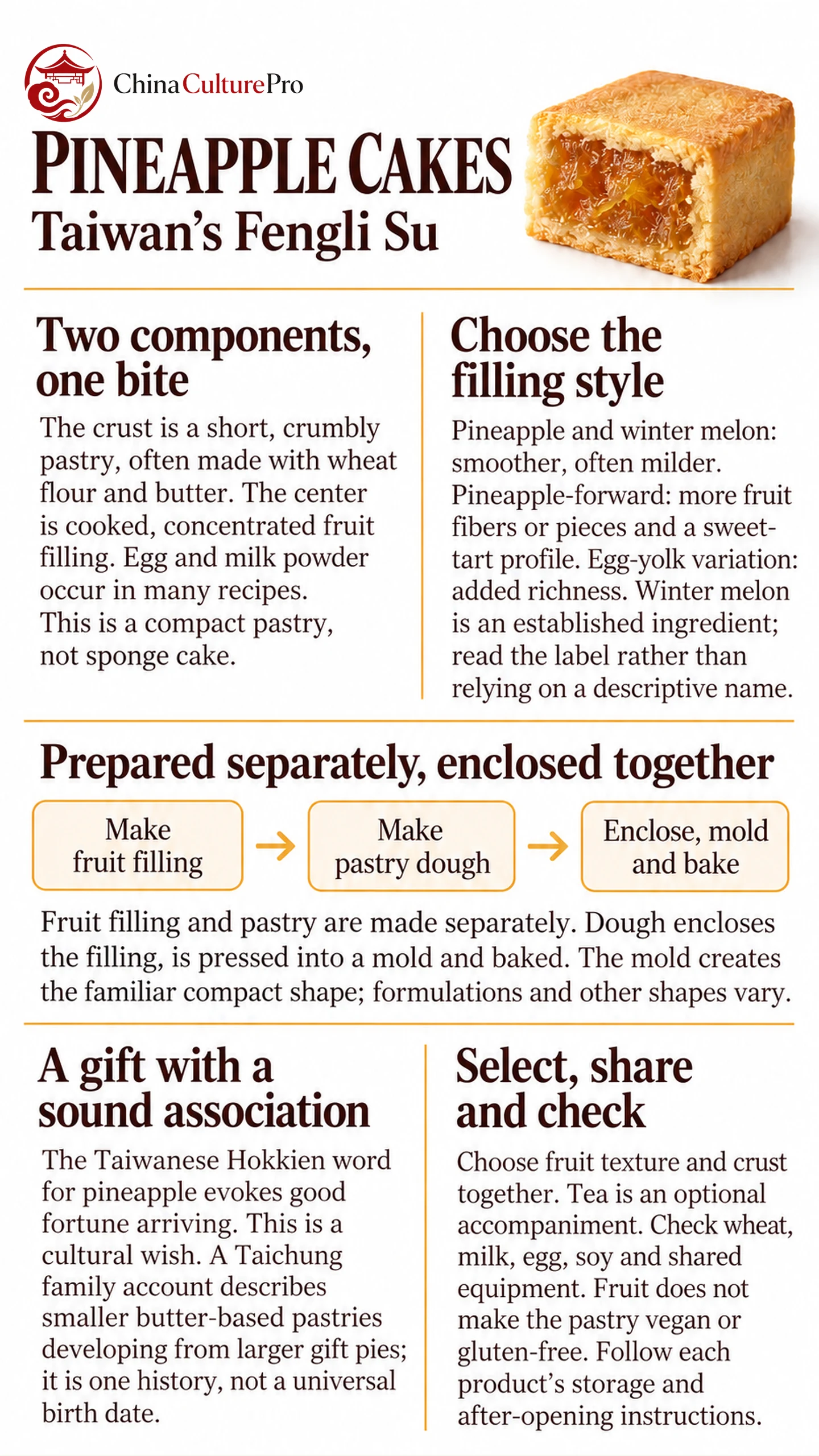
A small golden rectangle breaks into buttery crumbs around a dense amber center. Another version may have a smoother, paler filling and a gentler fruit flavor. These differences are part of the story of pineapple cakes within Taiwanese food culture, where bakery craft and gift giving meet.
Crumbly Pastry Around a Dense Fruit Filling
The outer pastry and inner filling perform different jobs. The crust holds a compact shape yet breaks easily when bitten. Wheat flour supplies structure, while butter or other fat contributes a short, crumbly texture. Egg and milk powder appear in many formulations, adding ingredients that cannot be identified from the fruit name alone.
The center is a cooked, concentrated filling rather than a slice of raw pineapple. In a pineapple-forward version, fruit pieces or fibers can remain noticeable, contrasting with the finer pastry. A smooth filling provides another experience: less resistance in the center and a more uniform bite. These are differences to choose between, not a simple quality ladder.
The whole bite depends on both components: a rich crust and a tart center create a different balance from a firmer pastry and a smoother blend. [2]
Pineapple and Winter Melon Filling Styles
Winter melon is a long-established ingredient in pineapple-cake fillings. It can contribute a smoother texture and soften the impression of coarse, tart pineapple. A producer’s published pineapple-and-winter-melon blend is one concrete example of this style. Its presence is not, by itself, evidence that a pastry is counterfeit. [3]
Other products emphasize pineapple pulp, sometimes with dried pineapple pieces, and list no winter melon in their filling. This produces a different fruit texture rather than a universal promise of extreme sourness. Pineapple variety, sugar and the rest of the formulation also matter. [4]
| Filling style | Typical character | Yang perlu diperiksa |
|---|---|---|
| Pineapple and winter melon blend | Smoother, often milder fruit impression | The actual ingredient list and the balance you enjoy. |
| Pineapple-forward filling | More noticeable fruit fibers or pieces, with a sweet-tart profile | Whether winter melon is listed; a descriptive product name is not the whole specification. |
| Egg-yolk variation | Egg adds richness alongside the sweet fruit filling | Whether the yolk is part of the filling and how the bakery describes the version. |
The term tu fengli su(土鳳梨酥,tǔ fènglí sū)is often used for a local-pineapple, fruit-forward style. Read the ingredients rather than treating those words as a substitute for the label. Modern bakeries also vary the pastry’s milk or egg flavor and add other fillings. [5]
How Fengli Su Are Shaped and Baked
The fruit is cooked into a filling with enough body to be enclosed. Separately, the baker prepares the pastry dough. A portion of dough is wrapped around the filling, closed and pressed into a mold; baking sets the pastry and gives it color. The familiar square or rectangle comes from this shaping process, not from cutting a large sponge cake into portions.
These stages explain several visible features. A well-enclosed filling stays inside its pastry jacket. A mold helps create straight sides and a compact form. The crust can crumble while the fruit center remains cohesive. Different shapes and pastry treatments can still belong to the same broad category. [6]
This is an explanation of bakery technique rather than a complete home recipe. A fruit filling’s moisture and the dough’s formulation affect handling; changing either component requires more than copying the appearance of a finished pastry.
A Taiwan Gift with an Auspicious Name
In Taiwanese Hokkien, the word for pineapple sounds like an expression associated with good fortune arriving. That sound association helps explain the fruit’s auspicious role and the appeal of pineapple pastries as gifts. It is a cultural wish, not an effect the food can produce. The pronunciation connection belongs to Hokkien, rather than the Mandarin reading supplied for fengli su.
A documented Taichung bakery-family account describes a change from a large pineapple-filled gift pie to a smaller square pastry with a butter-based crust. It also explains the preference for a smooth pineapple-and-winter-melon filling. Later interest in more fibrous, tart pineapple fillings shows that tastes continue to change. That family account documents one line of development rather than a universal invention date. [5]
Pineapple cakes fit into the broader practice of Chinese gift giving: a boxed sweet can be offered to hosts, relatives or colleagues. They are also everyday pastries, so enjoying one with tea does not require a festival or ceremony.
Choosing, Serving and Storing Pineapple Cakes
Choose the filling profile first: smooth and mellow, visibly fibrous, or enriched with egg yolk or another addition. Then consider the crust. A very crumbly pastry and a firmer biscuit-like version may suit different preferences. Ask what fruit and pastry ingredients create the flavor and texture you prefer.
Tea provides a simple accompaniment. A small serving allows the fruit filling and pastry to be tasted together; an oolong from Taiwan’s high-mountain tea traditions offers one related direction to explore. The tea choice is a preference, not a required pairing rule.
Read the full label for wheat, butter, egg, milk powder and any ingredients in the filling. One published product list contains both pineapple jam and pineapple-winter-melon jam within the same pastry. Its storage instructions specify a cool, dry place, illustrating why the actual package matters more than a blanket refrigeration rule. [2]
For allergies, check milk, egg, wheat and soy where relevant, including shared equipment. [7] Fruit filling does not make a wheat-and-butter pastry vegan or gluten-free. Follow the product’s storage and after-opening instructions; do not apply one bakery’s shelf life to every gift box.
FAQs About Pineapple Cakes
Do pineapple cakes contain winter melon?
Many do, while other fillings emphasize pineapple alone. A winter melon blend is an established style; check ingredients to find the version you want.
Are pineapple cakes the same as pineapple buns?
No. Fengli su are compact filled pastries. A pineapple bun is a bread product with a different structure and does not identify the same sweet.
Are pineapple cakes vegan or gluten-free?
Usually they require special adaptations. Common versions contain wheat, butter, egg or milk; verify the complete ingredients rather than assuming fruit means plant-only.
Do pineapple cakes need refrigeration?
Storage varies by product and whether it has been opened. Follow the package or bakery instructions instead of assuming all versions require the same conditions.
Sumber
[1] Taiwan Tourism Administration. Souvenirs
[2] Sunmerry. Bite-Size Pineapple Cake
[3] Hurng Fur Foods, Taipei International Food Show. Pineapple Cake
[4] Sunnygogo. Pineapple Cake Product Ingredients
[5] Cathy Teng, Taiwan Panorama. Soothing Taiwan’s Sweet Tooth
[6] Taiwan Ministry of Agriculture knowledge portal. Pineapple Cake Making Experience
[7] U.S. FDA. Food Allergies: What You Need to Know (Alergi makanan: hal yang perlu diketahui)