

Quick Answer: What Are Fuling Cakes?
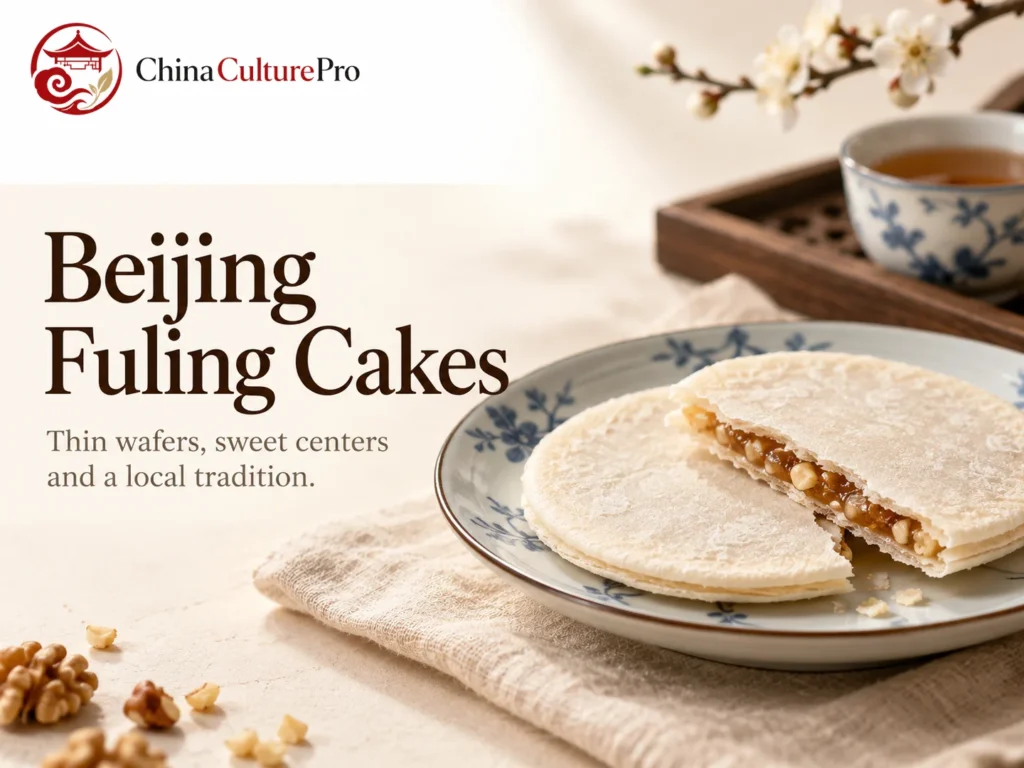
Beijing’s fuling cakes, fuling jiabing(茯苓夹饼,fúlíng jiābǐng), are thin sandwich-like sweets with pale wafers enclosing a sweet filling. English descriptions also call them tuckahoe pies.
- Shell: Very thin, light-colored wafers rather than a thick cake crumb.
- Center: A sweet mixture that can include honey, sugar, nuts or other additions.
- Identity: A Beijing specialty associated with poria, the fungal ingredient behind its name.
The name does not establish a fixed recipe or quantity of poria. These wafers also differ from thicker rice cakes sold under similar English names. Read the actual product description rather than expecting every “fuling cake” to have the same structure.

Two pale wafers enclose a narrow layer of sweet filling, making a snack that looks almost paper-thin beside a conventional pastry. Fuling cakes belong to Beijing’s food traditions, where packaged sweets can serve as small refreshments or gifts. Their shell, center and named ingredient each deserve separate attention.
Thin Wafers and a Sweet Center
The familiar Beijing form uses a delicate outer skin, often described as paper-thin. Its pale appearance contrasts with the filling, which supplies much of the sweetness and added flavor. Honey, sugar and nut kernels occur in traditional descriptions; the center need not be a smooth cream.[1]
That contrast is the useful guide to eating it. A light wafer gives way to a more substantial sweet layer, sometimes with small pieces of nuts. The shell is not intended to resemble the multiple flakes of a laminated pastry, nor the elastic body of a glutinous rice cake.
A flavor label may describe only the center. A nutty version, floral version or another named variation can use a similar wafer structure while changing the middle. Check both parts if you are comparing products: the same pale surface can hide different ingredients.
Fuling: The Ingredient Behind the Name
Fuling(茯苓,fúlíng), often called poria in English, is fungal material. More precisely, the familiar hard mass is a sclerotium: a compact structure formed from fungal threads. It is not a tree root, a nut or the cap of an ordinary culinary mushroom.[2]
The ingredient can be processed into powder for food preparations. Its name appears on more than one kind of sweet, so the presence of the word “fuling” does not tell you whether you are buying a thin wafer or a thicker steamed cake.[2]
In a finished wafer snack, flour or starch still forms the shell, and sweeteners and other ingredients form the center. Poria does not replace all of those components. The cake should be understood through its complete ingredient list, without assigning a health benefit simply because the named ingredient also appears in traditional medicine.
How the Filled Wafers Are Made
A documented preparation combines processed fuling with flour, starch and water to make a thin batter. A small amount is spread and cooked into a wafer. A sweet nut mixture is placed between two thin layers, producing the filled form rather than a single unfilled pancake.[3]
Another account describes batter set in a heated metal wafer mold. The cooked sheets are paired around a filling that can include pine nuts, walnuts, honey, sugar and osmanthus. Current products may change the filling while retaining the paired-wafer form.[4]
The sequence separates shell-making from filling. Thin sheets provide the structure; the center contributes sweetness, aroma and texture. This helps explain why the cake can be visually delicate without being an airy baked sponge.
Modern products can vary in shape, filling and packaging. A named flavor or a differently sized piece does not by itself indicate a different basic category, but the product should still show the thin filled-wafer structure described on the pack.
Beijing Snack Culture and Related Cakes
Fuling wafers have a place among Beijing specialty gifts and tea-table sweets. Their association with packaged local snacks links them naturally with Chinese preserved fruit. Gift boxes can contain different producer-specific recipes.[1][4]
The English word “cake” can obscure useful distinctions. Fuling gao(茯苓糕,fúlíng gāo)may describe a thicker rice-flour preparation. A wife cake instead uses layered wheat pastry around a sweet winter melon center. Similar translations do not make these foods interchangeable.[2][5]
| Makanan | Typical structure | Perbedaan utama |
|---|---|---|
| Beijing fuling jiabing | Thin wafers enclosing sweet filling | A delicate sandwich-like snack |
| Fuling gao | A thicker rice-flour cake preparation | A different body and cooking method |
| Wife cake | Flaky wheat pastry around sweet filling | Layered pastry rather than paired wafers |
For a wider comparison, explore Chinese rice cakes. The product’s physical structure is usually more informative than the English word “cake” alone.
Choosing, Serving and Ingredient Checks
Handle a wafer gently and use a small plate for broken pieces. It can accompany tea or form part of a selection of Chinese desserts. Choose by the actual filling rather than assuming that all versions taste primarily of the named poria ingredient.
Check flour and starch separately. Some preparations include wheat flour, so a white wafer or a starch-based description cannot establish gluten-free suitability. Nut kernels, sesame or other flavor additions may also matter for allergies. Confirm ingredients and shared-equipment practices for the specific product.[6]
Honey is an animal-derived ingredient for vegan checking, even when no egg or dairy is visible. Other recipes may use different sweeteners or additional ingredients. An apparently simple wafer still needs a whole-product assessment.
Keep packaged cakes under the conditions printed on their label and close the pack as directed after opening. Do not infer a universal shelf life from the thin shell, and do not use its white color as proof of ingredient purity or safety.
FAQs About Fuling Cakes
Are fuling cakes made entirely from mushrooms?
No. The familiar wafers combine a flour or starch shell with sweet filling. Poria is the named fungal ingredient, not the entire cake.
Are fuling cakes the same as fuling gao?
Not necessarily. Beijing’s filled wafers and thicker rice-flour cakes can share an ingredient name while having different structures.
Are fuling cakes gluten-free?
Do not assume so. Wheat flour can occur in the shell, and other ingredients and cross-contact information also need checking.
Are fuling cakes vegan?
Some formulations may suit a vegan diet, but honey and other additions must be checked. The pale wafer alone does not establish suitability.
Sumber
[1] Beijing Tourism. Beijing Local Products
[2] Alden Dirks, Fungi. Famous Fuling
[3] Beijing University of Chinese Medicine Museum. Fuling: Fungal Ingredient and Food Preparations
[4] Beijing Hongluo Foods. Fuling Wafer Making Tradition
[5] Judy Leung. Wife Cake
[6] U.S. Food and Drug Administration. Food Allergies: What You Need to Know (Alergi makanan: hal yang perlu diketahui)