
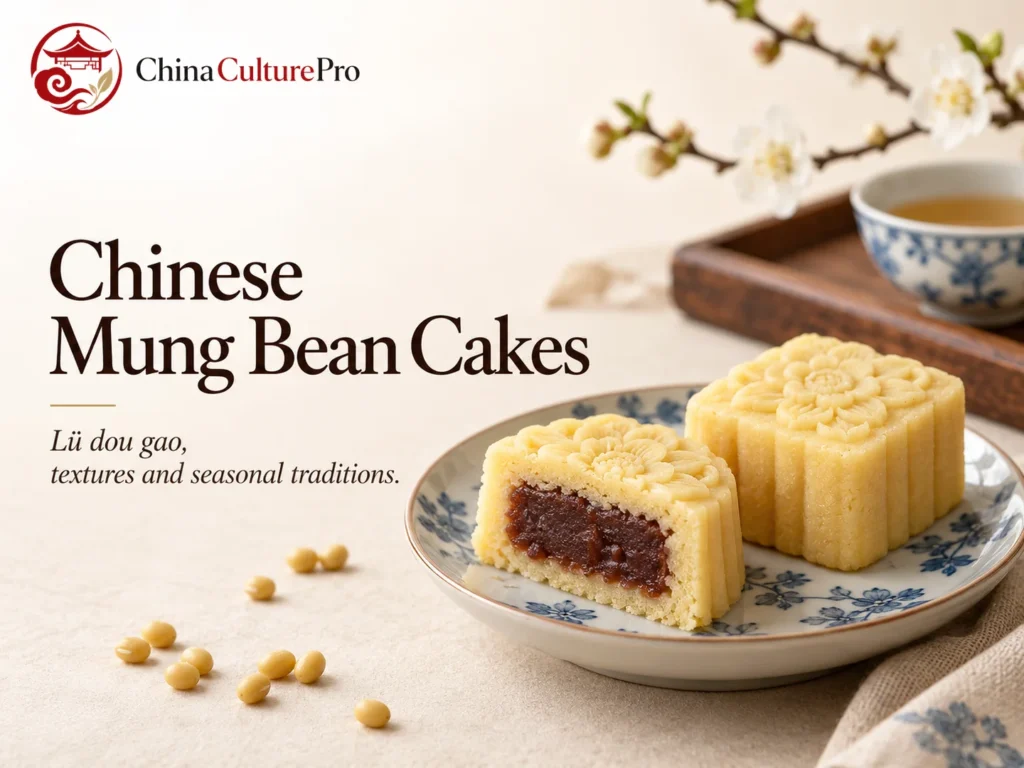

Quick Answer: What Are Mung Bean Cakes?
Chinese mung bean cakes, lü dou gao(绿豆糕,lǜdòu gāo), are sweet cakes whose body is made from prepared mung beans or mung bean flour.
- Texture: From relatively dry and crumbly to soft, smooth and rich, depending on the formula.
- Shape: Often pressed into decorative molds, with or without a separate filling.
- Occasion: A tea sweet and seasonal gift, associated with the Dragon Boat Festival in several regional traditions.
They are not necessarily green, made from rice or wrapped in wheat pastry. “Mung bean cake” can also be used loosely for other pastries, so the physical structure matters. The bean mixture, added fat and any center should be considered separately.
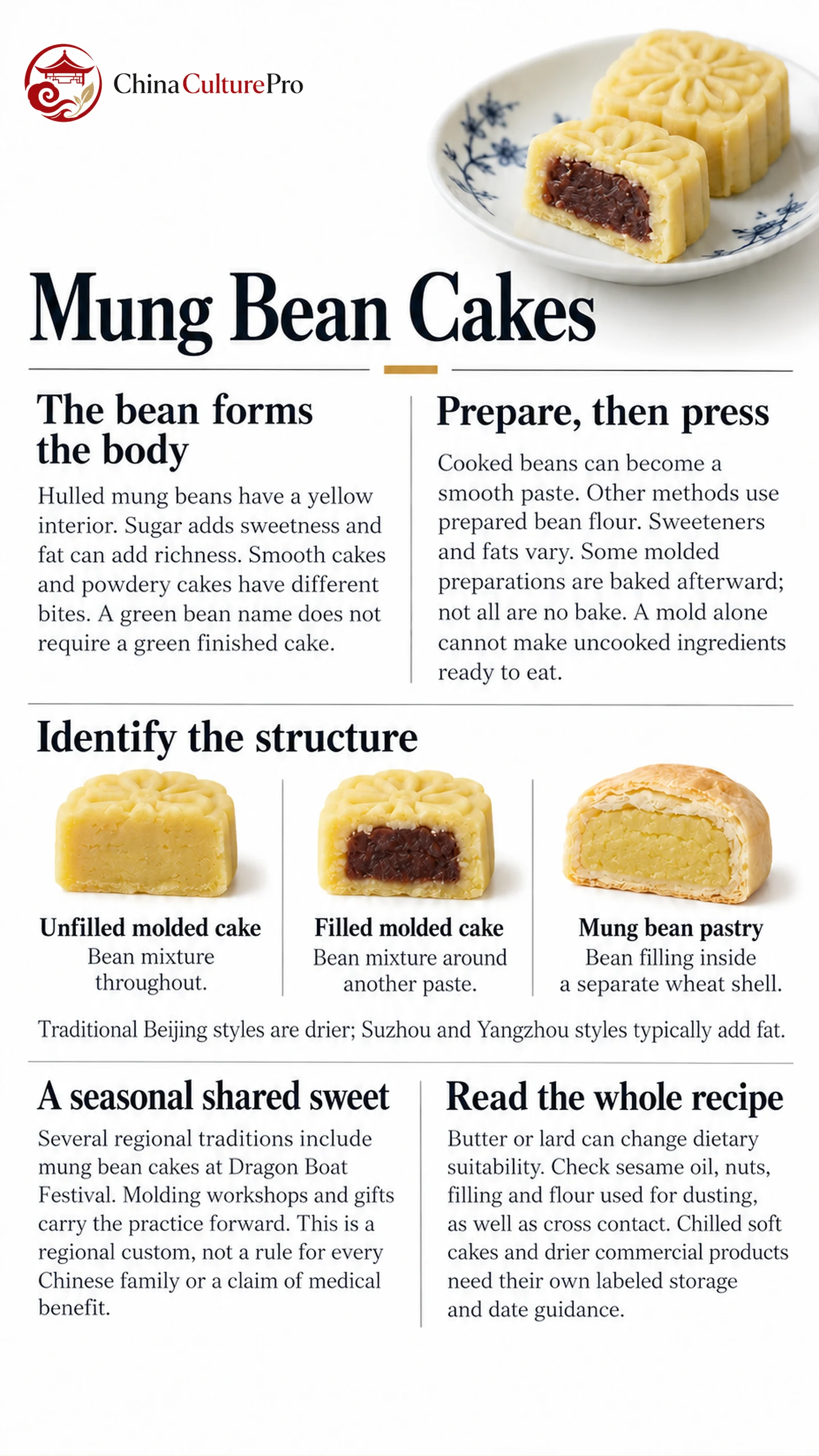
A pale yellow cake carries a flower pattern, and its cut edge may reveal either more bean mixture or a dark red bean center. The soft bite differs from a crisp cookie or chewy rice sweet. Understanding those distinctions places mung bean cakes more clearly within traditional Chinese desserts.
Beans, Sugar and Distinct Textures
The word “green” in the Chinese name refers to mung beans, not a requirement for green food coloring. Hulled split mung beans have a yellow interior, which helps explain the pale yellow appearance of many smooth modern cakes. The finished color also reflects the recipe and any added ingredients.[1]
Beans provide the main body and familiar bean aroma. Sugar sweetens that body, while fat can make it richer and easier to work. Butter and coconut oil occur together in one preparation, while other versions use different fats. These choices help explain why two molded cakes can look alike but feel different in the mouth.[1]
A smooth cake can be tender without being sticky like a glutinous rice cake. A more powdery version breaks into finer crumbs rather than stretching. Neither texture is established by the flower pattern on top: the mold gives a shape, while the underlying mixture determines the bite.
From Cooked Beans or Flour to Molded Cakes
One route begins with cooked beans made into a paste. Sweetener and fat are incorporated until the mixture can be shaped. A portion may enclose red bean paste before being pressed into a mold. Some preparations then bake the molded cakes, showing why “all mung bean cakes are no-bake” is too broad.[2]
Another tradition works with prepared mung bean flour. A Huizhou method combines prepared ground beans with sweeteners and sesame oil before firmly pressing the mixture into molds. This produces a different process from blending whole cooked beans into a smooth paste.[3]
The meaningful sequence is preparation of the bean material, adjustment of the mixture and shaping. A decorative press does not make uncooked beans or raw flour ready to eat. Equally, the presence of a mold does not mean that every version requires the same cooking after shaping.
For a filled cake, the outer bean mixture and center must each hold their form. In an unfilled version, the prepared bean mixture supplies the entire piece. Both arrangements can show the same decorative surface, so the pattern is not a filling guide.
Styles, Fillings and Similar Names
A traditional regional distinction describes Beijing-style cakes as relatively dry and made without added fat, while Suzhou and Yangzhou styles incorporate fat for a more delicate, rich texture. This is a useful description of styles rather than a promise about every modern product sold under those city names.[4]
A separate issue is whether mung bean forms the cake’s body or merely its filling. Mung bean paste can sit inside layered wheat pastry too, including versions of Suzhou mooncakes. Those pastries have an additional shell and a different bite.[5]
| Bentuk | Where the mung bean appears | Gambaran rasa dan tekstur |
|---|---|---|
| Unfilled molded cake | Throughout the shaped bean mixture | A consistent bean texture from outside to center |
| Filled molded cake | Around a separate sweet center | Bean mixture outside, often contrasting paste within |
| Mung-bean-filled pastry | Inside a distinct pastry shell | A separate wheat-based crust around bean filling |
Red bean is one possible center, not a mandatory ingredient. Its darker color can make the cross-section especially clear. The related red bean dessert guide explains that filling family, while Chinese rice cakes cover another set of starch-based textures.
Dragon Boat Festival and Seasonal Gifting
Mung bean cakes appear among regional Dragon Boat Festival foods alongside better-known rice dumplings. Their seasonal importance is visible in practical activities as well as shop counters. A 2024 community event in Guangde taught children to loosen the prepared bean mixture, press it into molds and take the finished cakes home to share.[6]
That kind of activity makes the pattern and handwork part of the food’s cultural role. A molded sweet can be both a snack and something made for another person. No single shape or printed character is required for that sharing function.
The association is regional rather than a nationwide rule that every family must eat mung bean cake on the same day. Modern home cooks may also include the cakes in other festive spreads. Their place in Dragon Boat food culture reflects seasonal custom and shared preparation.
Serving and Dietary Checks
A small plate helps with fragile or crumbly cakes. Choose a plain cake to focus on the bean mixture, or a filled version for a contrasting center. Some soft preparations are served chilled, while others are intended for a different texture; follow the maker’s directions for that particular sweet.
Check the fat rather than assuming beans mean vegan. Butter introduces dairy, and traditional formulas may use lard. Sesame oil, nuts or a separate filling can add ingredients that are not obvious from the cake’s pale appearance.[2][7]
Mung beans themselves do not establish gluten-free suitability for the whole product. Some preparations use flour for dusting, and wheat-based shells belong to a different pastry structure altogether. Read the complete ingredient list and ask about cross-contact when needed.[7]
For packaged cakes, use the stated storage conditions and date marking. A soft freshly prepared cake and a drier commercial version should not be assigned one universal shelf life. A neat molded pattern is a presentation feature, not evidence that the food can be left out indefinitely.
FAQs About Mung Bean Cakes
Why are mung bean cakes yellow rather than green?
Many use hulled split mung beans, whose interior is yellow. The word “green” in the Chinese name does not require a green finished cake.
Are mung bean cakes the same as mooncakes?
No. Some are shaped with similar presses, but a molded bean cake differs from a pastry shell enclosing a mooncake filling.
Do mung bean cakes need a filling?
No. They can be made entirely from the prepared bean mixture, or enclose a separate center such as red bean paste.
Are mung bean cakes vegan or gluten-free?
Not automatically. Check added fat, flour, dusting, filling and cross-contact information for the complete product.
Sumber
[1] Lisa Lin. Mung Bean Cakes
[2] Ellen L. Mung Bean Cakes
[3] China.org.cn. Traditional Huizhou Mung Bean Cake Making
[4] Hunan Market Regulation Administration. Dragon Boat Food Consumer Guidance
[5] Michelle, Sift & Simmer. Suzhou-Style Mooncakes
[6] Guangde Municipal Government. Dragon Boat Mung Bean Cake Workshop
[7] U.S. Food and Drug Administration. Food Allergies: What You Need to Know (Alergi makanan: hal yang perlu diketahui)