

Quick Answer: What Is Dragon’s Beard Candy?
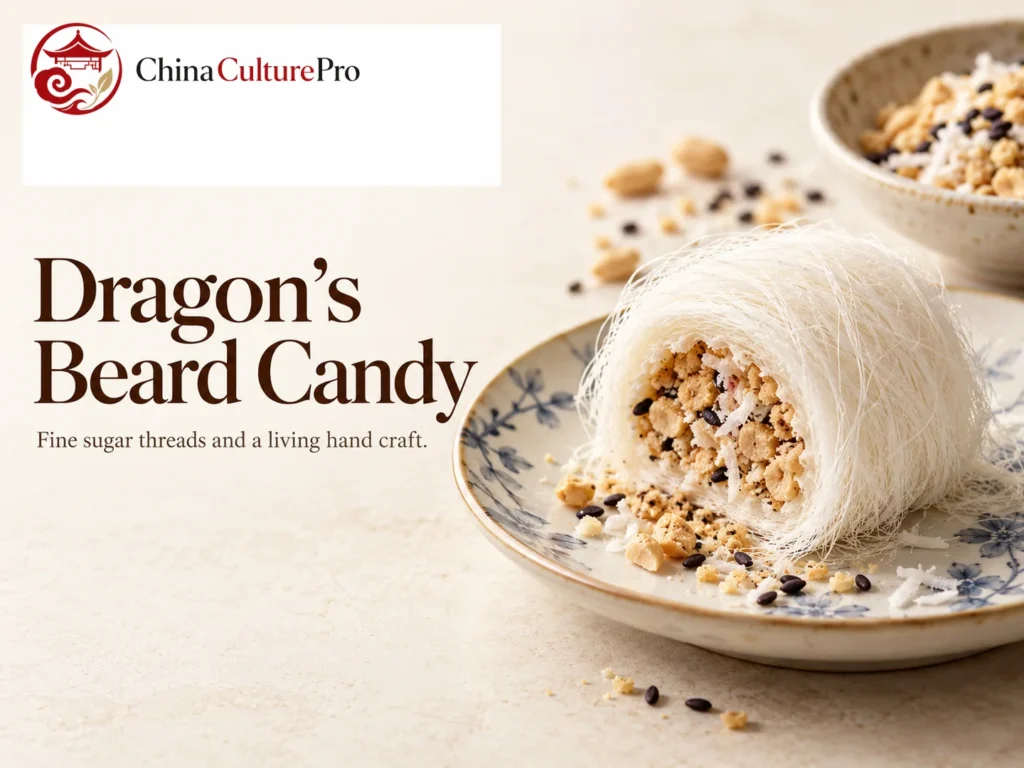
Dragon’s beard candy, longxutang(龙须糖,lóngxūtáng), is a Chinese confection made from fine sugar strands wrapped around a filling.
- Outside: Delicate, pale threads made by repeatedly pulling and folding pliable sugar.
- Inside: A commonly nutty, crunchy mixture, often including peanuts, sesame and coconut.
- Craft: A hand skill in which texture, temperature and moisture affect the result.
The name describes the wispy appearance of the sugar, not an animal ingredient. Although sometimes called Chinese cotton candy, its familiar filled form is a compact bundle of pulled strands rather than a large cloud on a stick.
A small white cocoon conceals a crunchy center. On the first bite, fine threads break apart and dissolve, while the filling supplies roasted flavors and a firmer texture. Among traditional Chinese sweets, dragon’s beard candy stands out because the transformation from sugar ring to delicate fibers is part of its appeal.
Sugar Threads, Dusting and Crunchy Filling
The outer strands and inner filling create different sensations. Fresh fine threads can feel fluffy and fragile before turning sticky in the mouth. Peanuts and sesame bring a roasted crunch that remains after the light sugar layer has begun to dissolve. Coconut may add another texture, while newer fillings include chocolate or other flavors.[1]
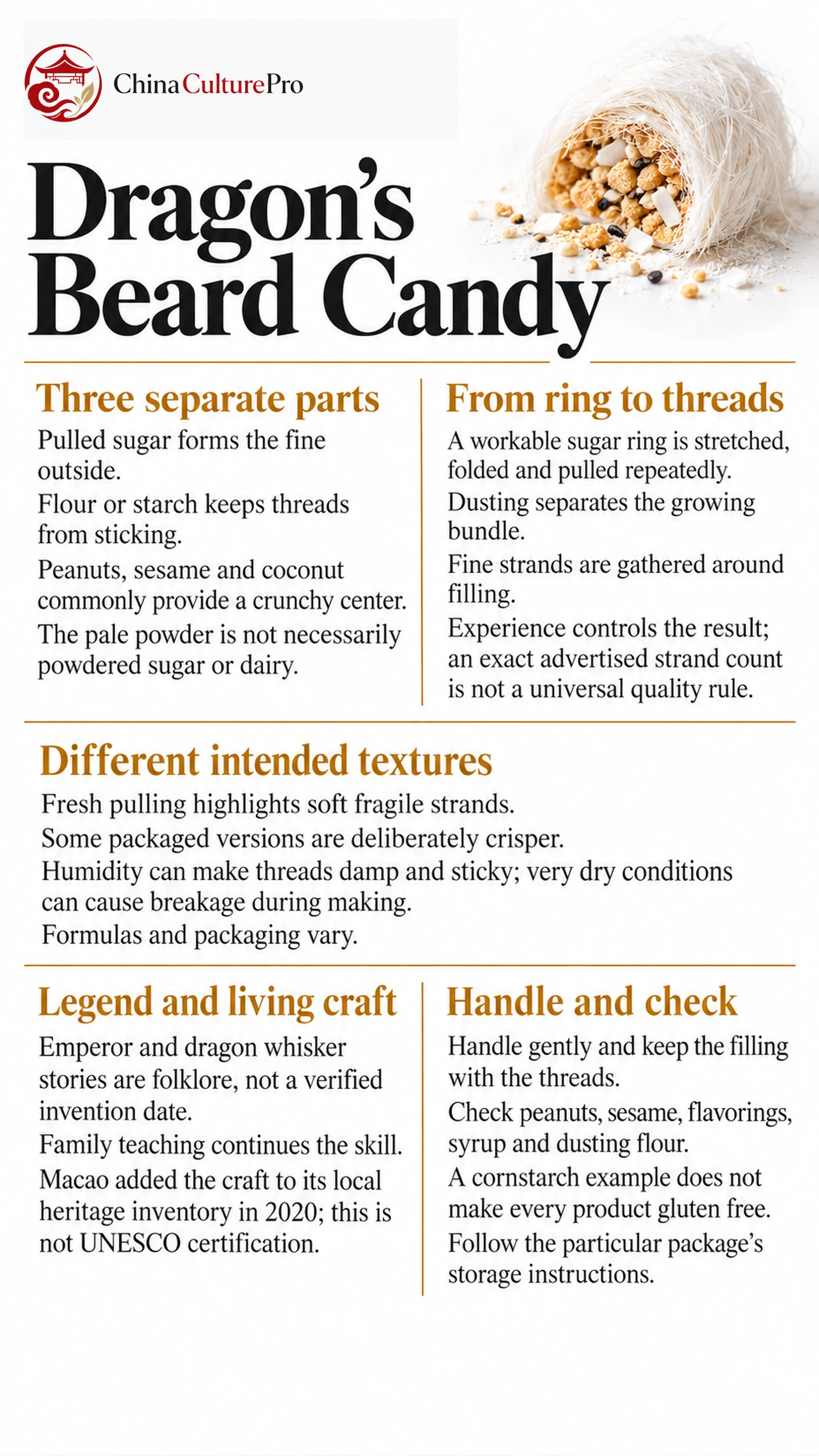
A typical ingredient list includes sugar or malt syrup, a dusting flour or starch, and the filling. These ingredients have separate jobs. The pale powder is not necessarily powdered sugar, and the white appearance does not indicate dairy. One documented workshop preparation uses glutinous rice flour alongside sugar, malt syrup, peanuts, sesame and coconut.[2]
| Bagian | Main role | Yang perlu diperiksa |
|---|---|---|
| Pulled sugar | Forms the fine outer threads | Syrup formulation and added flavorings |
| Dusting flour or starch | Helps keep the strands from sticking together | Exact flour or starch used |
| Isian | Adds crunch, aroma and flavor contrast | Peanuts, sesame, coconut or other additions |
Cornstarch and corn or glucose syrup also occur in contemporary preparations. The dusting material can therefore vary without changing the basic pulling principle.[3]
How a Sugar Ring Becomes Fine Strands
The process begins with a cooked sugar mixture brought to a workable state. A hole in the center turns it into a ring. The maker stretches the ring, twists or folds it back on itself, and continues pulling. Each repetition divides the bundle into increasingly fine parallel strands.[3]
Dusting helps prevent the filaments from merging into one sticky mass. The difficulty lies in maintaining a workable texture while handling the growing bundle evenly. Too much force can break the strands; an unsuitable sugar consistency makes them difficult to separate. The final fibers are gathered around a portion of filling and shaped into a small sweet.[1][3]
Large strand counts often feature in demonstrations. Repeated doubling explains how a ring can become many threads, but an exact advertised number is not a universal quality standard. The meaningful result is a fine, separable bundle that can enclose the center.
Watching the process makes the craft easier to appreciate. It requires judgment in the hands as well as a recipe: family accounts describe years of practice and knowledge passed between generations. The same broad pulling principle can produce noticeably different textures as makers adjust their methods.[4]
Freshly Made and Packaged Styles
A street demonstration emphasizes the immediate transformation, with the candy assembled in front of the customer. Packaged versions make the confection portable and suitable for gift boxes, but their formulas and production conditions may differ from the freshly pulled sweet.[1][4]
Some makers have developed a crisper version or introduced new fillings. A crunchy packaged piece and a soft, freshly pulled bundle therefore should not be judged as though they were identical products. Ask what texture the maker intends, then assess the actual candy rather than assuming that one mouthfeel defines every version.
Moisture is especially important. Humid conditions can make the threads damp and sticky, while excessively dry conditions can encourage breakage during production. Controlled indoor conditions and packaging help makers manage those changes. They do not justify assigning one shelf life or storage method to every dragon’s beard candy.[1][5]
Naming Legends and Documented Craft Traditions
Imperial stories often explain the name: a ruler sees the fine strands as a dragon’s whiskers, or sugar clings to his face like a beard. These are naming legends, not a verified record of an inventor or a precise creation date. They do not establish a dynasty-specific recipe.[5]
Modern transmission is easier to document. Interviews describe the craft moving through families in Hong Kong and Macao, and renewed interest after encounters with overseas Chinese communities. That history connects the sweet with Chinese street-food culture as well as contemporary workshops.[4]
In Macao, “Confection of Dragon Beard Candy” entered the local intangible cultural heritage inventory in 2020. An official 2023 parent-and-child workshop notice records both the listing and practical teaching of the skill. This is a local inventory recognition, not a UNESCO inscription or a certification of every packaged sweet.[6]
Eating, Buying and Ingredient Checks
Handle a piece gently: squeezing the bundle compresses the fine threads and can spill the filling. A small portion is intended to deliver the sugar and center together. A plate or wrapper helps catch loose powder and strands without changing the sweet into separate components.
Ask about the filling even when the outside looks familiar. Peanuts and sesame are common, and a chocolate variation can introduce additional ingredients. For an allergy, picking out visible nuts is insufficient because small particles are distributed through the center and may contact the outer threads.[7]
Flour and syrup also need checking. A cornstarch-coated example does not prove that every product is gluten-free, and a familiar flavor does not establish vegan suitability. Read the complete label and ask about shared equipment. For other textures, peanut and sesame candies offer a different way of combining roasted ingredients with sugar.
Keep a packaged product sealed and follow its stated storage instructions. Freshly made and specially packaged versions should not be given an invented shared expiry period. For a gift, the intended journey and the maker’s handling guidance matter as much as the appearance of the box.
FAQs About Dragon’s Beard Candy
Is dragon’s beard candy cotton candy?
The nickname describes its fine sugar fibers. The familiar Chinese sweet is made by pulling and folding sugar, usually around a filling, rather than producing a large spun cloud.
Does dragon’s beard candy always contain peanuts?
Peanuts are common, but fillings vary. Confirm the complete ingredient list; an unfamiliar flavor does not guarantee that peanuts or sesame are absent.
Why does dragon’s beard candy become sticky?
The delicate sugar threads are sensitive to moisture. Humid conditions can change their texture, so suitable handling and product-specific packaging matter.
Is dragon’s beard candy gluten-free?
Not automatically. Check the syrup, dusting ingredient, filling and production environment rather than assuming the pale coating is always cornstarch.
Sumber
[1] Shelby Chan, Cathay. Made in Hong Kong: Year of the Dragon’s Beard Candy
[2] Hong Kong University of Science and Technology. Chocolate Dragon’s Beard Candy Workshop
[3] Argo. Dragon Beard
[4] Ann Chiu, Time Out. Interview: Wong Hon-keung
[5] Inara Sim, Macao Magazine. Candy Crush
[6] Macao Cultural Affairs Bureau. Traditional Candy-Making Workshop, 2023
[7] U.S. Food and Drug Administration. Food Allergies: What You Need to Know (Alergi makanan: hal yang perlu diketahui)