


Quick Answer: What Is a Huabiao?
A huabiao(华表,huábiǎo)is a freestanding ceremonial column associated with important architectural settings, including palace approaches and imperial tomb landscapes.
- Form: Familiar stone examples combine a carved shaft, a projecting cloud-shaped board and a creature above the cap.
- Setting: Position helps explain how the column marks an approach or ceremonial space.
- Meaning: Interpretations connect decoration with authority, auspiciousness and ideals of responsible rulership.
The famous Tiananmen columns are particular examples, not a specification for every huabiao. Their material form, the stories attached to them and accounts of earlier wooden posts provide different kinds of evidence.
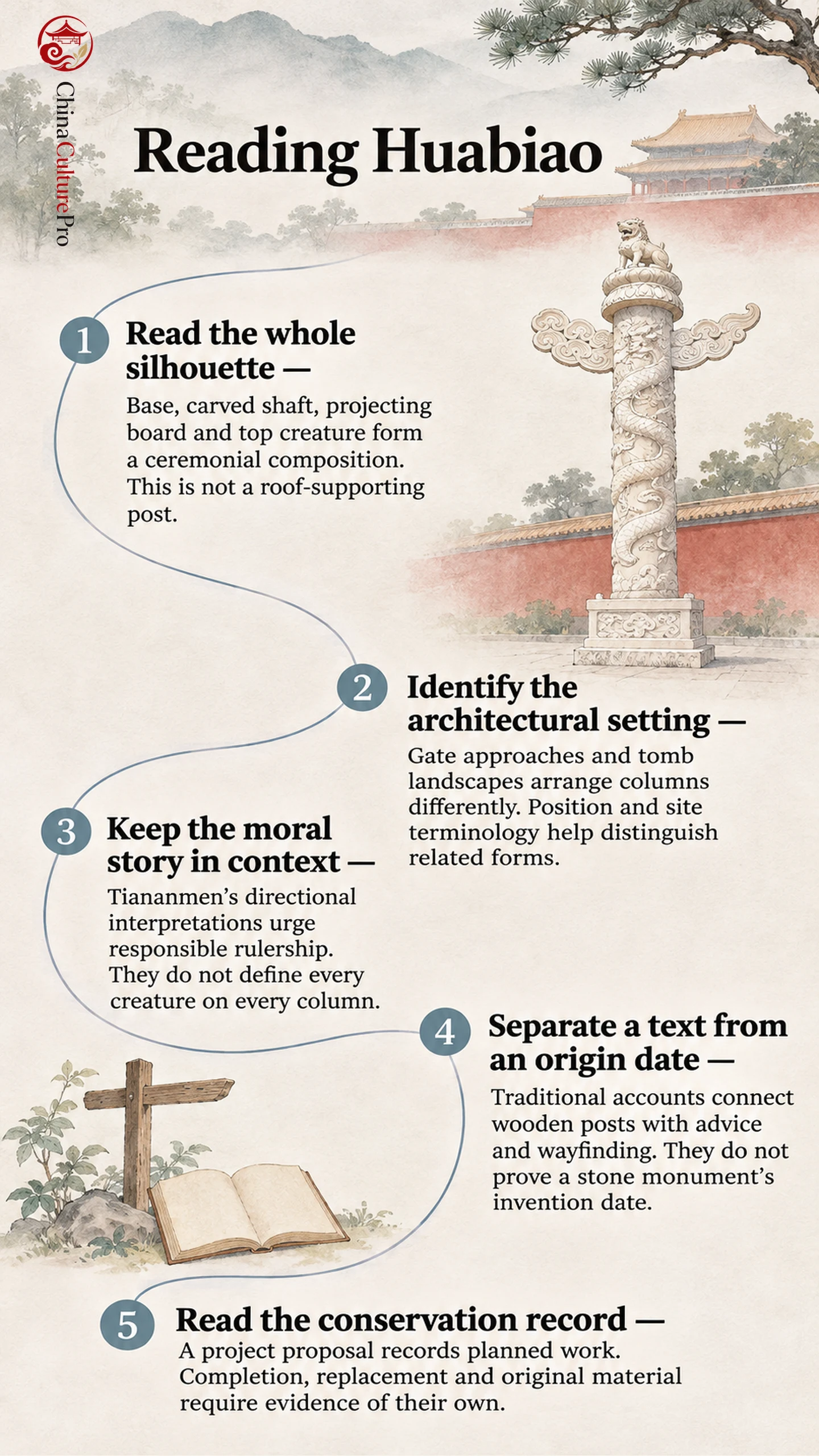
A carved dragon winds around a pale stone shaft, rising toward a cloud-shaped crosspiece and a small creature at the top. The familiar silhouette is easy to recognize; its architectural setting deserves equal attention. Huabiao offers a way to read ceremonial space within Chinese architecture, beyond the outline of the column alone.
Reading the Base, Shaft, Cloud Board and Beast
The Palace Museum’s glossary describes a column with clouds and a winding dragon, a projecting cloud board, a decorated cap and a stone creature above it. These elements create a vertical sequence, from the base to the small figure against the sky.[1]
The Tiananmen site authority identifies the beast there as a hou(犼,hǒu)and describes the white-stone columns in front of and behind the gate. The figure is therefore not best labeled a lion merely because its crouching silhouette looks familiar.[2]
The column is freestanding. It does not act like a structural post carrying the roof of a hall. The projecting cloud board is a distinctive part of the sculptural composition. Looking at the whole silhouette before isolating a dragon or animal makes these distinctions easier to see.
Gate, Tomb and Ceremonial Approach
At a palace entrance, columns participate in a wider arrangement of gates, bridges and open space. The National Museum of China’s account of a Beijing palace-city map identifies huabiao, stone lions and the Golden Water bridges outside the gate then called Chengtianmen. The image records relationships between elements, rather than just a portrait of one column.[3]
A tomb setting offers another configuration. The Palace Museum’s account of Changling describes stone huabiao around the stele pavilion, with octagonal bases and shafts, clouds and dragons, and creatures above. It separately describes a pair of stone watch-columns further along the approach with the sculpted figures.[4]
Do not assume that every column on a tomb route is identical simply because it occupies the same broad ceremonial landscape. Position, shape and the terminology used in a reliable site account belong together. For the wider imperial setting, see the Forbidden City’s history.
The Ruler’s Return and Departure: A Moral Interpretation
The Tiananmen authority explains the front pair’s south-facing beasts as wang jun gui(望君归,wàng jūn guī), a wish that the ruler return from excursions to attend to affairs of state. The rear pair’s north-facing beasts are explained as wang jun chu(望君出,wàng jūn chū), urging him to leave the palace and understand the people’s conditions.[2]
This is a moral interpretation attached to the figures’ placement. It turns two directions into complementary reminders: neither absence from government nor isolation inside the palace is presented as an ideal.
This interpretation belongs to the Tiananmen setting. It does not identify the meaning of every animal on every Chinese column, nor show that an actual creature supervised a ruler. Its value lies in the way architectural imagery expresses expectations about authority.
Wooden Posts and the Tradition of Remonstrance
The transmitted Gujin zhu(古今注,Gǔjīn zhù)discusses wooden posts with crosspieces in connection with accepting criticism and marking road junctions. Its explanation links the huabiao name to accounts of rulers receiving advice.[5]
Such a text is evidence for a tradition of explanation. It is not archaeological documentation of a surviving stone column being invented by a legendary ruler. A wooden marker described in a literary account and a carved stone monument belong to related discussions, but they cannot be assigned identical dates or physical forms without further evidence.
The traditional explanation concerns willingness to hear criticism. It does not show that people used the surviving Tiananmen stone columns as writing boards.
Surviving Stone and the Evidence of Repair
Historic ceremonial columns also have conservation histories. Beijing’s cultural heritage bureau published a request to initiate a Tiananmen huabiao repair project, identifying the columns as components of a protected monument and setting out a planned program.[6]
The document establishes that a conservation proposal existed. It does not, by itself, prove that every planned intervention was completed or identify every piece of stone as original. Those questions need records appropriate to the work actually carried out.
When reading an account of a huabiao, separate the age assigned to the monument, the material visible today and the histories of repair or replacement. This keeps architectural continuity from becoming a claim that every surface has remained untouched. A recognizable ceremonial form can have a complex material history.
FAQs About Huabiao
Is a huabiao a column supporting a building?
No. The ceremonial columns discussed here are freestanding rather than roof-supporting posts.
Is the animal on top always a lion?
No. Use the identification given for the particular monument; Tiananmen’s beasts are described as hou.
Are huabiao found only at Tiananmen?
No. Imperial tomb settings also provide examples.
Were huabiao invented by Yao or Shun?
Those associations belong to traditional accounts. They do not establish an archaeological invention date.
Sumber
[1] Palace Museum. Architectural Glossary: Huabiao
[2] Tiananmen Area Administration Committee. The Tiananmen Huabiao
[3] National Museum of China. Map of the Beijing Palace City
[4] Palace Museum. Changling and Its Ceremonial Approach
[5] Chinese Text Project, Primary Chinese Text. Gujin Zhu: Wooden Posts and Huabiao
[6] Beijing Municipal Cultural Heritage Bureau. Request to Initiate a Tiananmen Huabiao Conservation Project