

Quick Answer: What Shapes Chinese Culture in Thailand?
Chinese culture in Thailand is part of the cultural life of Thai Chinese (泰国华人, Tàiguó huárén), shaped by migration, regional communities and local relationships. Heritage appears through family histories, languages, shrines, festivals, food and performance, while people participate in different ways.[1]
- Regional histories: Bangkok and southern Thai communities carry different migration and institutional histories.
- Everyday connections: Language choices, associations, shops and food connect heritage with local life.
- Living traditions: Festivals, museums and performance preserve and reinterpret cultural practices.
Chinese ancestry does not prescribe one home language, religion or set of customs. Cultural connections should be understood within Thai society and particular communities.

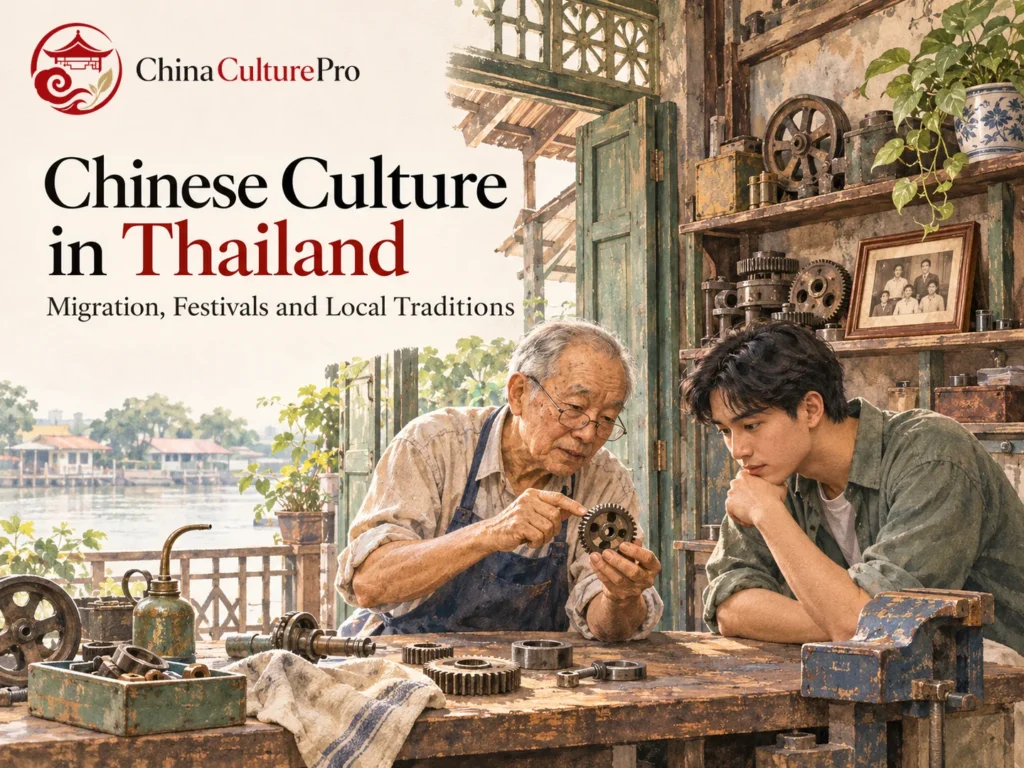
A shop sign, a shrine procession and a neighborhood machine shop preserve different kinds of memory. Looking beyond festival spectacles reveals how Chinese diaspora histories became rooted in Thailand through regional settlement, family choices, work and changing forms of public participation.
Migration, Regional Settlement and Local Identity
Surat Thani offers a southern perspective on migration. Historical research describes substantial settlement from the late nineteenth century and an early twentieth-century port where migrants formed associations around regional and language connections. Temples and schools helped organize these networks.[1]
The communities included Hokkien (福建话, Fújiànhuà), Teochew (潮州话, Cháozhōuhuà), Kanton (粤语, Yuèyǔ), Hainanese (海南话, Hǎinánhuà) and Hakka (客家话, Kèjiāhuà) backgrounds. These are Mandarin labels for familiar regional and language names, not pronunciations of the English forms.[1]
In Phuket, the Thai Hua Museum occupies a former Chinese school building associated with Hokkien immigrants. The building dates to 1934. Its later museum role connects education with the preservation of local migration history.[2]
Thai, Heritage Languages and the Meaning of Shop Signs
Visible Chinese writing does not establish which language a shopkeeper speaks at home. A 2016 study of Bangkok Chinatown shop names examined Chinese characters alongside Thai and English. For Thai-speaking customers, Chinese writing could carry a symbolic heritage role as well as identify a business.[3]
A 2026 study of Charoen Chai, Luenrit and Talat Noi likewise found that everyday communication in those Bangkok communities was primarily in Thai. Some older residents spoke heritage varieties such as Teochew and Hokkien; Mandarin was used with participants fluent in it. These observations concern the study communities, not everyone in Thailand.[4]
The distinction matters when reading diaspora language histories. A family may keep a Chinese shop name, take part in community celebrations and mainly speak Thai. Learning Mandarin is another possible connection, rather than proof that a heritage variety has been maintained.
Shrines, Associations and Community Life
Shrines provide places for devotion and community relationships. A 2023 study purposively selected 28 inner-Bangkok shrines associated with several Chinese regional groups. It traced changes from community organization and ritual preservation toward additional heritage and tourism functions. Its sample illustrates variety; it is not a count of every shrine in Thailand.[5]
The relationship with native-place and community associations helps explain why religious places also matter to collective life. Maintaining a building, supporting ceremonies and sustaining ties among participants can overlap without making every participant’s beliefs identical.
At Phuket’s Pudjor Shrine, devotion centers on Guanyin (观音, Guānyīn) and other Chinese deities. These religious connections give one particular community setting for faith.[6]
Chinese New Year and the Vegetarian Festival
Chinese New Year (春节, Chūnjié) has household and public dimensions. In its announced 2026 program, the Tourism Authority of Thailand paired Chinese arts such as paper cutting and calligraphy with Thai embroidery and khon mask painting. That program illustrates a public presentation of cultural exchange, distinct from a family’s New Year customs.[7]
Phuket’s Vegetarian Festival takes place in the ninth Chinese lunar month. Connected with the island’s Hokkien community, it brings together shrine ceremonies, street processions and nine days of devotion. The Nine Emperor Gods (九皇大帝, Jiǔhuáng Dàdì) are central to its religious setting. Beliefs about blessings and purification give meaning to the rites.[6][11]
Within temple festivals, processions have devotional as well as public roles. This particular period of vegetarian observance does not describe everyone’s year-round diet. Check ingredients separately when choosing vegetarian dishes.
Food Rooted in Local Everyday Settings
Phuket’s food culture reflects Hokkien Chinese, Peranakan, Malay and Southern Thai connections. Everyday eateries, markets and breakfast places keep that heritage visible alongside tourism. The local names below follow Thai usage; they identify different food forms.[8]
| Local food | Bentuk yang mudah dikenali |
|---|---|
| Hokkien noodles | Thick yellow noodles cooked with seafood and a rich sauce. |
| O-tao | An oyster dish combining soft batter, taro and egg. |
| O-aew | A jelly dessert served with syrup, shaved ice and toppings. |
These examples range from a substantial noodle dish to an iced dessert, within one regional food culture.[8]
The connections with Chinese noodles and Chinese food across communities can be read through ingredients, local names and eating habits. The oyster dish and iced dessert also show why this heritage extends beyond a few familiar noodle or rice categories.
Keeping Neighborhood Histories and Performance Alive
Community memory includes work as well as festivals. Talad Noi Museum occupies a former machine-shop setting associated with ship parts, machinery and rice-mill equipment. Its public spaces bring neighborhood history into a setting for meeting, learning and community activities.[9]
The preservation of Chinatown communities also involves choices about redevelopment. The 2026 Bangkok study found different responses in Charoen Chai, Luenrit and Talat Noi, including local-history initiatives, cooperative management and tourism-related activity. It also identified tensions around commercialization and the loss of community traditions.[4]
Performance carries another kind of connection. Teochew opera (潮剧, cháojù) circulated through networks linking southern China and Bangkok, including performances for community deities at temples. Its language and music linked audiences with regional heritage while performances adapted to local conditions.[10]
Understanding it as one form within Opera Tiongkok makes room for both inherited conventions and local change. Museums, working neighborhoods and performance networks preserve different parts of cultural life; none alone can represent the whole.
FAQs About Chinese Culture in Thailand
Is Chinese Thai culture the same as culture in China?
No. Chinese heritage has developed through local Thai histories, regional settlement, institutions and cultural exchange. Its forms and meanings vary among communities.
Do all Thai Chinese speak Mandarin?
No. Thai, Mandarin and different heritage varieties can have different roles. Chinese writing on a shop sign does not establish a family’s spoken language.
Are all Thai Chinese communities Teochew?
No. Historical communities also included Hokkien, Cantonese, Hainanese and Hakka backgrounds. Teochew heritage is important, but it does not represent everyone.
Is the Vegetarian Festival the same as Chinese New Year?
No. Chinese New Year begins the lunar year; Phuket’s Vegetarian Festival falls in its ninth month. Their religious and social settings differ.
Are Chinese Thai traditions found only in Bangkok’s Chinatown?
No. Surat Thani and Phuket provide southern examples, while Bangkok itself contains several distinct communities. Local histories extend beyond a single tourist district.
Sumber
[1] Royal Holloway, University of London Research Portal. Identity in Time of Crisis: Chinese Migration during the First Half of the 20th Century in Surat Thani
[2] Government Public Relations Department, Thailand. Historical Tourism: History of the Chinese at Phuket Thai Hua Museum
[3] MANUSYA, Journal of Humanities. Chinatown in Bangkok: The Multilingual Landscape
[4] International Journal of Heritage Studies. Reinventing Ordinary Heritage: Sino-Thai Communities in a Transforming Bangkok
[5] RMUTK Journal of Liberal Arts. Change in the Functions of Chinese Shrines in Inner Bangkok
[6] Tourism Authority of Thailand. TAT Highlights Phuket Vegetarian Festival 2026 as a Distinctive Cultural Experience
[7] Tourism Authority of Thailand. TAT Announces Amazing Thailand Chinese New Year 2026 in Bangkok and Hat Yai
[8] Government Public Relations Department, Thailand. Explore Phuket through Its Food Culture, a UNESCO Creative City of Gastronomy
[9] Treasury Department, Thailand, Talad Noi Museum. Talad Noi Museum
[10] Binghamton University, Center for Theater Arts Collaboration. Travelling with Chinese Theatre-Troupes: A Performative Turn in Sino-Southeast Asian Interactions
[11] Thailand Trade and Economic Office (Taipei). Thai Vegetarian Festival 2026