


Quick Answer: How Are Chinese and Vietnamese Cultures Connected?
Chinese and Vietnamese cultural connections include shared written traditions, models of learning and government, religious exchanges and related New Year customs. These connections developed through different historical settings and Vietnamese choices about how to use and reshape inherited ideas.[1][2]
- Texts and institutions: Written learning connected scholars and courts across the region.
- Local development: Vietnamese writing, religious traditions and festivals developed distinctive forms.
- Continuing differences: Shared cultural references do not make the two languages or societies identical.
This is a guide to connections across societies. Hoa community life in Vietnam is a related, more specific subject; it does not account for every historical Chinese–Vietnamese cultural relationship.
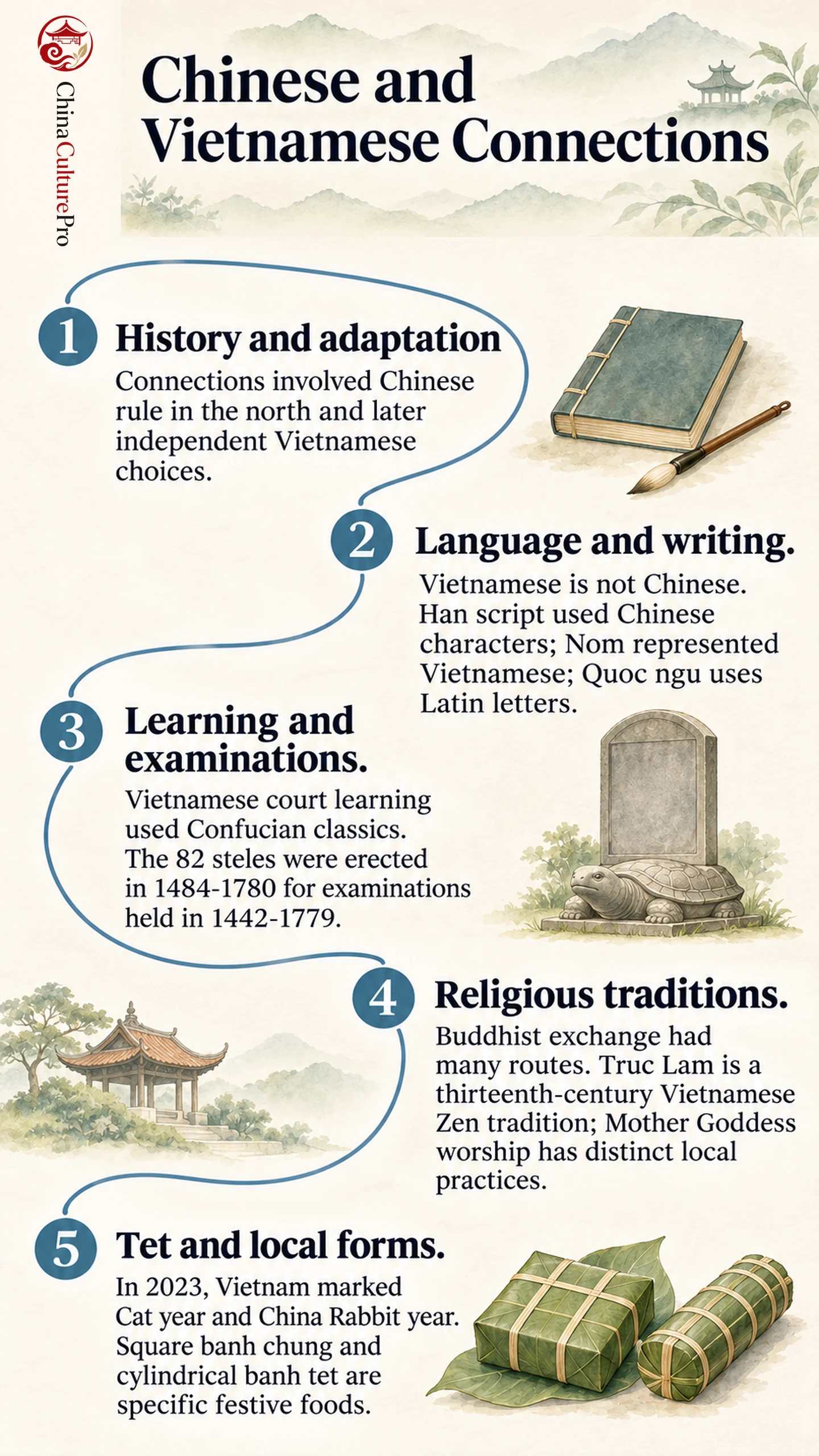
A Chinese-character inscription in Vietnam, a Vietnamese poem in Nôm script and a Tết celebration reveal different kinds of connection. Shared resources acquired new roles in local languages, institutions and community traditions over many centuries.
Historical Exchange and Vietnamese Adaptation
The relationship developed through several periods of contact and adaptation. Chinese writing was established during periods of Chinese rule in the north of what is now Vietnam, but its uses continued and expanded under later independent Vietnamese dynasties. Political independence did not mean abandoning every shared textual resource.[3]
From the tenth century onward, Vietnamese state-building drew on regional models while maintaining local speech and customs. Borrowing and adaptation served the needs of governing a Vietnamese kingdom alongside its existing cultural life.[2]
Confucianism (儒家, Rújiā) also developed through stages. Vietnamese scholars engaged with shared texts, including the Five Classics (五经, Wǔjīng), and interpreted them for local political and social circumstances. The priorities of scholarly learning changed over time; its long presence does not mean an unchanging national philosophy.[1]
Chinese Characters, Chữ Nôm and Quốc Ngữ
Spoken language and writing must be separated. Vietnamese belongs to the Austroasiatic language family; it is not a variety of Chinese. Historically, several writing resources served different purposes in Vietnamese society.[10]
| Writing resource | Perbedaan utama |
|---|---|
| Chữ Hán | Chinese characters (汉字, hànzì; Mandarin reading), used in classical written learning, administration and literature.[3] |
| Chữ Nôm | A writing system that adapted Chinese character forms and principles to represent Vietnamese.[11] |
| Quốc ngữ | The Latin-based writing system used for modern Vietnamese, with diacritics marking distinctions in the language.[10] |
Chữ Hán and Nôm coexisted rather than replacing one another in a simple sequence. Nôm enabled Vietnamese-language compositions, including narrative poetry such as Nguyễn Du’s Truyện Kiều, while classical Chinese remained important in other domains.[3][11]
Even shared characters did not require modern Mandarin pronunciation: Vietnamese readers developed Sino-Vietnamese readings. A historic inscription’s appearance therefore does not identify the language someone speaks today. Its writing, reading tradition and intended audience are separate questions.[3]
Confucian Learning and the Examination Steles
Vietnamese courts adopted examinations based on Confucian classics by 1075. The imperial examination (科举, kējǔ; Mandarin term), called khoa cử in Vietnamese, connected learning with official recruitment. Comparing it with China’s imperial examinations shows a related institutional model developed within a different state.[2]
The surviving doctoral steles at Văn Miếu–Quốc Tử Giám in Hanoi make that history concrete. Their dates must be read carefully: the 82 steles were erected between 1484 and 1780 to commemorate examinations held between 1442 and 1779. The dates of an examination and of its monument are different.[4]
The inscriptions preserve laureates’ names and information about compilers, revisers, calligraphers and engravers. Their calligraphy and tortoise-shaped bases connect official records with material craft. These are records of particular examinations and scholarly institutions, rather than evidence that everyone in premodern Vietnam could read classical Chinese.[4]
Religious Connections and Vietnamese Traditions
Buddhist exchange involved Indian, Central Asian, Chinese and Vietnamese practitioners. Chinese Buddhist traditions form one part of these wider networks, which developed in particular local settings.[6]
Trúc Lâm is a Vietnamese Zen tradition founded in the thirteenth century under the Trần rulers, notably Trần Nhân Tông. It belongs within the wider history of East Asian Zen, which includes Chinese Chan (禅, Chán), while having its own Vietnamese institutional history. Its formulation combines Mahayana Buddhism, Confucian ethics, Daoist cosmological ideas and local beliefs. The associated heritage landscape preserves temples, inscriptions and Chinese–Nôm woodblocks.[5]
Vietnamese religious life also includes practices with distinct local histories. Worship of the Mother Goddesses of Three Realms centers on heaven, water, and mountains and forests, with ritual, music and dance transmitted by practitioners. Its 2016 intangible-heritage inscription recognizes these practices as living community heritage.[7]
Tết, Zodiac Animals and Local Festive Foods
Tết is Vietnam’s New Year celebration; Spring Festival (春节, Chūnjié) is a Chinese name for the corresponding holiday tradition. The wider phrase Lunar New Year covers related celebrations without implying that all their practices are identical.
Family reunion, cleaning and remembrance of ancestors are important parts of Tết. These provide useful points of comparison with Chinese ancestral remembrance, while local names, foods and family routines retain their own settings.[9]
Animal labels also differ. In 2023, Vietnam welcomed the Year of the Cat while Chinese celebrations marked the Year of the Rabbit. The shared twelve-year framework, discussed in zodiac traditions across Asian cultures, does not require identical animal lists.[8]
Festive rice cakes offer another local example: bánh chưng is characteristically square and bánh tét cylindrical, with glutinous rice and fillings that can include mung beans and pork. They are named Vietnamese dishes with family and regional variations.[9]
FAQs About Chinese and Vietnamese Cultural Connections
Is Vietnamese a form of Chinese?
No. Vietnamese is an Austroasiatic language. Historical Chinese vocabulary and writing connections do not make it a Chinese speech variety.
Is chữ Nôm the same as writing Chinese?
No. Nôm uses Chinese-derived graphic resources to represent Vietnamese. A Nôm text is not simply a passage written in Chinese.
Did Vietnam use Confucian civil-service examinations?
Yes. Vietnamese courts used examinations based on Confucian learning. The surviving Hanoi steles commemorate particular examinations and their laureates.
Is Tết identical to Chinese New Year?
They are related celebrations with distinct local traditions. Vietnamese zodiac animals and festive foods provide clear examples of difference.
Are these connections limited to Hoa communities?
No. Hoa community life is one part of the relationship. Historical writing, state institutions, religion and local festivals involve wider Vietnamese society.
Sumber
[1] John K. Whitmore, Oxford University Press. Confucianism in Vietnam
[2] Chin-Hao Huang and David C. Kang, Cambridge University Press. Vietnam Emerges: Tenth to Fourteenth Centuries
[3] Nguyễn Quang Hồng, Digitizing Việt Nam. Chinese Characters and Nôm Script in Vietnam’s Classical Literary Tradition
[4] UNESCO Memory of the World Committee for Asia and the Pacific. Stone Stele Records of Royal Examinations of the Lê and Mạc Dynasties
[5] UNESCO World Heritage Centre. Yên Tử–Vĩnh Nghiêm–Côn Sơn, Kiếp Bạc Complex
[6] Humanities and Social Sciences Communications. Cultural Additivity: Confucianism, Buddhism and Taoism in Folktales
[7] UNESCO Intangible Cultural Heritage. Practices Related to the Việt Beliefs in the Mother Goddesses of Three Realms
[8] Vietnam News Agency, VietnamPlus. Why Does Vietnam Celebrate the Year of the Cat Instead of the Rabbit?
[9] Viet Nam National Authority of Tourism. Tết: Tradition, Reunion and Taste
[10] University of Hawaiʻi at Mānoa, Department of Indo-Pacific Languages and Literatures. Vietnamese Language Program
[11] Kenji Tomita, Japanese Journal of Southeast Asian Studies. Chữ Nôm: Its Structure and Origin