


Quick Answer: What Languages Do Chinese Diaspora Communities Speak?
Chinese diaspora languages include several Chinese speech varieties alongside the other languages used in the societies where communities live. Inheritance through family and community can involve different languages, uneven skills and changing relationships across generations.[2]
- Several varieties: Communities transmit different Chinese speech traditions; this guide covers four examples.
- Different settings: A language used with grandparents may differ from the language of school or work.
- Different abilities: Understanding speech, speaking, reading and writing are separate skills.
Language is one part of Chinese diaspora culture. An ancestry label does not establish which language someone knows or prefers, and a Chinese-language class may not teach the language a family uses at home.
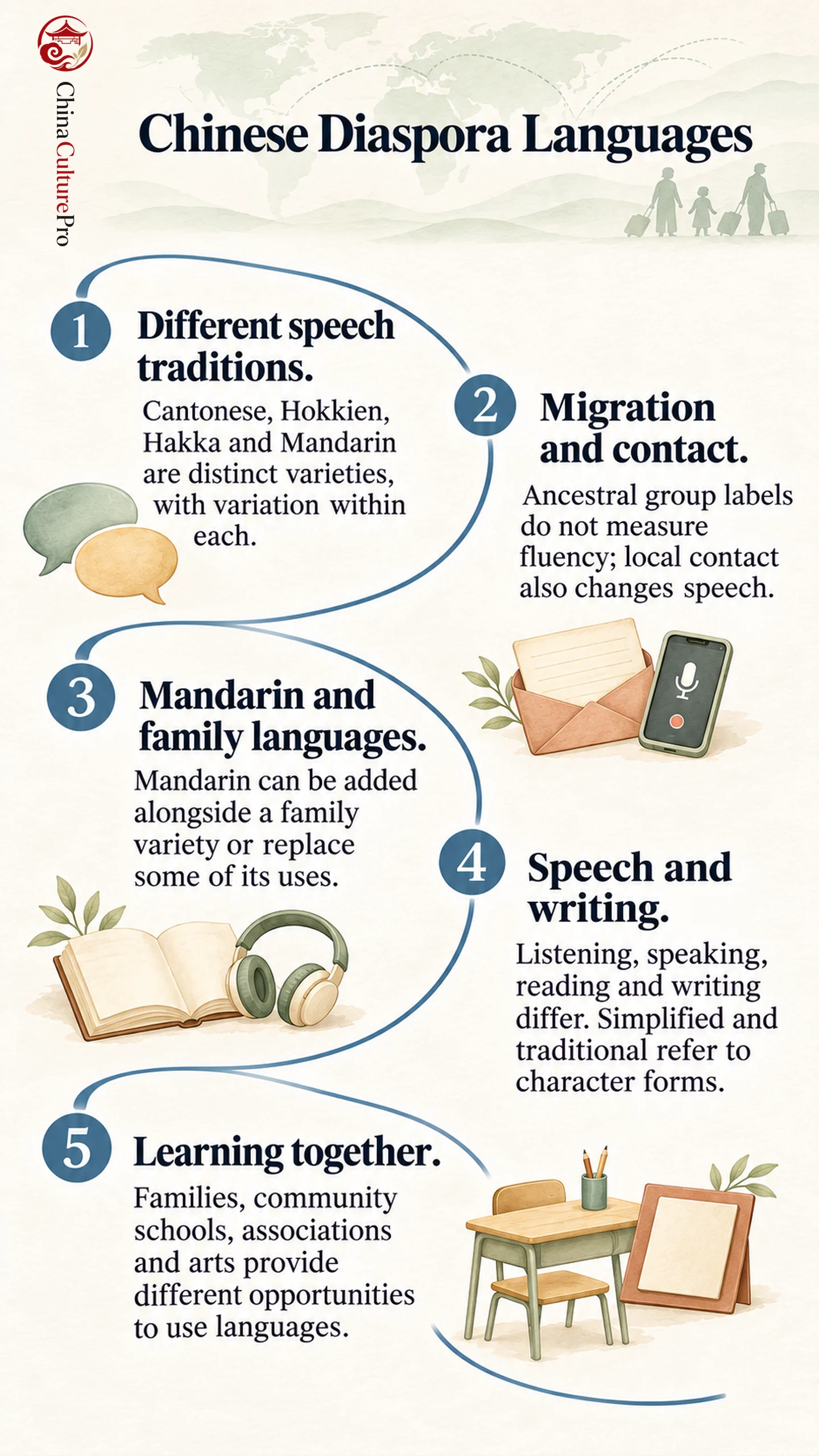
“Do you speak Chinese?” can hide several different questions. A person may understand a family conversation, study a different Chinese variety at school and use another language with friends. Specific names clarify these experiences.
Cantonese, Hokkien, Hakka and Mandarin: What the Names Mean
These labels refer to distinct speech traditions, not interchangeable accents of one standard spoken language. Each also contains internal variation. Knowing one does not automatically supply conversational understanding of another.[1]
| Nama | Regional or community association | Perbedaan penting |
|---|---|---|
| Kanton (粤语, Yuèyǔ) | Associated with the Pearl River Delta and communities connected to it. | Its speech differs from the standard spoken form; diaspora speakers may also use other languages.[1][3] |
| Hokkien (福建话, Fújiànhuà) | A familiar label in Southeast Asian communities with southern Fujian connections. | Usually refers to Southern Min (闽南语, Mǐnnányǔ) in this setting, not every language of Fujian province.[4] |
| Hakka (客家话, Kèjiāhuà) | A Chinese variety associated with Hakka communities. | A distinct heritage language, rather than an accent of the standard spoken form.[1] |
| Mandarin (普通话, Pǔtōnghuà) | A standard spoken form used across regional backgrounds and in education. | It may be a home language, an additional learned language or a replacement for an older family variety.[1][6] |
The pinyin in parentheses gives Mandarin readings of Chinese names, rather than their pronunciation in each variety. The Chinese term fangyan (方言, fāngyán), often translated as “dialect,” does not mean the differences are only pronunciation. Vocabulary and grammar also differ. The language-and-dialect distinction concerns classification and social usage; Mandarin and Cantonese provide one useful comparison.[1]
Migration Networks and Local Language Contact
Migration connected particular regions with particular settlements, supporting speech communities through family and neighborhood networks. In Singapore, people from southern China formed communities associated with different places of origin and language varieties. A census “dialect group” can record that community background without measuring an individual’s proficiency.[3]
Those connections, explored in Chinese migration history, did not freeze speech at the moment of departure. Singapore Hokkien developed through contact with Malay, English and Cantonese, while also contributing expressions and grammatical patterns to local Mandarin. Borrowing can be part of a living language, rather than evidence that speakers have simply forgotten it.[4]
Multilingual speakers may move between languages in conversation or help relatives communicate across them. These practices are part of diaspora language contact; a person’s repertoire need not fit one separate language for every situation.[10]
Mandarin Learning and Other Heritage Languages
Learning Mandarin can add a language alongside Cantonese or replace some of its uses. These are different outcomes for family communication, even when both are described as “maintaining Chinese.”[6]
A study published in 2025 followed 24 Cantonese-speaking families in Metro Vancouver during 2019–2022. Parents’ attitudes toward Cantonese and Mandarin changed with family connections, local opportunities and wider networks. This particular sample does not predict every Chinese Canadian child’s experience.[6]
Language policy creates another setting. Singapore’s Speak Mandarin Campaign began in 1979. A July 2026 policy response retained Mandarin’s role as a shared language while recognizing regional-language arts and association classes. It also described English becoming more prominent in daily life. These overlapping priorities belong to Singapore’s local cultural context, not a universal policy for all diaspora communities.[7]
Speaking, Reading and Writing Are Different Skills
Han characters (汉字, hànzì) are a writing system, while Cantonese, Hokkien, Hakka and Mandarin are spoken varieties. Simplified and traditional Chinese describe character-form conventions; they are not two spoken languages. The visual form of a page therefore does not identify a speaker’s pronunciation or home language.[8]
Recognizing Chinese characters, following a conversation and composing a message are different tasks. The Vancouver families’ accounts distinguish spoken language from character learning; “fluent in Chinese” can conceal different abilities.[6]
For reading and writing, the character convention is an additional question. Check whether learning materials use simplified or traditional forms, and which speech variety their recordings teach. A script label alone does not answer both questions.
Community Schools and Learning Across Generations
Family interaction and formal lessons provide different opportunities. Heritage-language education involves home practices, school provision and learners’ sense of identity; a school course should be understood within those wider relationships.[2]
In Britain, London Hackney Chinese Community School offers both Cantonese and Mandarin classes. That example shows why checking the named variety matters before describing a course simply as “Chinese.” It does not establish what all British community schools teach.[9]
Community learning also takes place through the arts. In Singapore, Hakka associations have organized song classes and choirs, with both inherited repertoire and new local compositions. Such activities connect language with participation, rather than restricting it to vocabulary exercises. Community associations can support these opportunities alongside families and schools.[5]
Choose resources around the relationship or activity a learner wants to sustain: conversations with relatives, a community singing group or written correspondence. These are different learning goals, rather than steps on a single scale of how culturally Chinese someone is.
FAQs About Chinese Diaspora Languages
Are Cantonese, Hokkien and Hakka just accents of Mandarin?
No. Their differences extend beyond accent to vocabulary and grammar. They are distinct Chinese varieties with variation within each.
Does learning Mandarin preserve every family’s heritage language?
No. It can add a useful language while another family variety is maintained or displaced. The outcome depends on what people continue using.
Does a Chinese surname tell you which language someone speaks?
No. A surname or ancestral community label does not measure language knowledge, home use or personal preference.
Are simplified and traditional Chinese different spoken languages?
No. They are character-form conventions. They do not determine which spoken variety a person uses.
Can someone have Chinese heritage without speaking a Chinese language?
Yes. Chinese heritage and identity do not depend on a single language test. People can have different abilities and relationships with family languages.
Sumber
[1] International Journal of Bilingual Education and Bilingualism. Varieties of Chinese as Heritage Languages: A Research Synthesis
[2] Xiao Lan Curdt-Christiansen and Angie Baily, Cambridge University Press. Heritage Language Education in Diasporic Communities: A Focus on Chinese Speakers
[3] Singapore Chinese Cultural Centre, Culturepaedia. Chinese Dialects in Singapore
[4] Singapore Chinese Cultural Centre, Culturepaedia. The Hokkien Dialect in Singapore
[5] Singapore Chinese Cultural Centre, Culturepaedia. Hakka Music in Singapore
[6] Guofang Li, Zhen Lin and Ziwen Mei, Urban Education. Cantonese-Canadian Families’ Divergent Paths Toward Childhood Bidialectalism
[7] Singapore Ministry of Culture, Community and Youth. The Speak Mandarin Campaign and Chinese Dialect Heritage
[8] Unicode Consortium. Chinese and Japanese: Han Character FAQ
[9] London Hackney Chinese Community School. School Introduction
[10] Cambridge University Press. The Chinese Diaspora: Language Maintenance and Loss