

Quick Answer: What Defines Chinese Food Culture?
Chinese food culture includes how meals are assembled, how people eat together and what food communicates on particular occasions.
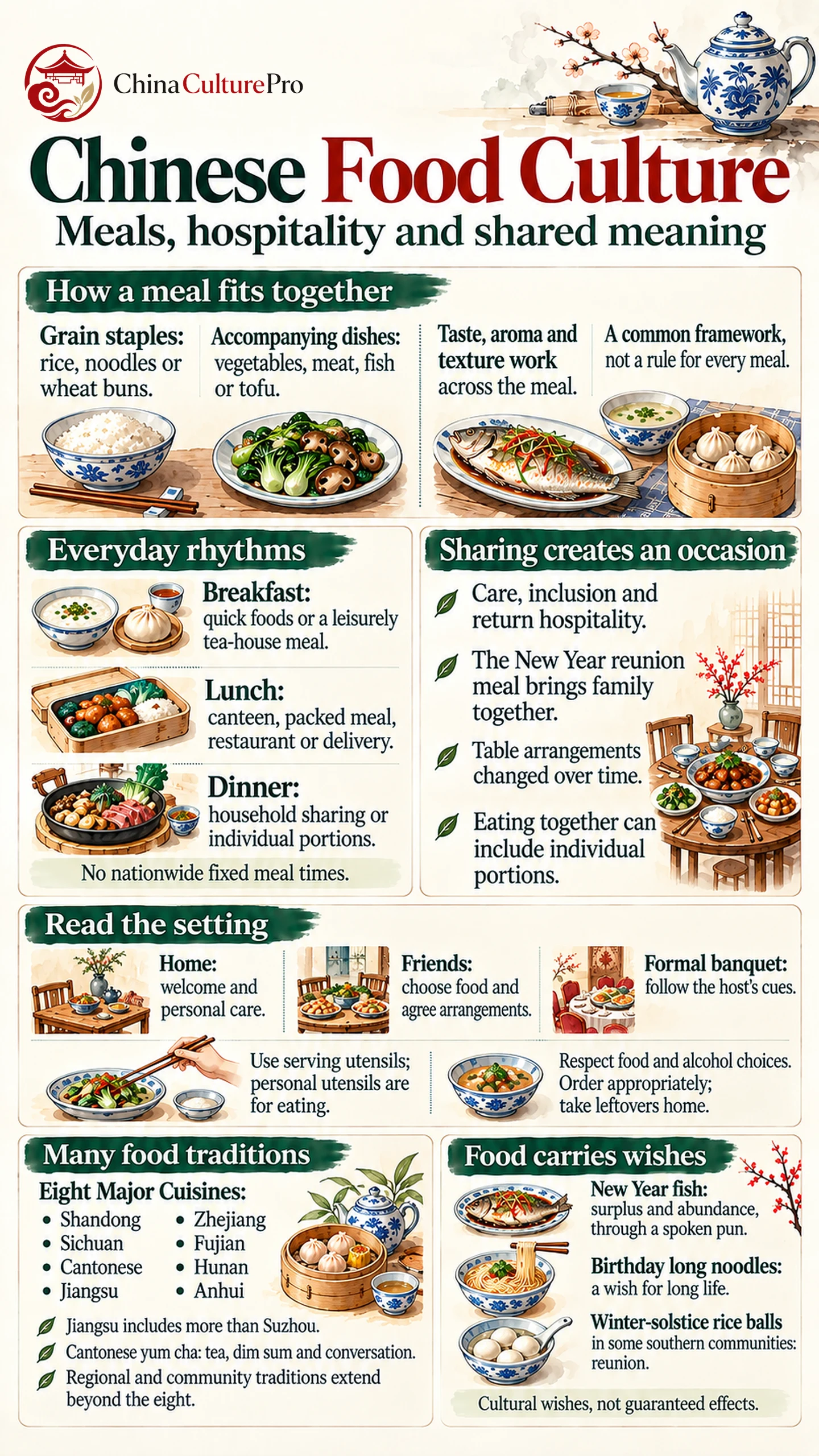
- Meal structure: A common framework pairs grain staples (主食, zhǔshí) with accompanying dishes (菜, cài): vegetables, meat, fish or tofu.
- Social relationships: Eating together can express care for family, welcome guests and sustain friendships.
- Place and occasion: Local food traditions and celebratory meanings influence what appears on the table. [3]
These are useful patterns, not a compulsory national menu. Shared meals coexist with individual portions, and a formal banquet does not represent every Chinese meal.
A shared dish, an offer of more food and a fish served at New Year can each communicate something beyond appetite. Chinese food culture connects the composition of a meal with care, hospitality and celebration. The setting matters: an ordinary lunch, a family gathering and a formal banquet carry different expectations.
How a Chinese Meal Is Put Together
One useful framework distinguishes grain staples from accompanying dishes. Rice, noodles, steamed wheat buns and other grain foods can provide the staple; the dishes add different ingredients, seasonings and textures. In this context, cai means prepared dishes, including meat, fish, seafood and bean products as well as vegetables. Translating it simply as “vegetables” misses much of its meaning. [1]
Consider an illustrative home dinner: steamed rice, one meat dish, one vegetable dish and a light soup. Each diner might have a rice bowl while taking portions from the dishes in the middle. This is a way to understand the arrangement, not a prescribed ratio of meat to vegetables or a minimum number of bowls. A household can scale the meal to its members, preferences and available ingredients.
Variety also operates across the whole meal. A crisp vegetable dish may accompany something soft or braised; a lightly seasoned soup can contrast with a more strongly flavored dish. Color, aroma, appearance and texture can matter alongside taste. Such contrasts explain why several modest dishes may be chosen to complement one another rather than compete as separate main courses. [2]
This framework does not require every meal to contain separate plates, soup and tea. A bowl of noodles can combine the grain food and its accompaniments, while dim sum offers a different arrangement of small dishes. The balance between everyday simplicity and an elaborate spread depends on the occasion. [4]
Everyday Meals: Breakfast, Lunch and Dinner
Breakfast may be a steamed bun, soy milk, jianbing, congee, rice noodles or small steamed dumplings. Local availability and the morning routine shape the choice; these examples do not define exclusive northern or southern menus. Cantonese tea-house breakfasts can also be leisurely social occasions. [4]
On a working day, lunch might come from a canteen, a nearby restaurant, a packed container or a delivery order. A rice plate or noodle bowl can be an individual meal; colleagues can also order dishes together. Neither canteens nor delivery services have only one serving format.
Dinner may bring household members around shared dishes, but work schedules, living arrangements and personal preferences make it variable. Someone living alone may have a simple portion, while friends may meet at a restaurant. There is no nationwide clock time or obligatory family gathering that defines every breakfast, lunch or dinner.
Why Eating Together Matters
Shared-table dining (合餐, hécān) creates a common occasion as well as a common spread. Choosing dishes for several people requires attention to others’ preferences, and passing food or making room for another diner can express care. The social meaning lies in being included and considered, not simply in how many plates are ordered. [1]
The New Year’s Eve tuanyuanfan (团圆饭, tuányuánfàn), or reunion meal, makes this connection especially visible. The effort to gather is central to the occasion, even though the menu differs between households. Our Chinese New Year reunion dinner guide explores that specific gathering in more detail. [9]
Invitations and return hospitality can also sustain friendships and community ties. Their importance does not establish a fixed obligation to host a lavish return banquet. [1]
Present-day table arrangements have a history of change. Taller tables and chairs, changing vessels and exchanges with Central and West Asia helped reshape dining practices over time. Shared platters around a high table should therefore not be projected unchanged onto every period of Chinese history. Equally, eating together today can remain social when food is served in individual portions. [3]
Hospitality at Home, with Friends and at Banquets
An invitation to qingke (请客, qǐngkè), a meal hosted as a treat, identifies a host’s role. Offering food can communicate generosity, but the degree of formality depends on the relationship and occasion. The setting helps a guest judge what kind of welcome is intended.
| Penggunaan | How hospitality may appear | What changes for a guest |
|---|---|---|
| A meal in someone’s home | The host prepares dishes, introduces favorites and checks whether guests have enough. | Express appreciation and make preferences or limits clear without assuming every offer must be accepted. |
| An informal meal with friends | The group may choose dishes together; one person may invite the others, or payment can be agreed beforehand. | Clarify the arrangement with the group rather than assuming either hosting or bill splitting is universally required. |
| A formal banquet | The organizer may arrange seating, welcome guests and guide when the meal begins. | Follow the host’s seating and opening cues; do not apply the same formality automatically to a casual lunch. [1] |
A few conventions are useful across these settings:
- Follow the setting: If places or the start of the meal are organized, let the host guide you.
- Use the serving utensils: Serving chopsticks (公筷, gōngkuài) and shared spoons transfer food from communal dishes; personal utensils remain for eating. [7]
- Leave others a chance: Take a modest portion before returning for more, and ask before serving someone directly.
- Respect personal choices: A guest can decline alcohol or a food. Tea, juice or another suitable drink can accompany the shared occasion. [8]
Tea can be part of welcoming and conversation; it does not mean a full tea ceremony is taking place. The Chinese tea culture guide explains that wider context, while tea etiquette covers the more specific conventions.
Contemporary guidance also encourages ordering appropriate quantities and taking leftovers home. Abundance need not become waste, and hospitality does not require pressuring someone to eat or drink beyond their wishes. [7][8]
Regional and Community Differences
Local produce, migration, cultural exchange, religion and household circumstances all help shape food traditions. Climate matters, but it is not a complete explanation for what people eat. The Eight Major Cuisines (八大菜系, bā dà càixì) are a familiar framework: Shandong, Sichuan, Cantonese, Jiangsu, Zhejiang, Fujian, Hunan and Anhui. This list does not encompass every regional or community tradition. [5]
Jiangsu cuisine illustrates why the labels need care. It includes traditions such as Huaiyang, Nanjing’s Jinling style, Suzhou-Wuxi cooking and Xuzhou-Haizhou cooking. Jiangsu cuisine is broader than Suzhou alone. Northeastern, Shaanxi, Yunnan and Xinjiang foodways also cannot be understood simply by forcing every dish into the eight-category list. [5][6]
In Guangdong, yum cha (饮茶, yǐnchá in Mandarin; “yum cha” is Cantonese) combines tea with small dim sum dishes. Sitting over tea provides time for conversation with relatives and friends, making the gathering more than a way to finish breakfast. Its Cantonese roots do not mean the practice exists only in Guangdong; it has traveled with communities and changing lifestyles. [4]
Muslim food traditions and Buddhist vegetarian cooking add further differences in ingredients and practice. A region or cuisine label gives context, but it cannot tell you everything about an individual diner’s choices. [5]
Festival Foods and Life Celebrations
At festivals and family celebrations, a food’s sound, shape or length can help express a wish. The meaning comes from a cultural association in a particular setting, rather than a property that guarantees prosperity, health or long life. [3]
| Occasion and scope | Makanan | Cultural association |
|---|---|---|
| New Year’s Eve meals in many Chinese food traditions | Fish, sometimes presented whole | Fish (鱼, yú) sounds like surplus (余, yú), linking the dish with wishes for abundance in the coming year. [2] |
| Birthday celebrations in some families | Longevity noodles (长寿面, chángshòu miàn) | Long strands express a wish for a long life; the food is a symbol rather than a means of extending life. [2] |
| Dongzhi, the winter solstice (冬至, Dōngzhì), in some southern communities, including parts of Jiangnan | Tangyuan (汤圆, tāngyuán), glutinous rice balls | Roundness and the association with reunion connect the food with family togetherness, a theme taught at a 2025 community celebration in Suzhou. [10] |
These examples work in different ways: the fish association depends on a spoken pun, while the noodle association depends on length. Rice balls combine a round shape with ideas of reunion. This is why identifying the occasion helps explain a dish more accurately than assigning one meaning to every appearance of that food.
The Chinese New Year food guide explores the first context further. Dongzhi food traditions show how winter-solstice meals vary by place. Tangyuan traditions extend beyond Jiangnan, and none of these examples constitutes a compulsory menu for all families.
FAQs About Chinese Food Culture
Do people in China always share dishes?
No. Shared dishes are common at family gatherings and group meals, but individual rice plates, noodle bowls and other portions are also ordinary ways to eat. Sharing a table and sharing every dish are different choices; the format depends on the meal and its participants.
Is it rude to finish all the food?
There is no nationwide rule requiring guests to leave food uneaten. Contemporary dining guidance encourages appropriate portions, avoiding waste and taking leftovers home. Thank the host and eat within your appetite; neither overeating nor deliberately creating leftovers is necessary to show appreciation. [7][8]
Do guests have to drink alcohol?
No. Guests can politely say they do not drink and choose tea, juice or another suitable option. Respectful hospitality allows that choice. Contemporary civility guidance explicitly discourages forcing alcohol on others, so a toast need not become an obligation to drink. [8]
Are all Chinese meals served with rice?
No. Wheat-based buns, noodles and flatbreads can also be staples. The broad association of rice with the south and wheat foods with the north describes a tendency, not a rule for each household or meal. It should not replace attention to the actual food being served. [2]
Sumber
[1] Ellen Oxfeld. The Moral Registers of Banqueting in Contemporary China
[2] Embassy of China in India. The Essence of Chinese Food Culture and Culinary Diplomacy
[3] Hong Kong Palace Museum. A Movable Feast: The Culture of Food and Drink in China
[4] Kaiwei Guo and colleagues. Cantonese Morning Tea (Yum Cha): A Bite of Cantonese Culture
[5] Na Zhang and Guansheng Ma. Nutritional Characteristics and Health Effects of Regional Cuisines in China
[6] Jiangsu Provincial CPPCC. Proposal to Hold a Jiangsu Culture Festival
[7] Ministry of Culture and Tourism. Travel with Civility and Health During the May Day Holiday
[8] Shanghai Putuo Civilization Office. Table Civility and the Clean Plate Campaign
[9] Xinhua, via China’s State Council website. How Do Chinese People Celebrate Spring Festival?
[10] Suzhou Industrial Park Administrative Committee. A Parent-Child Winter Solstice Activity in Loufeng