


Quick Answer: What Is Zi Wei Dou Shu?
Zi Wei Dou Shu (紫微斗数, zǐwēi dǒushù), often called Purple Star astrology, arranges named stars within twelve thematic palaces using birth information and traditional counting rules. It belongs to Chinese fortune-telling traditions.
- Inputs: Birth year, month, day and hour, interpreted under a stated calendar convention.
- Framework: Twelve life themes, fourteen principal stars and transformation labels.
- Timing: Natal, ten-year and annual layers are compared rather than treated as one chart.
- Limits: A calculated placement is not proof of a personal trait or future event.
The useful starting point is understanding what each part of the chart represents before accepting an interpretation.
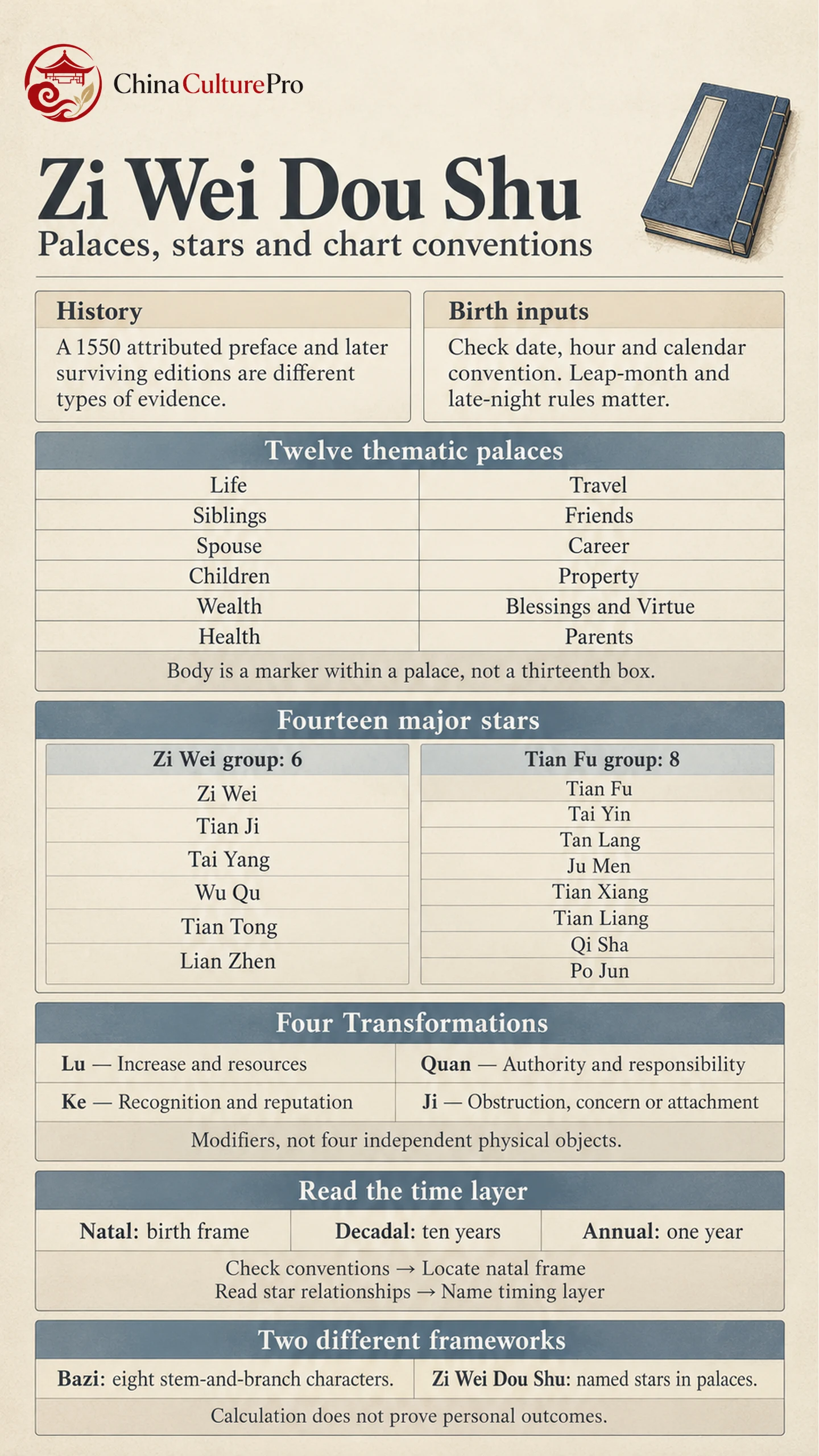
A Zi Wei Dou Shu chart can contain star names, numbered ages, branch characters and several overlapping sets of labels. They describe different parts of the system. A palace’s theme, its fixed branch position and the stars placed there are not three names for the same thing.
This guide introduces those components, checks their textual context and explains why two charts can disagree even before anyone interprets them.
History, Attribution and Surviving Texts
The Zi Wei Dou Shu Quanshu (紫微斗数全书, Zǐwēi Dǒushù Quánshū), or Complete Book, preserves a preface attributed to Luo Hongxian that links the teaching to Chen Xiyi, another name for Chen Tuan. The transcription dates that preface to 1550.[1] An attributed preface is evidence about a text’s transmission claims, not independent proof of every claimed ancestor.
A 2021 historical survey identifies the 1581 Zi Wei Dou Shu Jielan (紫微斗数捷览, Zǐwēi Dǒushù Jiélǎn) as a dated witness to the name. It also notes that surviving editions of the Complete Book are later than its attributed preface and require further investigation.[3] This is a reason to distinguish a document’s stated date from the date of the surviving edition.
Modern practice has its own social history. Research on Taiwan examines the system’s expansion after 1980 alongside changing occupations, gender roles and claims to scientific legitimacy.[4] Historical longevity, modern popularity and predictive accuracy remain different questions.
Birth Data and the Placement Rules
A chart begins with calendrical inputs. Record whether a birth date is Gregorian or lunar, how any leap month is treated and which hour convention is being used. Our Chinese lunar calendar guide explains why the calendar label matters.
The Life Palace (命宫, mìnggōng) and Body Palace (身宫, shēngōng) have distinct placement rules. In the cited classical example, the count starts at the Yin branch (寅, yín) for the first month, moves forward to the birth month, then counts backward from the Zi hour (子时, zǐ shí) for the life marker and forward for the body marker. A first-month Zi-hour birth puts both at the starting position.[2]
That example explains a rule; it is not a complete personal chart. Further placements use other inputs, and different schools or tools can make different calendar choices.
Contemporary charting documentation, for example, offers alternative year boundaries at the lunar first day or Start of Spring and different assignments of the late Zi hour to a civil day.[8] A comparison should therefore preserve the birthplace, recorded clock time, time convention and chosen calculation settings. Correcting an input mismatch is different from declaring one interpretation more accurate.
The Twelve Palaces and the Body Marker
The twelve palaces organize the following themes. Modern English names can differ from older labels; the social-network category, for example, appears as a servants category in the classical list.[2][5]
| Palace | Traditional area of interpretation |
|---|---|
| Life Palace (命宫, mìnggōng) | Self and overall life orientation |
| Siblings Palace (兄弟宫, xiōngdì gōng) | Siblings and peer relationships |
| Spouse Palace (夫妻宫, fūqī gōng) | Marriage and partnership |
| Children Palace (子女宫, zǐnǚ gōng) | Children and descendants |
| Wealth Palace (财帛宫, cáibó gōng) | Resources and earning |
| Health Palace (疾厄宫, jí’è gōng) | Bodily wellbeing in the tradition |
| Travel Palace (迁移宫, qiānyí gōng) | Life away from home |
| Friends Palace (交友宫, jiāoyǒu gōng) | Friends and social networks |
| Career Palace (官禄宫, guānlù gōng) | Work and official status |
| Property Palace (田宅宫, tiánzhái gōng) | Home and property |
| Blessings and Virtue Palace (福德宫, fúdé gōng) | Wellbeing and inner life |
| Parents Palace (父母宫, fùmǔ gōng) | Parents and elders |
The Body Palace is an additional marker sharing a position with one of the thematic palaces, rather than a thirteenth surrounding box.[5] Its name should not be confused with the Health Palace.
The themes organize interpretation; they do not establish facts about those areas of a person’s life. A wealth-themed box is not a statement of someone’s assets.
Fourteen Major Stars in Two Groups
The principal stars follow two placement sequences in the classical rules. Auxiliary and other named stars add further detail, so fourteen is not a claim that the whole system contains only fourteen symbols.[2][6]
| Principal star | Placement sequence |
|---|---|
| Zi Wei star (紫微, zǐwēi) | Zi Wei group |
| Tian Ji star (天机, tiānjī) | Zi Wei group |
| Tai Yang star (太阳, tàiyáng) | Zi Wei group |
| Wu Qu star (武曲, wǔqǔ) | Zi Wei group |
| Tian Tong star (天同, tiāntóng) | Zi Wei group |
| Lian Zhen star (廉贞, liánzhēn) | Zi Wei group |
| Tian Fu star (天府, tiānfǔ) | Tian Fu group |
| Tai Yin star (太阴, tàiyīn) | Tian Fu group |
| Tan Lang star (贪狼, tānláng) | Tian Fu group |
| Ju Men star (巨门, jùmén) | Tian Fu group |
| Tian Xiang star (天相, tiānxiàng) | Tian Fu group |
| Tian Liang star (天梁, tiānliáng) | Tian Fu group |
| Qi Sha star (七杀, qīshā) | Tian Fu group |
| Po Jun star (破军, pòjūn) | Tian Fu group |
Some palaces contain two principal stars; others contain none. An “empty” palace means no principal star in that location, not that the chart owner lacks that life area. The tradition may examine the opposite palace and related positions instead.[6]
Star names also carry interpretive associations, but a one-word English gloss cannot replace the system’s combinations and conditions. Memorizing an alleged personality type for each star leaves out how a chart is actually organized.
The Four Transformations
The Four Transformations (四化, sìhuà) modify the interpretation of stars rather than forming four independent physical objects. The following concise glosses describe their symbolic vocabulary.[7]
| Превращение | Common interpretive theme |
|---|---|
| Hua Lu (化禄, huàlù) | Increase and resources |
| Hua Quan (化权, huàquán) | Authority and responsibility |
| Hua Ke (化科, huàkē) | Recognition and reputation |
| Hua Ji (化忌, huàjì) | Obstruction, concern or attachment |
A concrete example appears under the Jia stem (甲, jiǎ) in the classical placement rule: Lian Zhen receives Lu, Po Jun receives Quan, Wu Qu receives Ke and Tai Yang receives Ji.[2] This demonstrates a mapping, not a forecast for everyone born under that stem.
The relevant Heavenly Stem and Earthly Branch information and the selected transformation table must be identified before comparing two charts. Tables and interpretive emphasis can differ by school.[7][8]
A label such as Hua Ji is also not a self-contained disaster forecast. Its role in the tradition depends on what receives it and how the relevant palaces and time layers are being read.
Read Natal, Decadal and Annual Layers Separately
The natal chart is the birth-based frame. Daxian (大限, dàxiàn) commonly names a ten-year timing layer, while Liunian (流年, liúnián) names the annual layer. Displayed age ranges may use nominal age, so check the convention before translating them into birthdays.[9] The guide to Chinese age reckoning explains that distinction.
The Three Sides and Four Positions (三方四正, sānfāng sìzhèng) connect a palace with its trine and opposite positions. In a common reading of the Life Palace, the linked themes include Travel, Career and Wealth.[9] The point is relational reading rather than extracting a prediction from one isolated box.
For a first pass through a chart:
- Check the conventions: Confirm the recorded birth information and the calendar rules used to cast the chart.
- Identify the natal frame: Locate the Life Palace and distinguish the theme names from fixed branch positions.
- Read the star relationships: Examine the major stars, relevant linked palaces and the transformation labels together.
- Name the timing layer: State whether a claim comes from the natal, ten-year or annual layer before comparing interpretations.
This sequence identifies what a reading is based on; it does not validate its conclusions.
How Zi Wei Dou Shu Differs from Bazi
Bazi (八字, bāzì), the Four Pillars system, centers its description on eight stem-and-branch characters. Zi Wei Dou Shu instead emphasizes named stars distributed through palaces. Their use of birth information does not make their diagrams or counting rules interchangeable.
See the Bazi birth-chart guide for that framework and Bazi versus the Chinese zodiac for the distinction from a birth-year animal alone.
Likewise, shared star names do not make this system identical to Flying Star feng shui. Similar vocabulary can have a different role in a different calculation.
These traditions can be studied as cultural systems of classification and interpretation. Neither a detailed chart nor software that reproduces its rules proves claims about a person’s character, relationships, health or financial future.
FAQs About Zi Wei Dou Shu
Are the chart’s stars actual positions in the sky?
The placements discussed here follow calendrical counting rules rather than a plotted observation of the sky. Some names refer to celestial objects, but that does not make the chart an astronomical sky map.
Does an empty palace mean that part of life is missing?
No. It means the palace has no principal star. Traditional reading can refer to its opposite and linked palaces rather than treating the theme as absent.[6]
Why do two calculators produce different charts?
Compare the inputs and conventions first, including calendar, year boundary, late-night hour treatment and transformation table. A software result reproduces its chosen settings.[8]
Does a Health Palace diagnose illness?
No. It is a category within an interpretive tradition, not a clinical examination or a reliable diagnosis from birth information.
Источники
[1] Classical text transcription. Zi Wei Dou Shu Quanshu, volume 1
[2] Classical text transcription. Zi Wei Dou Shu Quanshu, volume 2
[3] Zhao Yiwu, National Yunlin University of Science and Technology. The Origin and Development of Zi Wei Dou Shu, printed pages 79–82
[4] Fang-Ping Wang, National Taiwan University. The Construction of Traditional Chinese Horoscope Astrology: A Study of the Sociology of Knowledge
[5] Iztro. The twelve palaces in Zi Wei Dou Shu
[6] Iztro. The fourteen major stars in Zi Wei Dou Shu
[7] Iztro. The four transformations in Zi Wei Dou Shu
[8] Iztro. Configuration and plugins
[9] Iztro. Reading a Zi Wei Dou Shu chart