


Quick Answer: What Is Chinese Face Reading?
Chinese face reading, Mianxiang (面相, miànxiàng), interprets facial appearance through traditional associations with character and fortune. It is one branch of Chinese fortune telling, rather than a validated personality test.
- Definition: A system of interpretation applied to facial features and regions.
- Frameworks: Three Sections (三停, sān tíng), Five Officials (五官, wǔguān) and Twelve Palaces (十二宫, shí’èr gōng) are prominent organizing schemes.
- Variation: The names and boundaries must be checked against a particular text.
- Evidence: A traditional association does not establish an individual’s future.
Study the map as cultural history without treating another person’s face as a verdict on their worth.
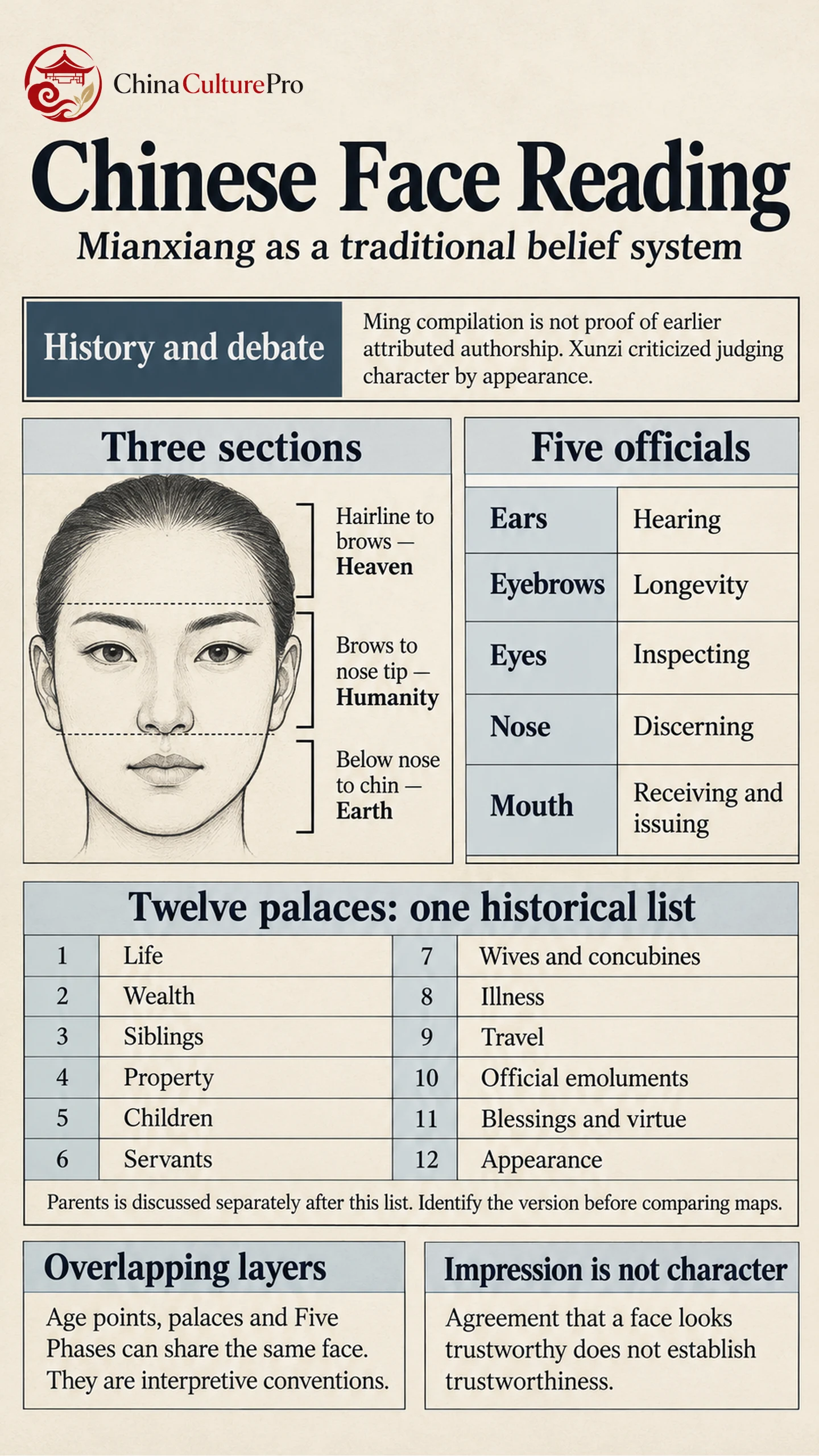
A Chinese face-reading chart combines several kinds of map on one face. A forehead can belong to a broad horizontal section, carry a named palace and contain numbered age positions. Those layers answer different questions within the tradition; they are not competing anatomical discoveries.
The most useful way into the subject is to learn what each layer organizes, identify the version being used and distinguish a manual’s claims from evidence about real people.
A History of Manuals and Competing Views
The Shenxiang Quanbian (神相全编, Shénxiàng Quánbiān) is a major compilation of Chinese physiognomy. Its transmission illustrates a common historical problem: a work can claim an illustrious earlier author while its surviving compilation belongs to a later period. Scholarship identifies Yuan Zhongche, active in the early Ming, as its compiler while distinguishing the edition’s attribution to Chen Tuan.[1]
Detailed surviving manuals and references to appearance in older writings are different kinds of evidence. Research on the textual tradition identifies dated manuals surviving from the tenth century onward. That does not make every method in a modern chart a tenth-century invention.[1]
Criticism also belongs inside the Chinese history of the subject. The opening of the Xunzi chapter against physiognomy places the mind and the way a person follows above outward form. Attractive appearance need not accompany good conduct, and unattractive appearance does not prevent moral worth.[4]
Chinese thought therefore cannot be reduced to unanimous acceptance of face reading. The manuals preserve systems of belief, while philosophical criticism supplies a way of questioning their assumptions from within Chinese intellectual history.
Three Sections and Five Officials
The Three Sections divide the face horizontally. The cited manual links them to heaven, humanity and earth and discusses early, middle and later phases of life.[2]
| Section | Approximate span | Cosmological association |
|---|---|---|
| Upper | Hairline to brows | Heaven |
| Middle | Brows to nose tip | Humanity |
| Lower | Below the nose to chin | Земля |
The Five Officials give five features bureaucratic titles. Here are the features attached to those titles in the same textual tradition.[2]
| Traditional title | Характеристика |
|---|---|
| Hearing Official (采听官, cǎitīng guān) | Ears |
| Longevity Official (保寿官, bǎoshòu guān) | Eyebrows |
| Inspecting Official (监察官, jiānchá guān) | Eyes |
| Discerning Official (审辨官, shěnbiàn guān) | Nose |
| Receiving and Issuing Official (出纳官, chūnà guān) | Mouth |
These are overlapping classification tools: the nose is both a feature and part of a horizontal section. “Official” is a metaphorical role, not a claim that a feature performs administrative work. Likewise, calling eyebrows the Longevity Official does not mean measuring eyebrows measures lifespan.
Twelve Palaces: Identify the Actual Version
The Twelve Palaces organize life themes. This table follows the numbered list in the cited encyclopedia transcription, retaining its historical categories.[3]
| Palace | Location in the list’s description |
|---|---|
| Life Palace (命宫, mìnggōng) | Between the brows |
| Wealth Palace (财帛宫, cáibó gōng) | Nose |
| Siblings Palace (兄弟宫, xiōngdì gōng) | Eyebrows |
| Property Palace (田宅宫, tiánzhái gōng) | Eyes |
| Children Palace (男女宫, nánnǚ gōng) | Under the eyes |
| Servants Palace (奴仆宫, núpú gōng) | Chin region |
| Wives and Concubines Palace (妻妾宫, qīqiè gōng) | Outer eye corners |
| Illness Palace (疾厄宫, jí’è gōng) | Nose root |
| Travel Palace (迁移宫, qiānyí gōng) | Outer brow corners |
| Official Emoluments Palace (官禄宫, guānlù gōng) | Central forehead |
| Blessings and Virtue Palace (福德宫, fúdé gōng) | Upper side forehead and chin |
| Appearance Palace (相貌宫, xiàngmào gōng) | Overall face |
The numbered list ends with Appearance; a following passage separately discusses the Parents Palace (父母宫, fùmǔ gōng). Its Property entry initially identifies the eyes. These details matter when comparing charts with a different twelfth category or narrower property zone.[3]
A clean modern diagram can conceal such textual variation. Give its edition or method rather than claiming that every map agrees. The terms concerning servants and wives or concubines also preserve the social arrangements of historical texts; they are not neutral categories for judging people today.
Age Maps and Cosmological Correspondences
Flowing Years (流年, liúnián) is a traditional label for age-related timing. A year-by-year facial map assigns successive ages to positions. The cited manual places age fifteen at the forehead and forty-eight at the nose tip, for example.[3]
That is a convention for locating an interpretation within the system. It does not show that a mark at the selected point causes or predicts what happens at that age. A historical chart and a record of someone’s actual life would need separate evaluation.
The Five Phases (五行, wǔxíng)—wood, fire, earth, metal and water—also supply classifications of shape and complexion in this literature.[2] They belong to a wider network of Chinese cosmological correspondences. Our Five Phases guide explains the framework beyond face reading.
When comparing charts, distinguish a feature name from a palace name, age position or phase classification.
Reading a Tradition Without Judging a Person
People can agree that a face looks trustworthy without accurately knowing whether its owner is trustworthy. Research on social judgments distinguishes agreement in impressions from their diagnostic validity and argues that the latter has often been overstated.[5]
This is an essential distinction for reading old manuals. A confidently expressed interpretation, a detailed diagram and a long history of use do not independently establish that interpretation’s truth. Repetition can document the circulation of an idea without documenting its accuracy.
Use the vocabulary to understand a text, an illustration or an episode of cultural history. Avoid using a nose, scar, facial proportion or complexion to decide whether someone deserves a job, a relationship or respect. Personal conduct supplies evidence of conduct; an inherited palace label does not.
The companion guide to Chinese palm reading shows a similar need to separate the vocabulary of interpretation from conclusions about a living person.
FAQs About Chinese Face Reading
Is Chinese face reading the same as reading expressions?
No. Interpreting a momentary expression and assigning fortune to a named facial region are different tasks. This article concerns the latter tradition, not a method for identifying emotions.
Why do twelve-palace charts disagree?
Texts can preserve different arrangements, and English labels may compress their distinctions. Identify the actual manual or method before comparing their boundaries.[3]
Can a face reveal wealth, lifespan or trustworthiness?
A traditional label does not demonstrate any of these. Agreement about a facial impression should not be confused with reliable knowledge of the person.[5]
Источники
[1] Livia Kohn. A Textbook of Physiognomy: The Tradition of the Shenxiang Quanbian
[2] Classical text transcription. Gujin Tushu Jicheng, Arts section, volume 632
[3] Classical text transcription. Gujin Tushu Jicheng, Arts section, volume 631
[4] Xunzi, Chinese Text Project. On Physiognomy
[5] Todorov, Olivola, Dotsch and Mende-Siedlecki. Social attributions from faces: determinants, consequences, accuracy, and functional significance