

Quick Answer: Are Yin–Yang and the Five Elements the Same?
Yin and yang (阴阳, yīnyáng) and the Five Elements, or wuxing (五行, wǔxíng), are related Chinese frameworks. Yin–yang describes paired, relative tendencies; wuxing organizes relationships through five phases.
- Yin and yang are interdependent rather than two isolated substances.
- Wuxing uses Wood (木, mù), Fire (火, huǒ), Earth (土, tǔ), Metal (金, jīn) and Water (水, shuǐ) as phase categories.
- The systems can combine: a phase can receive either yin or yang classification.
- A traditional classification does not establish a fixed personality or a scientific prediction.
They answer different questions and should not be treated as rival systems from which a reader must choose.
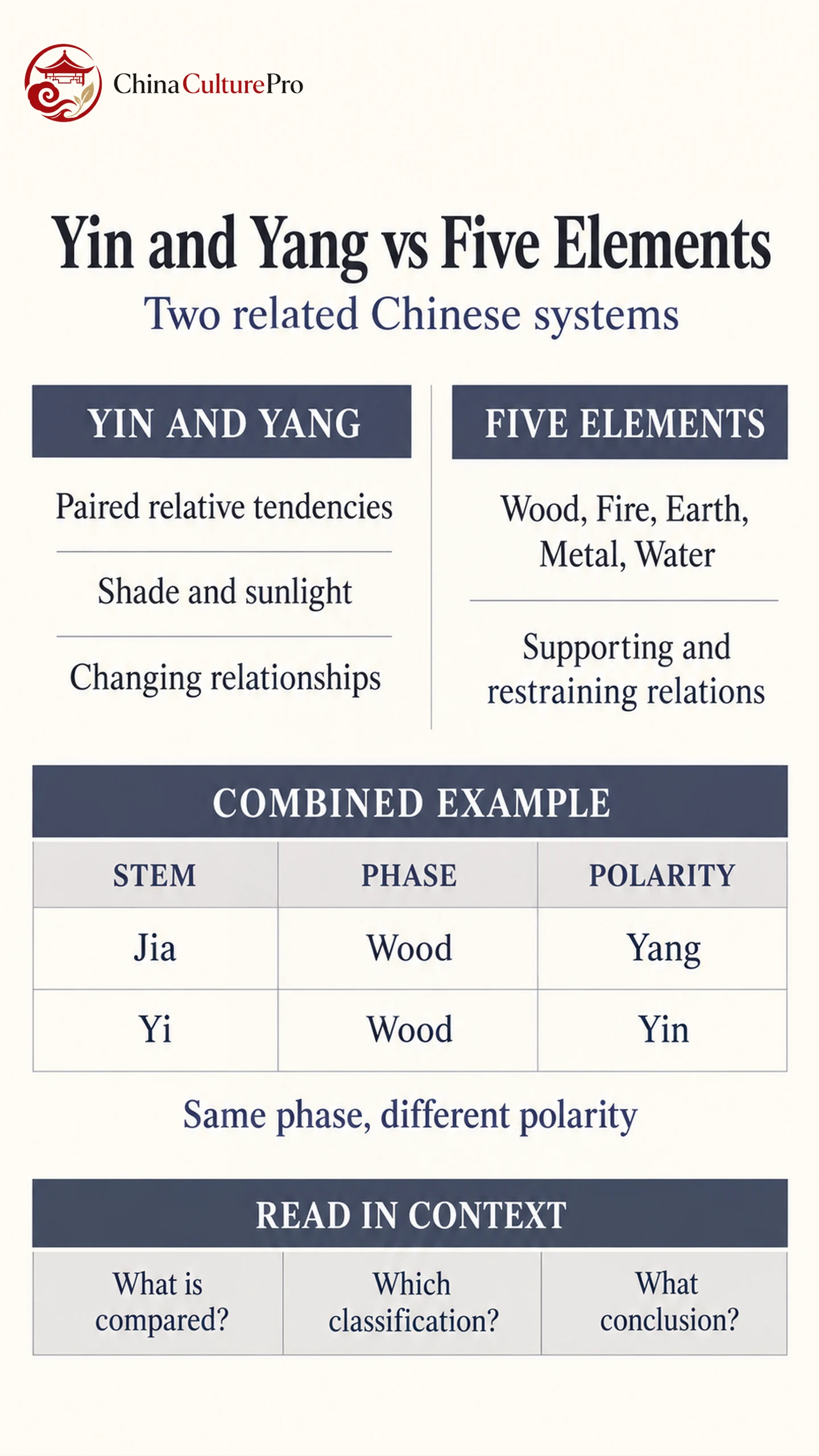
The useful difference is between the kind of relationship each framework describes. A statement about a sunny and shady slope is not doing the same work as a statement about Wood generating Fire. Both can appear within Chinese cosmology, but the words do not become interchangeable simply because they occur together.
Yin and Yang Describe Relative Tendencies
Yin and yang describe paired tendencies understood in relation to each other. Familiar associations include shade and sunlight, coolness and warmth, stillness and activity. The comparison and context matter; the terms are not simply permanent labels attached to separate kinds of things.[1][4]
The sunny and shady sides of a mountain offer a useful starting image. They are aspects of one landscape, distinguished by their relation to sunlight.[4] Asking which side is shaded tells you more than calling the mountain itself permanently yin or yang.
Change also matters. Yin–yang discussion often concerns waxing and waning, interaction and transformation, rather than a frozen division into two equal halves.[1] A daily cycle, for example, contains transitions as well as the broad contrast between day and night.
This is why “yin means bad and yang means good” is a poor general definition. Historical social applications could nevertheless be hierarchical: cosmological language was used to interpret differences of gender, age and status.[4] Conceptual interdependence should not be rewritten as a claim that every historical use was egalitarian.
Five Elements Describe a Fivefold Pattern
Wuxing is a fivefold framework of interrelated phases and processes. Its five names are Wood, Fire, Earth, Metal and Water. “Five phases” helps emphasize dynamic relations, while “Five Elements” remains familiar English.[2]
The framework includes generating and controlling sequences. Wood generating Fire describes one supporting relationship; Water controlling Fire describes a restraining one. Neither is a complete chemical explanation. See the two cycles guide for all ten connections.
| Сравнение | Yin and yang | Пять элементов |
|---|---|---|
| Basic pattern | Two interdependent tendencies | Five interrelated phase categories |
| Typical question | What is relatively shaded, active, inward or outward? | Which phase and which supporting or restraining relation? |
| Знакомый пример | Shady and sunny aspects of a landscape | Wood generating Fire |
| Распространённая ошибка | Treating people or objects as permanently one-sided | Treating phases as five modern chemical ingredients |
Seasonal imagery helps illustrate the fivefold pattern: growth is associated with Wood, summer maturation with Fire, ripening with Earth, autumn harvest with Metal and winter storage with Water.[5] These are traditional interpretive associations, not a requirement that every climate follow an identical five-season calendar. The wuxing reference explains their wider correspondences.
How the Two Systems Work Together
The systems were associated in correlative cosmology by the Han period.[1] Their combination is particularly clear in the ten Heavenly Stems, where each phase has a yin and a yang stem.[3]
| Ствол | Фаза | Polarity |
|---|---|---|
| Jia (甲, Jiǎ) | Дерево | Ян |
| Yi (乙, Yǐ) | Дерево | Инь |
Both entries are Wood; their polarity differs. This directly shows why “Wood is always yang” is too broad. Conversely, saying something is yang does not by itself identify which of the five phases it belongs to.
The table is a classification example, not a personality assessment. In a traditional birth-chart discussion, a stem occupies a specific position; an entire chart contains more information than one label. The BaZi and zodiac comparison separates a full four-pillar chart from a birth-year animal.
Read the Comparison Without Fixed Labels
When you encounter either framework, first identify what is being compared. Does “yin” describe a relation to another activity, or is the writer assigning a conventional polarity within a calendar table? Does “Wood” identify a phase, a stem’s classification or a literal material? The surrounding method determines how the word is being used.
Keep classification separate from prediction. In feng shui, for example, a symbolic category can inform an interpretation of a space; it does not demonstrate that adding one object will produce a particular life event. A framework may be culturally influential without every claim made in its name being established.
For further context, Chinese philosophy of nature explores how thinkers connected the human and natural worlds. Here, the key reading skill is preserving both the relationship being described and the scale of the claim.
FAQs About Yin–Yang and the Five Elements
Is yin bad and yang good?
No. That is not a useful general definition of a relational pair. Historical uses could rank particular social relationships, but that does not make good versus evil the meaning of the concepts.
Is Wood always yang?
No. The Heavenly Stems include both yang Wood and yin Wood. A phase name alone does not settle its polarity in every classification.
Do the Five Elements replace yin and yang?
No. The frameworks can operate together, describing different aspects of a traditional classification rather than replacing one another.
Does balance mean equal amounts of everything?
Not as a general rule. These frameworks discuss relationships and changing conditions; neither “half yin, half yang” nor equal quantities of all five phases is a universal numerical requirement.
Источники
[1] Robin R. Wang, Internet Encyclopedia of Philosophy. Yinyang (Yin-yang)
[2] Internet Encyclopedia of Philosophy. Wuxing (Wu-hsing)
[3] Joseph A. Adler, Kenyon College. Stems-Branches
[4] Columbia University, Asia for Educators. The Chinese Cosmos: Basic Concepts
[5] University of Minnesota, Taking Charge of Your Wellbeing. Five Phases of Transformation or the Five Elements