
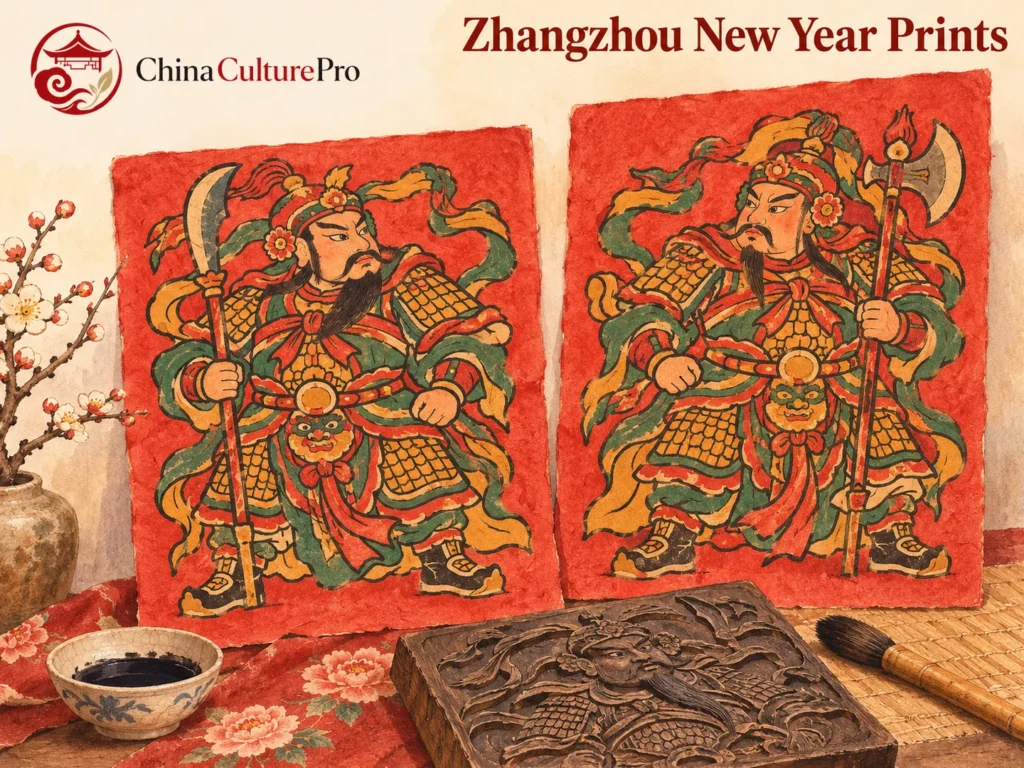

Quick Answer: What Are Zhangzhou New Year Prints?
Zhangzhou New Year prints (漳州木版年画, Zhāngzhōu mùbǎn niánhuà) are woodblock pictures from southern Fujian. Printers use separate blocks for different colors and add a dark outline impression after the colors. Door gods (门神, ménshén) are a prominent subject.[1][2]
- Paper: Some door prints start on scarlet paper. Others start on a natural-colored sheet and receive a printed background.[1][3]
- Images: Paired guardians, blessings, theater stories and festival subjects appear in the repertoire.[1][3][4]
- Circulation: Prints made in Zhangzhou traveled through southern Fujian and to Taiwan, Hong Kong and Southeast Asia.[1][5]
The color of the sheet, the color printed behind the figure and the final black lines are three separate clues to how a print was made.[1][2][3]
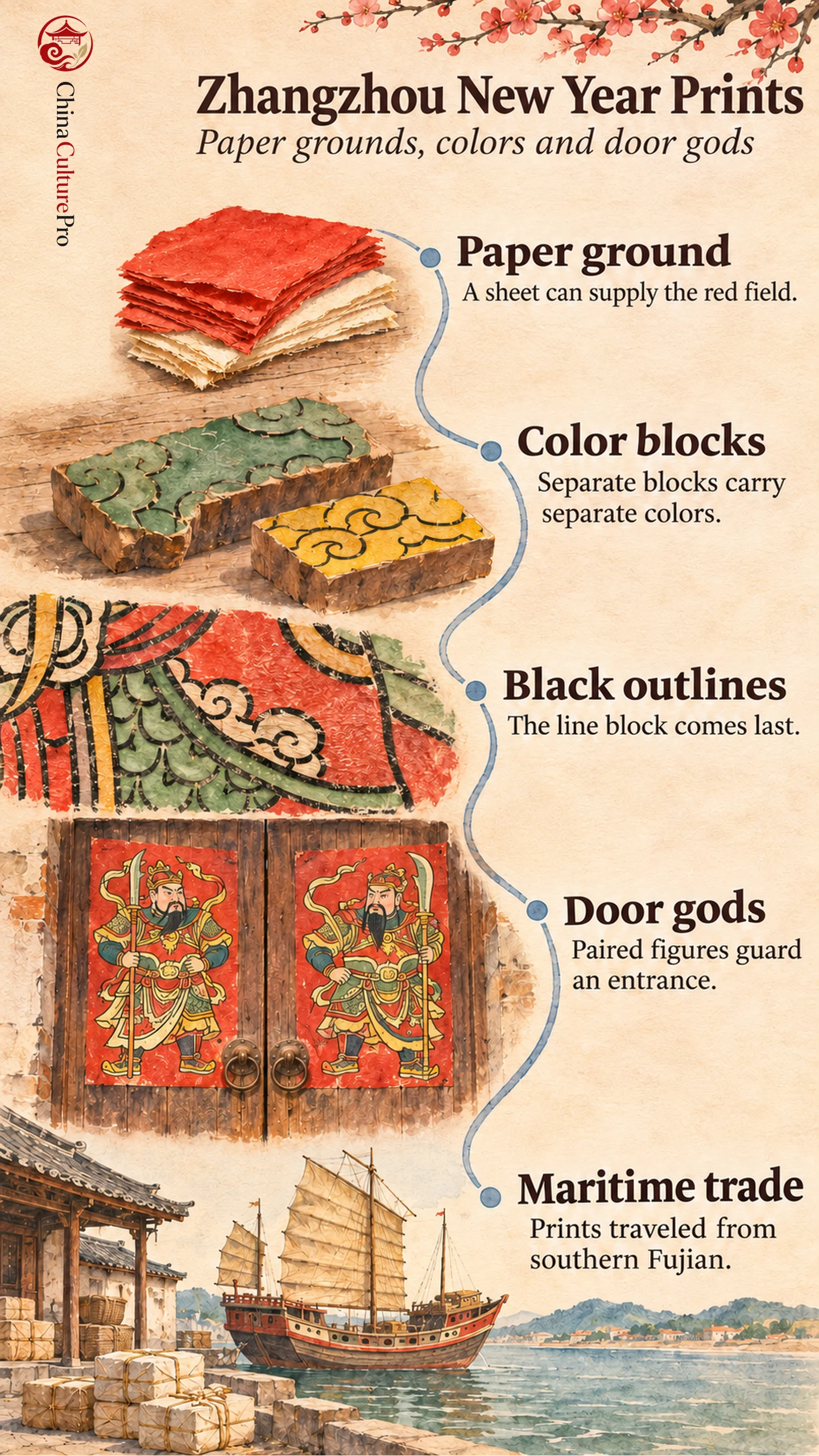
On a Zhangzhou door print, a dark outline can run across a green sleeve and the red field behind it. Each color has its own place in the image. The black lines bring the figure into focus at the end of the printing sequence.[1][2]
How Zhangzhou Printers Build Color and Outline
Carvers divide a design among several blocks. One block carries the black outlines and others carry areas of color. The national heritage record names pear wood among the woods used and identifies several papers from western Fujian. Workshop accounts describe successive impressions of color, followed by the black line impression.[1][2]
Each impression must meet the others in roughly the right place. The printed edge of a sleeve can drift a little beyond the black line around it. Yan Chaojun describes aligning the blocks by eye and leaving the finished impression without brush touchups in the practice he documents. That small shift can help explain how separate blocks met on a single sheet. Use a collection or workshop record when identifying where a particular sheet was printed.[2]
In Zhuxian New Year prints, another woodblock tradition, the sequence of impressions is a useful point of comparison. For Zhangzhou work, look for the black lines lying visibly over the neighboring fields of color.[1][2]
Door Gods, Paper Grounds and New Year Uses
The national register describes two named approaches to door-print backgrounds. Cushen (粗神, cūshén) prints use bright red or vermilion paper as their ground. Youshen (幼神, yòushén) prints start on natural-colored paper and add a pale red field around the figure with a background block. On the first sheet, red extends to the paper’s edge. On the second, the block determines the boundary of the colored field.[1][3]
The subject is a separate decision. The University of Hong Kong Libraries exhibition guide records military guardians such as Qin Qiong and Jingde, and civil or blessing images such as the Heavenly Official Bestowing Fortune. Figures on horseback or with banners are clues to the martial group described in the Zhangzhou heritage record. See Chinese door gods for the wider practice of placing paired protectors on entrances.[1][3]
The same exhibition guide records prints with kitchen deity and Mazu subjects and even decorations for above the doorway. It also describes dark papers used in Zhangzhou. The subject and the intended position of an image both help explain why workshops made so many forms and sizes.[3]
The Yan Family and the Prints’ Maritime Circulation
The national heritage profile records the rise of local New Year print production in the Ming and Qing periods and links overseas sales with trade through Yuegang. A print could travel well beyond the street where its block was carved. The regional setting also helps explain connections between Zhangzhou images and the broader traditions of Minnan culture.[1][5]
The Yan family workshop preserved old blocks and continued to print. The national heritage biography of Yan Shiguo records his apprenticeship with his father Yan Wenhua and identifies works featuring Shentu and Yulei, a pair of door guardians. Another family maker, Yan Chaojun, has worked from surviving designs to recut missing blocks. The national register added Zhangzhou woodblock New Year prints in 2006.[1][2][4]
FAQs About Zhangzhou New Year Prints
Are Zhangzhou New Year prints always on red paper?
Red paper is characteristic of one group of door prints. Zhangzhou printers have also worked on natural-colored and dark sheets. Some prints on natural-colored paper gain a red field from a separate impression.[1][3]
Do the printers apply the black outlines first?
The documented Zhangzhou practice starts with the colors and adds the black line block at the end. The outlines sharpen the boundaries where several color impressions meet.[1][2]
What were the red and black workshops?
In the national register’s account, the red workshops printed New Year pictures and the black workshops printed texts. The terms name workshop trades. The color of a finished sheet is a separate feature.[1][3]
Источники
[1] China Intangible Cultural Heritage Digital Museum. Zhangzhou woodblock New Year prints, national heritage record
[2] Fujian Provincial Government. Yan Chaojun on printing, carving and preserving Zhangzhou blocks
[3] University of Hong Kong Libraries. Exhibition guide to regional New Year prints, Zhangzhou section
[4] China Intangible Cultural Heritage Digital Museum. Yan Shiguo, apprenticeship and representative works
[5] Fujian Provincial Government. Zhangzhou woodblock New Year paintings