


Quick Answer: What Are Huishan Clay Figurines?
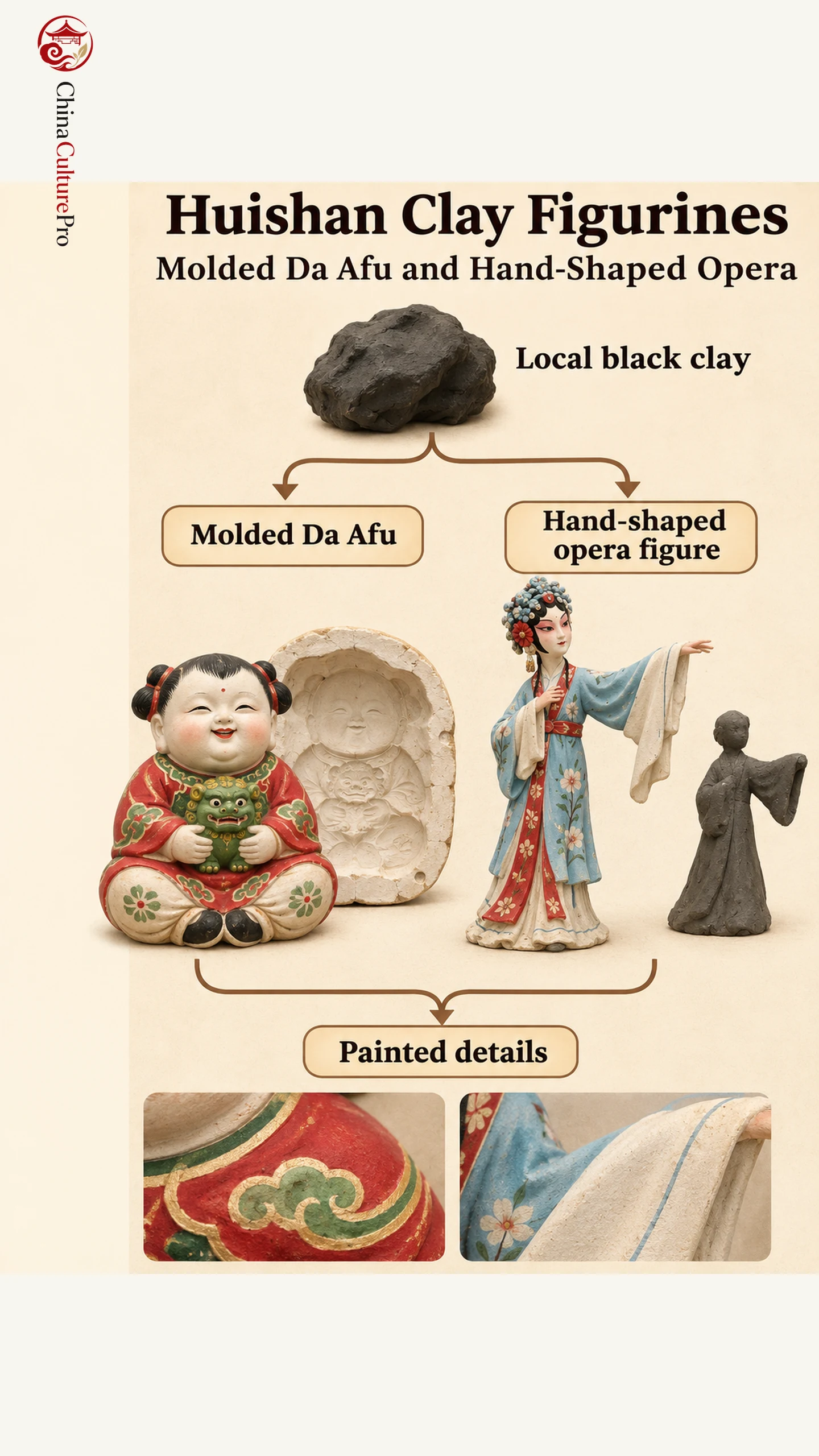
Huishan clay figurines (惠山泥人, Huìshān nírén) are painted clay sculptures associated with Huishan in Wuxi, Jiangsu. The craft includes molded figures such as Da Afu and hand-shaped figures inspired by opera, stories and customs. The two forms use the clay body and painted details differently. [1][2][3]
- Clay: Traditional makers use fine black clay from near Huishan.
- Molded form: A mold can reproduce a compact figure such as Da Afu, which is then painted by hand.
- Hand-shaped form: Makers can shape a pose, fold or sleeve to capture a particular scene. [1][2][3][4]
Look at the silhouette and the paint separately. On an opera figure, a brush line and a fold in the clay may work together to show a gesture.
Two Wuxi Museum pieces give black clay very different shapes. One is a seated child whose hands, feet and animal companion make a compact form. The other arranges a whole group of figures on a small stage.
Black Clay, Molds and Hand Shaping
The national register describes using fine black clay from near Huishan. In a molded figure, a maker presses the clay into a form to produce a blank. The National Library notes that this blank is painted by hand. In hand-shaped work, the maker forms the pose directly, rolling, pressing or pinching the clay. A long sleeve can be modeled to hang or curve as part of that pose. [1][2][3]
A Wuxi report describes Zhang Xiaoying rolling clay for an opera figure’s head, marking the eyes with her thumb and picking out the ears. These small changes establish a face before paint brings out its expression. Paint can bring out the edge of a sleeve or divide a costume into areas of color. A workshop saying recorded in the national entry gives painting a larger role than shaping, a way of emphasizing how much the final expression depends on the brush. [1][2][5]
What to Look for on Da Afu
Da Afu (大阿福, Dà Āfú) is a well-known figure in the group called cūhuò (粗货), often translated as coarse goods. Molding makes it possible to repeat the broad face and compact body. Bold blocks of paint make the hands, costume and animal easy to pick out within that compact shape. [1][3][4]
The Qing Da Afu in Wuxi Museum is about 22 centimeters tall. The child sits cross-legged, with a peony on the head, a longevity lock at the chest and a small green lion in the arms. The lion fits into the circle of the seated figure. Wuxi Museum relates the lion to a local story about a child subduing a beast. It also links the peony and the lock with wishes for prosperity and long life. [2]
How Makers Put an Opera Scene into Clay
The category known as xìhuò (细货), or fine goods, includes hand-shaped characters from Китайская опера. This work is called shǒuniē xìwén (手捏戏文). A turn of the head or the curve of a long sleeve can give the same clues to action that viewers get from a stage performance. [1][2][3]
Wuxi Museum records a late Qing Peach Banquet ensemble made for a commission in 1884. Zhou Asheng shaped the clay and Chen Xingfang painted it. Twenty-four immortal figures occupy four levels around the banquet scene. The tiers keep smaller figures visible around the central banquet scene. Painted details let viewers pick out individual robes and objects across the group. [2]
How the Craft Continues in Wuxi
Wuxi Museum records another partnership between Yu Xianglian, who shaped figures, and Wang Nanxian, who painted them. Their work includes Li Huiniang. The museum connects the curved modeling in their work with the motion of long sleeves in Kunqu opera. [2][3]
A 2026 Xinhua Finance report documents Shi Yifan working with teacher Zhou Lu at the Huishan clay figurine factory. Her new design pairs a rounded white horse with a red apple. The round form is easy to recognize across a room. The red apple also carries a wordplay on píng’ān, a wish for safety and peace. [6]
FAQs About Huishan Clay Figurines
What do coarse goods and fine goods mean?
Coarse goods usually refers to molded pieces such as Da Afu, often painted by hand. Fine goods usually refers to hand-shaped figures, including detailed scenes from opera. [1][3][4]
Are all Huishan figures based on opera?
The repertoire includes figures associated with good fortune and everyday life, as well as opera, stories and myths. Da Afu belongs to the auspicious molded group. [1][2][3]
When were Huishan clay figurines nationally listed?
Huishan clay figurines entered China’s first national intangible cultural heritage list in 2006. [1]
Источники
[1] China Intangible Cultural Heritage Network. Clay Sculpture: Huishan Clay Figurines
[2] Wuxi Museum. Huishan Clay Objects in the Wuxi Museum
[3] National Library of China. Yu Xianglian and Huishan Clay Figurines
[4] Liu Jiakui, Chinese Social Sciences Net. Reading Huishan Clay Figurines
[5] Wuxi Municipal Government. Wuxi’s Intangible Heritage in Everyday Life
[6] Liu Taoxiong, Li Zhenbei and Li Zhihong, Xinhua Finance. Wuxi Clay Figurines and New Workshop Designs