
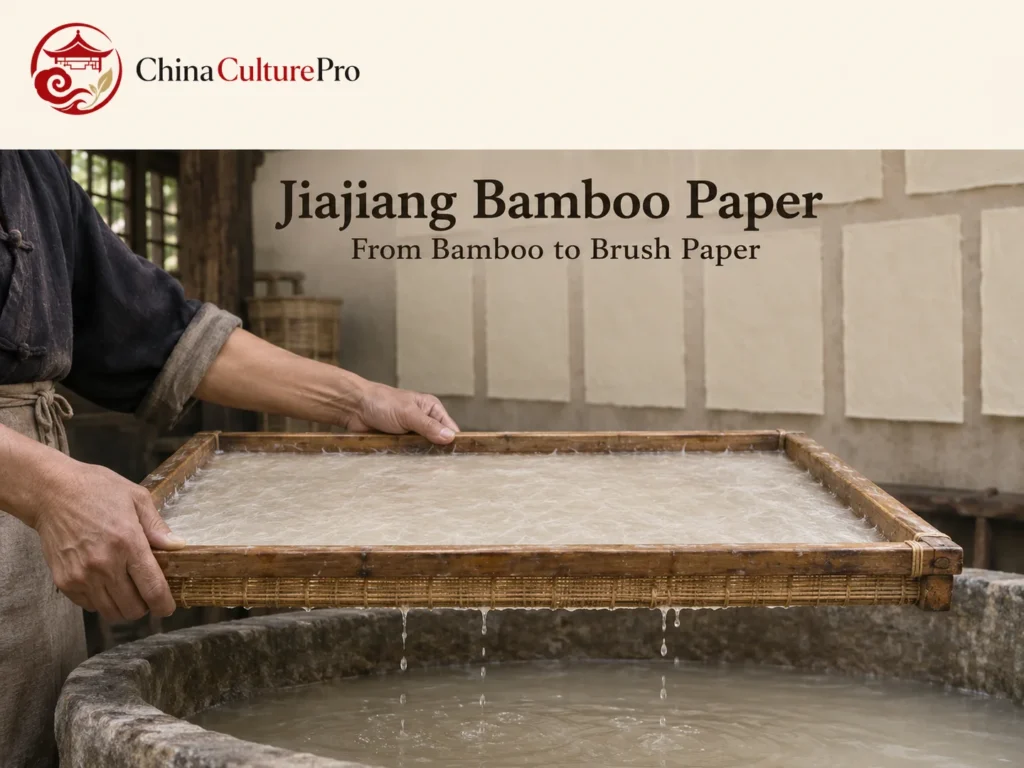

Quick Answer: What Is Jiajiang Bamboo Paper?
Jiajiang bamboo paper (夹江竹纸, Jiājiāng zhúzhǐ) is handmade paper from Jiajiang County, near Leshan in Sichuan. Makers prepare young bamboo as pulp, lift a thin layer of fibers on a fine screen and dry the pressed sheets. Some grades are made for Chinese ink painting and calligraphy. [1][2][3]
- Fiber: Young bamboo is softened and broken down into pulp.
- Screen: A fine bamboo screen holds the fibers as water drains away.
- Finishing: The wet sheets are pressed, separated and dried before trimming. [1][2][3]
The fiber preparation and the handling of the screen help determine how evenly a sheet forms.
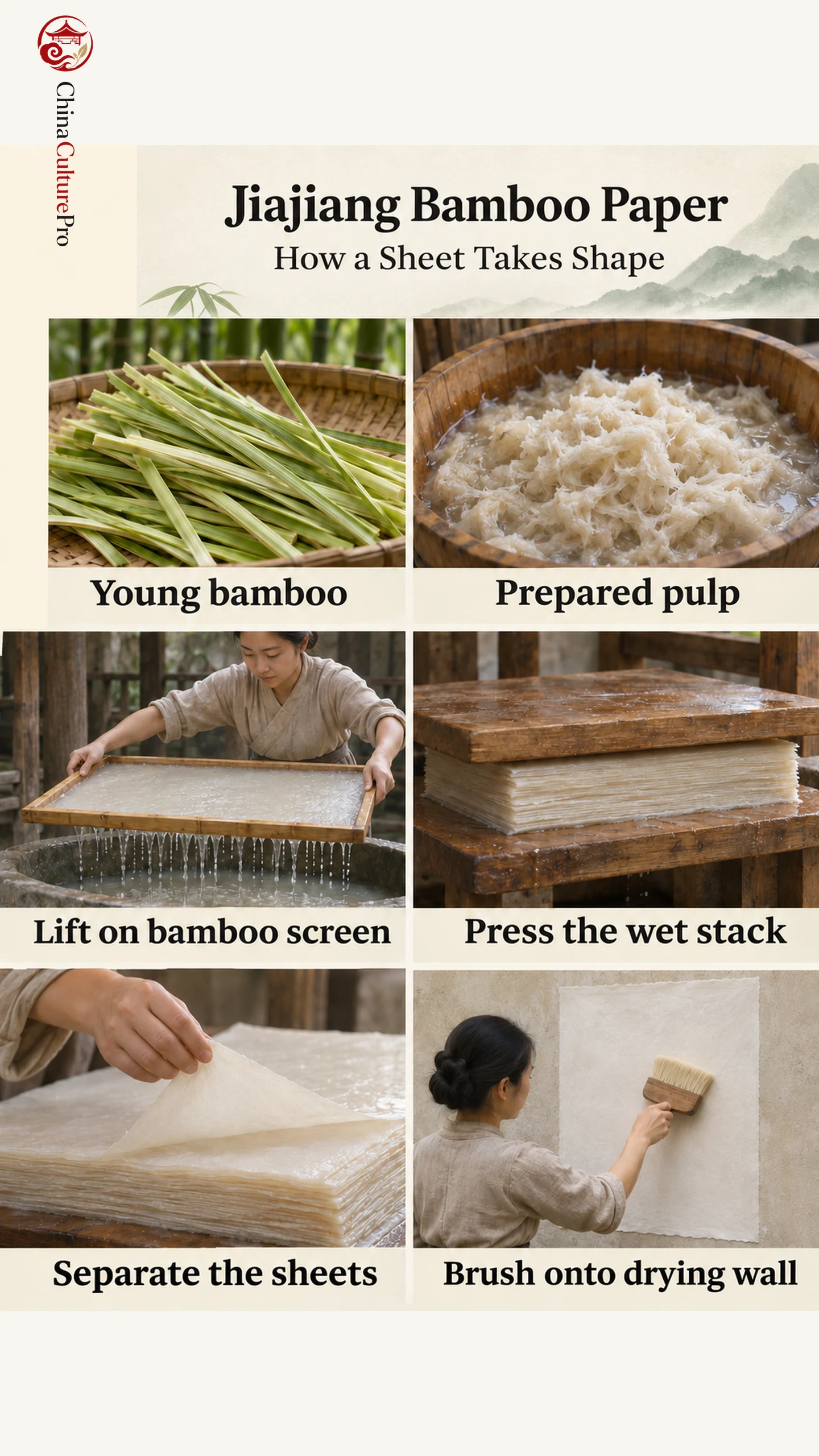
In a workshop in Shiyan village, a thin film of fibers stays on the bamboo screen when a papermaker lifts it from a vat. Across the room, damp sheets are brushed onto a wall to dry. Between those stations, the sheet has to stay even while the maker transfers and separates it.
From Young Bamboo to Pulp
Jiajiang lies along Sichuan’s Qingyi River. The national register records a long history of bamboo papermaking there, with expansion under the Ming and Qing dynasties. A Qing-period stele on papermaking lists preparing the bamboo, soaking, cooking, washing and pounding before it mentions the screen or drying wall. These steps soften and disperse the fibers so that the pulp can be diluted in a vat. [1][2][3]
In his study of a Sichuan papermaking community, historian Jacob Eyferth examines how families and workshops passed on knowledge and organized production. Preparing pulp, forming sheets and drying paper could be distinct jobs even within a small workshop. [3][4]
Lifting, Pressing and Drying a Sheet
At the Daqian Paper Workshop in Shiyan, a worker dips a fine bamboo screen into a vat and moves it to spread the fibers. As the worker lifts the screen, water drains through the mesh and leaves a wet layer of fibers. Small movements help distribute that layer across the whole screen. [2][3]
Workers transfer the layers into a stack and press out water. They lift the edge of each damp sheet from the pressed stack and brush the sheet flat against a wall. At the Shiyan workshop, the wall was heated to dry the paper. The dry sheets come off for measuring and trimming. [2][3]
How Artists Shaped Jiajiang Paper
During the war with Japan, painter Zhang Daqian worked with papermakers in Macun to develop sheets for painting and calligraphy. The Sichuan heritage account records names including Shujian и Lianhuajian. The named papers document a collaboration between an artist looking for a particular writing and painting surface and a community that knew how to make it. [2]
Another change concerned sheet size. The heritage account credits Jiajiang maker Yang Zhanyao with developing a locally made large-format bamboo paper known as yī zhàng èr (一丈二). Forming a larger sheet calls for spreading the pulp across a wider screen while keeping the wet layer even. The paper also has to hold together as workers lift and dry it. Paper is one of the four treasures of the study, and the sheet’s surface changes the effect of the same brush and ink. [1][2]
The Workshops Keeping the Skill in Use
In 2022, the county cultural center held a training session in Macun where papermaker Xu Wangchun guided hands-on work. Participants studied lifting a sheet and observed drying and finishing. In November 2025, the county published a proposed list of five workshops or producers in a handmade-paper certification pilot after site visits and sample testing. The list included the Zhuangyuan Paper Workshop and a cooperative that makes bamboo screens. [5][6]
FAQs About Jiajiang Bamboo Paper
Are Jiajiang and Fuyang bamboo paper the same regional craft?
They are two regional practices with separate entries under bamboo paper making. Jiajiang is in Sichuan and Fuyang is in Zhejiang. Both make paper from bamboo and have their own local products and workshop methods. [1]
Does every Jiajiang workshop use all 72 operations?
The national register describes the traditional process as 72 operations across 15 groups. The Shiyan workshop report describes a shorter sequence used there in 2019, with workers still forming sheets by hand. [1][2][3]
How does Jiajiang paper take ink?
The national register describes fine fibers and even wetting among the qualities of Jiajiang handmade writing and painting paper. The absorbency and feel can vary by sheet and finish. [1][2]
Источники
[1] China Intangible Cultural Heritage Network. Bamboo Paper Making, Jiajiang
[2] Sichuan Intangible Cultural Heritage via China Intangible Cultural Heritage Network. Jiajiang Bamboo Paper and Its Makers
[3] Luo Yuan, Sichuan Civilization Network. Jiajiang Paper at the Daqian Workshop
[4] Harvard Fairbank Center for Chinese Studies. Eating Rice from Bamboo Roots, by Jacob Eyferth
[5] Jiajiang County Culture and Tourism Bureau. Bamboo Paper Craft Training in Macun
[6] Jiajiang County Culture and Tourism Bureau. Proposed Workshops for the Handmade Jiajiang Bamboo Paper Certification Pilot