


Quick Answer: What Is Huizhou Ink?
Huizhou ink (徽墨, Huīmò) is solid ink from the historic Huizhou region, now associated with places in southern Anhui such as She County, Tunxi and Jixi. Ink makers bind fine soot with glue, press the mixture into a mold and dry it into a stick. A writer or painter grinds the stick with water on an inkstone. [1][2][3][5]
- Soot: Fine particles supply the black pigment.
- Glue: A binder holds the particles in a workable mass and then a dry stick.
- Mold: The mold gives the ink its shape and can transfer details to the surface. [1][3][4]
The molded sides can carry an image or a workshop mark. An end of the stick provides a surface for grinding.
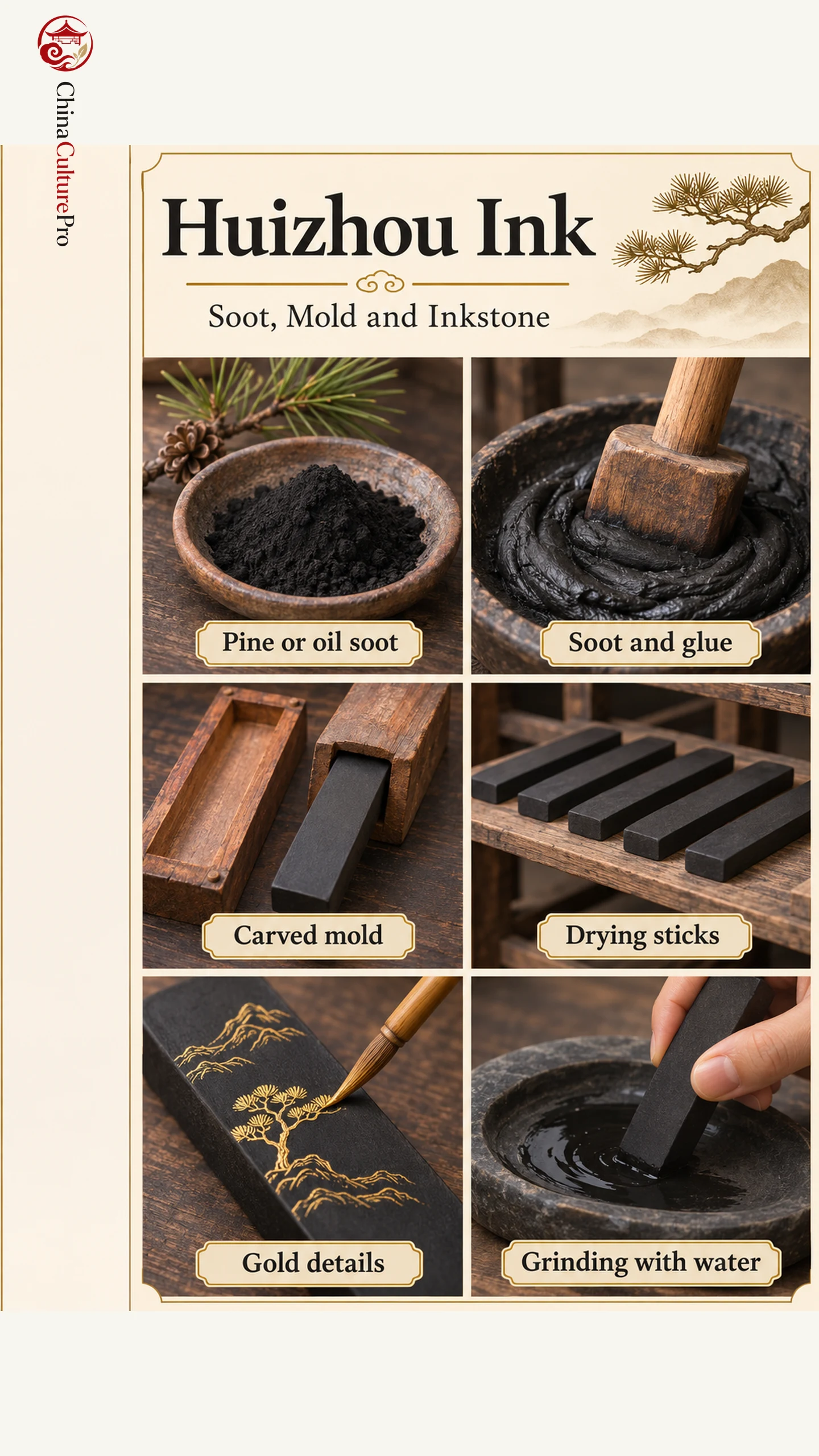
One Huizhou inkstick might have a plain end with a worn face and a broad side filled with gold details. The worn end shows where it meets the inkstone. The broad side records the work of the mold carver and the person who added color.
Pine Soot, Oil Soot and Glue
Pine soot, called sōngyān (松烟), comes from burning pine. A She County workshop report describes soot settling on the inside of a kiln and being collected after cooling. For oil soot, or yóuyān (油烟), the report describes workers collecting the black deposit from small bowls over oil lamps. The national register names more than one oil or other fuel used for soot. [1][3]
Glue binds the particles together. The workshop report describes mixing and repeatedly pounding the warm mass so that the soot and binder combine evenly. A maker can adjust materials and proportions for a particular kind of stick. Those choices happen before the carved details appear. [1][3]
How the Inkstick Gets Its Shape
In She County, workers divide the prepared mass into portions and press each into a mold. The mold defines the outline and can press a design or a name into the surface. The same carved mold can repeat those details on many sticks. [1][3][4]
The piece is removed and dried. Drying takes time and the length can vary with the piece. The stick has to hold its shape before the surface is finished. On some pieces a brush adds gold color to details already present on the surface. [3][6]
What a Qing Inkstick Shows
The Palace Museum holds a pair of Cao Sugong inksticks known as Ziyuguang (紫玉光) from the Kangxi period. They are rectangular, about 8.7 centimeters long. One has gold-filled lines for the design known as the True Forms of the Five Sacred Mountains. The backs have paired dragons, and the sides carry marks associated with the maker. [4]
The design covers several faces of a small object. A single face can carry both an image and a title, while a side mark gives information about the workshop. The museum records gold in recessed designs and lettering in relief on the edge. Those details invite a viewer to turn the stick and read each side. [4]
Grinding Ink and Teaching the Craft Today
At the desk, a little water and the grinding surface of an inkstone bring the stick into use. The writer rubs one end to release pigment into the water, then loads a brush with the resulting liquid. Ink, inkstone, paper and brush work together as the four treasures of the study. [3][5]
A 2026 report follows Zhou Jian at the old Hu Kaiwen factory in She County. He learned in the mold carving, ink making, drying and decorative workshops and helped open stages of the work to visitors. The separate workrooms make it possible to see how a prepared lump becomes a crisp molded form. Zhou’s workshop has also produced sticks in forms such as a stylized Tang horse, which uses the mold to give the ink a different silhouette. [6]
FAQs About Huizhou Ink
What is the difference between pine soot and oil soot ink?
The names refer to the source of the black particles. Pine soot is collected from burning pine. Oil soot comes from an oil flame, such as one fueled with tung oil. [1][3]
Do you grind the whole decorated face of an inkstick?
In ordinary use, one end of the stick is rubbed on the wet grinding surface. An inkstick’s wider face may carry relief, lettering or gold details. [3][4][5]
When was Huizhou ink making nationally listed?
Huizhou ink making entered the first national intangible cultural heritage list in 2006, with entries for She County, Tunxi and Jixi. [1][2]
Источники
[1] China Intangible Cultural Heritage Network. Huizhou Ink Making, She County
[2] China Intangible Cultural Heritage Network. Related National Heritage Projects
[3] Xu Jing, People’s Daily. Crafts Behind the Four Treasures
[4] Zhang Shufen, Palace Museum. Cao Sugong’s Ziyuguang Inksticks
[5] Asian Art Museum. An Introduction to Chinese Brushpainting Techniques
[6] Li Junjie, People’s Daily. Teaching Ink Making in the She County Workshop