
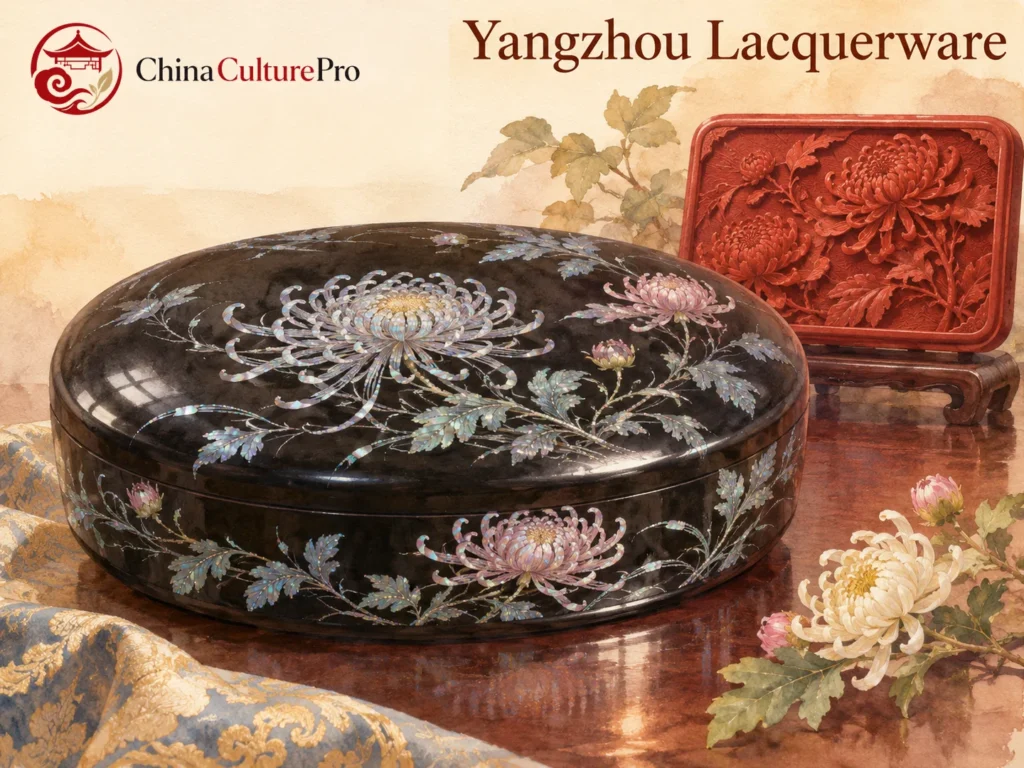

Quick Answer: What Is Yangzhou Lacquerware?
Yangzhou lacquerware (扬州漆器, Yángzhōu qīqì) is a Jiangsu craft family that includes several ways to finish and decorate objects with lacquer. In some pieces, carving gives the lacquer its relief. In others, shell inlay (螺钿, luódiàn) or different inserted materials form the design.[1][2][3][5]
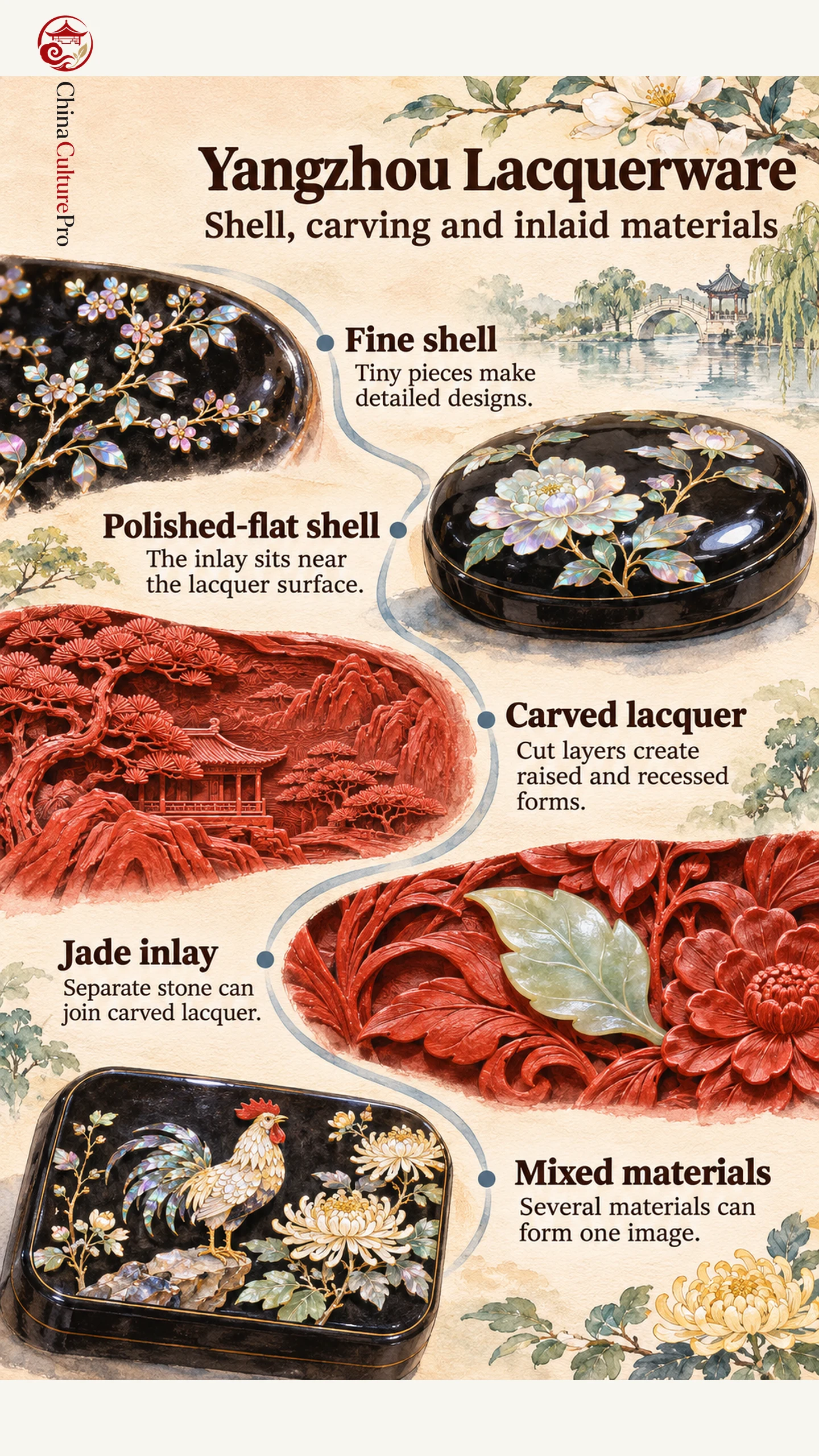
- Fine shell: Dianluo (点螺, diǎnluó) uses tiny, thin pieces of shell for a detailed motif.[2][5]
- Carved lacquer: Built-up lacquer layers supply material for raised and recessed forms.[1][2]
- Mixed inlay: Several materials can share one design on a prepared ground.[1][3]
The national inventory recognized Yangzhou lacquer decoration in its first batch in 2006.[1]
A flower on a glossy box can seem to change color when you turn it toward the light. A flower on carved red lacquer can change appearance for another reason: the raised edge throws a shadow. Yangzhou workshops developed several ways to make a design visible on the same kind of object.[1][2][3]
How Shell, Lacquer and Stone Make Different Surfaces
| Surface treatment | What forms the motif | На что обратить внимание |
|---|---|---|
| Fine shell inlay | Tiny shell dots, strips and other small pieces | Narrow details that reflect color as the angle changes |
| Polished-flat shell inlay | Shell pieces set into the surface and leveled | A shell design that sits close to the surrounding ground |
| Carved lacquer | A design cut into accumulated lacquer layers | Deliberate height changes and visible recesses |
| Carved lacquer with jade inlay | Carved lacquer and a separate inserted stone element | Two materials meeting within one composition |
A report from the Yangzhou Lacquerware Factory describes makers placing fine shell pieces individually on a smooth prepared surface for dianluo. A viewer can look for small reflective points, narrow strands and edges that vary with the light. The shell changes in brightness as the object turns. The dark lacquer gives those tiny shapes a contrasting background.[2][5]
A carved design uses a different surface treatment. The workshop report describes building up many lacquer coats before carving. Side light on the relief can reveal thickness even where the lacquer has a uniform color. In Pingyao polished lacquerware, the polishing of a finished surface offers another way to consider how lacquer itself affects what the viewer sees.[1][2]
Reading a Qing Inkstone Box
The Palace Museum holds a rectangular inkstone box from the Daoguang reign marked with the maker’s name Lu Kuisheng. The lid shows a rooster, chrysanthemums and rocks in many-treasures inlay (百宝嵌, bǎibǎoqiàn). The museum lists jade, shell, coral and turquoise among its materials. The rooster and plants are built from individual inlay pieces whose colors belong to their materials.[3]
The catalog also records a lacquer-sand inkstone inside and a red maker’s mark on the underside. The lid carries the design, the mark identifies the maker, and the inkstone is the working surface. This is one kind of inkstone and case. The account of She inkstones covers a separate material tradition for grinding ink.[3]
Yangzhou Workshops and the National Heritage Record
The national project connects Yangzhou with a long history of lacquer decoration and describes expansion during the Ming and Qing. It records several modern technique families under the same project. A 2019 workshop visit describes separate work areas for carving, shell inlay and mixed materials. Zhao Rubai’s national practitioner record describes how he joined the Yangzhou factory in 1956 and learned from lacquer carver Liang Guohai. Zhao later worked in the factory’s carving section and used relief, sculpture in the round and openwork in his designs.[1][2][4]
Materials can play different roles in related crafts. In Xiamen lacquer thread sculpture, a raised line can be made from a rolled lacquer paste applied to a prepared body. Yangzhou’s range includes methods in which the motif is cut into lacquer and others in which separate materials supply the shapes.[1][2]
FAQs About Yangzhou Lacquerware
Is all Yangzhou lacquerware carved red lacquer?
Yangzhou makers also use fine shell, polished-flat shell, jade and mixed-material inlay, alongside carved lacquer and painted surfaces.[1][2]
What makes dianluo different from other shell inlay?
The documented Yangzhou technique places very small, thin shell pieces individually. Look for tiny points and slivers of reflected color within a detailed design.[2][5]
Can one piece combine several materials?
Yes. Lu Kuisheng’s cataloged inkstone box is one documented example. Its lid combines shell, stone and other materials in a single composition on a lacquer ground.[3]
Источники
[1] China Intangible Cultural Heritage Digital Museum. Yangzhou Lacquer Decoration
[2] China Intangible Cultural Heritage Digital Museum. A Visit to the Yangzhou Lacquerware Factory
[3] The Palace Museum. Lu Kuisheng’s Inkstone Box with Inlaid Rooster Design
[4] China Intangible Cultural Heritage Digital Museum. Zhao Rubai
[5] The Palace Museum. Shell Inlay