

Quick Answer: Is Xuan Paper the Same as Rice Paper?
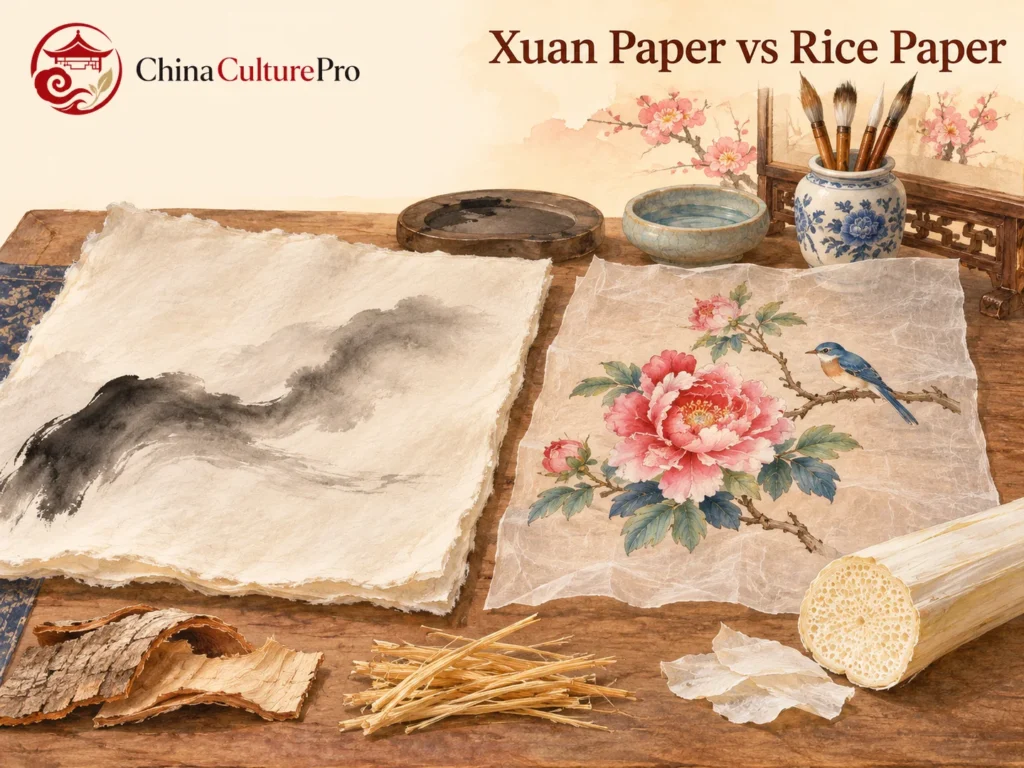
Xuan paper (宣纸, xuānzhǐ) is a traditional Chinese writing and painting paper made with bark fiber and rice straw. “Rice paper” is an English label used for several different materials. In an art shop it can refer broadly to brush paper. In a collection it may mean pith paper (通草纸, tōngcǎozhǐ). In a grocery it can mean an edible wrapper.[1][3][4][5][6]
- For art: Check the fiber description and whether the surface is sized.[1][2][3][7]
- In a museum: Look for a material description such as sliced plant pith.[4][5]
- For food: Look for packaging that identifies the sheet as a food wrapper.[6]
The words “rice paper” alone give too little information to identify a sheet.[3][4][5][6]

A pale sheet in a watercolor album and a pale sheet for calligraphy can carry the same English nickname. Their materials can differ, and so can the way they respond to a wet brush. Where you see the label is often the first clue.[1][3][4][5]
What Traditional Xuan Paper Is Made From
UNESCO’s record for traditional Xuan papermaking identifies Jing County in Anhui and two principal plant materials: blue sandalwood bark and rice straw. Papermakers prepare bark and straw as separate pulps before combining them for different grades. Papermakers lift the mixed pulp onto a screen so its fibers form a sheet. The material includes fiber from the stalk, which is a different part of the rice plant from the grain used as food.[1][2][6]
Xuan paper serves as a surface for ink and brushwork. A Xuan brush is a tool that puts the ink on the sheet. Both names connect to a region, and each craft has its own material and heritage record. UNESCO inscribed traditional Xuan papermaking in 2009.[1][2]
What “Rice Paper” Can Mean
| Where you see “rice paper” | What it can mean | Что уточнить |
|---|---|---|
| Art supply listing | A broad label for brush painting or calligraphy paper | Fiber content, product name and sizing |
| Museum or historic album | Thin sliced pith used as a painting support | Whether the record names pith or Tetrapanax |
| Food package | An edible sheet used as a wrapper | The label identifying it as a food product |
Kew’s conservation account explains that Chinese export painters worked on thin slices of the stem pith of *Tetrapanax papyrifer*. The sheet retains the structure of the plant’s inner tissue. Pulp paper is formed from separate fibers gathered together. The Library of Congress records that the thin, translucent pith has often been called “rice paper.” On those objects, the label refers to pith even though the material has no rice fiber.[4][5]
The same term can appear on sheets sold for Vietnamese rolls. Those sheets are food products. In a brush-paper listing, “rice paper” may be a broad translation without an exact fiber description. A material label or maker’s specification is more informative than appearance alone.[3][6]
Art-paper labels can name a different fiber entirely. The Chinese Brush Painters Society lists bamboo-fiber practice paper and paper-mulberry bark paper as separate supplies. Those papers can be useful for brushwork in their own right. A package that names its fibers gives you a clearer starting point than a generic translation on a storefront.[3]
How Sizing Changes the Ink Mark
Unsized Xuan (生宣, shēngxuān) tends to take up ink quickly, allowing a wet mark to spread into the fibers. Sized Xuan (熟宣, shúxuān) has a treatment that slows absorption, giving the painter more control over the edge of a line. Semi-sized sheets give painters another option between faster and slower uptake. The result still depends on the specific sheet, brush, water and ink.[3][7]
A broad ink wash can use that spreading to build soft changes in tone. Fine outlines generally benefit from a surface that keeps their edges readable. A test mark with the brush and ink you intend to use can show how the sheet behaves. See how the same material choice fits into Chinese painting techniques и Chinese calligraphy.[3][7]
FAQs About Xuan Paper and Rice Paper
Does Xuan paper contain rice?
Traditional Xuan papermaking uses rice straw and blue sandalwood bark. Straw supplies plant fiber for the sheet. A food wrapper is a different product.[1][2][6]
Why do museum labels sometimes say rice paper?
Historic Chinese export paintings were sometimes made on sliced plant pith. Older accounts may call that material “rice paper.” A modern catalog may specify pith or identify the plant.[4][5]
Which Xuan paper gives a more controlled line?
Sized Xuan generally slows the spread of ink and helps keep lines more defined. If the exact sheet is unfamiliar, a test mark can show its response.[3][7]
Источники
[1] UNESCO Intangible Cultural Heritage. Traditional Handicrafts of Making Xuan Paper
[2] China Intangible Cultural Heritage Digital Museum. Traditional Xuan Paper Making
[3] Chinese Brush Painters Society. Paper for Chinese Brush Painting
[4] Royal Botanic Gardens, Kew. Conserving Chinese Pith Paintings
[5] Library of Congress. Preserving Pith Paintings
[6] Go Vietnam. Bánh Tráng: Vietnamese Rice Paper
[7] University of Hong Kong Learning Archive. Xuan Paper