
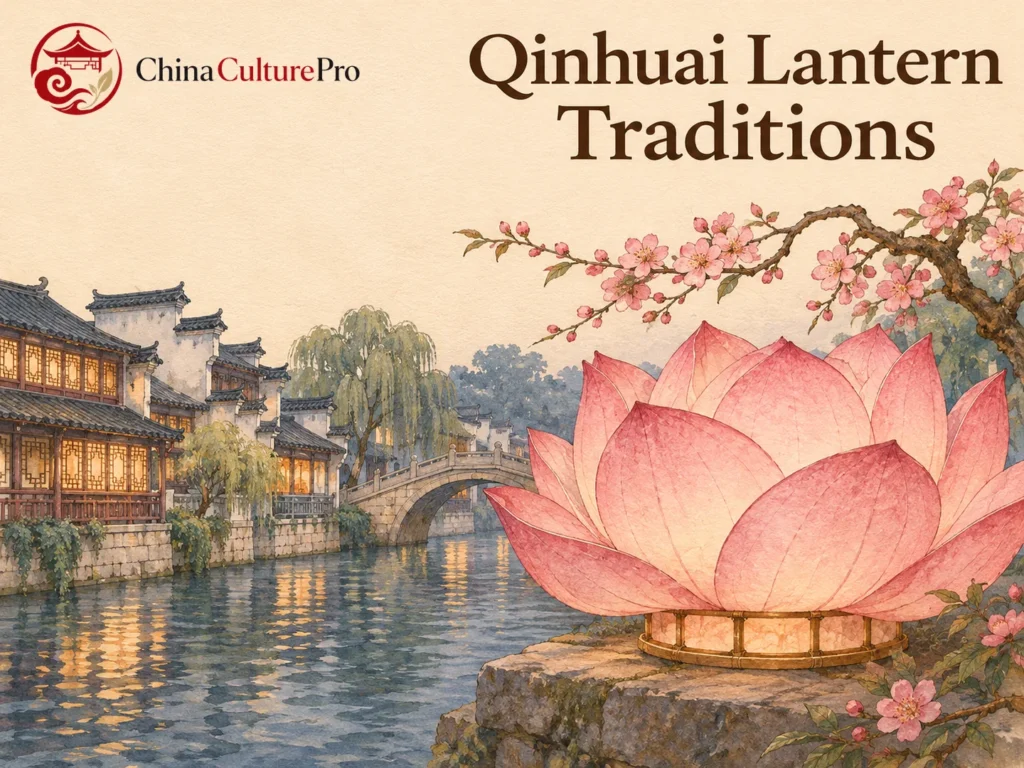

Quick Answer: What Are Qinhuai Lantern Traditions?
Qinhuai lantern craft (秦淮灯彩, Qínhuái dēngcǎi) is a tradition of making colored lanterns associated with Nanjing and the Qinhuai River area. Makers shape frames and cover them to create forms such as lotus flowers, rabbits and fish. The Qinhuai Lantern Fair (秦淮灯会, Qínhuái dēnghuì) is the public celebration in which many of these forms are displayed.[1][2][3][5]
- Structure: Thin bamboo strips and paper are documented in hand-built lanterns.[3]
- Forms: Petals and animal outlines give different lanterns their shapes.[2][5]
- Setting: The seasonal fair brings lanterns into streets and riverside spaces.[1][5]
China’s national heritage inventory records the Nanjing fair and a Jurong lantern-craft project under separate entries.[1][2]

A lotus lantern can read as a flower from several steps away. Get closer and you can see the curved outline of each petal and the paper stretched over it. The same craft takes on a different scale when lights are arranged across a street or along the river.[1][3][5]
What Makes a Lantern Look Like a Lotus
In a documented Nanjing workshop, the maker starts with thin bamboo strips bent into a frame. Thin paper covers the framework, and decoration completes the form. The bamboo provides the silhouette and carries the light covering. Color can be placed on the parts that need to read clearly once the lantern is lit.[3]
A lotus lantern needs a recognizable set of petals around the center. A rabbit lantern can depend on long ears and the outline of the body, while a goldfish can be recognized by its fins and tail. A maker bends or joins the frame to establish the petal, ear or fin before covering it. Painted, pasted or cut details then supply features that a bare frame cannot show.[2][3][5]
The tradition includes work that combines more than bamboo and paper. The Jurong entry describes influences from paper modeling, painting, paper-cutting and other arts. It lists boats and modern subjects among designs developed alongside familiar forms. For another approach to how a lantern is built, Quanzhou lantern craft includes techniques that make fine openings part of the illuminated surface.[2]
Why the Qinhuai River Matters
The fair belongs to Nanjing’s Qinhuai River area and the season from Spring Festival through the Праздник фонарей. The heritage entry traces older lantern celebrations in Nanjing and describes early Ming encouragement of the custom. It also records lanterns hung on decorated boats. Lanterns on boats placed light over the water as well as along the banks.[1]
The fair has been associated with the area around Fuzimiao, Nanjing’s Confucius Temple. A 2019 account describes lantern viewing on land and water, with displays and performances at different points around the historic district. A single hand-built lantern lets you study its outline and decoration. A fair also depends on how the lights are placed and how people pass through them.[1][5]
Two Heritage Entries and a Living Craft
The Qinhuai Lantern Fair in Nanjing entered the first national list of representative intangible heritage projects in 2006 under folk customs. In 2008, a Qinhuai lantern craft entry from Jurong in Jiangsu was added as an extension under traditional fine art. One entry describes the fair and its customs. The other describes lantern design and making. Jurong’s connection to the Qinhuai headwaters helps explain the shared regional name.[1][2]
Gu Yeliang learned lantern making from his father and later studied with the maker Li Guisheng. His record as a representative practitioner of the fair includes teaching at schools and colleges. Gu’s path shows how a skill learned at home and through apprenticeship could also be taught in a classroom.[4]
FAQs About Qinhuai Lanterns
What are Qinhuai lanterns made of?
One documented hand-built method uses thin bamboo strips for the frame and thin paper for the cover. Makers can add colored and decorative elements to define the design.[2][3]
Is the lotus the only traditional shape?
Lotus lanterns are a familiar form. Festival records also describe rabbits, goldfish and lions among the traditional designs.[2][5]
Do the craft and the lantern fair share a heritage entry?
They have separate national records. The 2006 entry concerns the Nanjing fair. The 2008 Jurong extension concerns Qinhuai lantern craft as traditional fine art.[1][2]
Источники
[1] China Intangible Cultural Heritage Digital Museum. Qinhuai Lantern Fair
[2] China Intangible Cultural Heritage Digital Museum. Lantern Art: Qinhuai Lantern Craft
[3] China Daily. An Ode to the Moon
[4] China Intangible Cultural Heritage Digital Museum. Gu Yeliang
[5] China Culture Daily. Lantern Viewing at the Qinhuai Fair in Nanjing