


Quick Answer: What Is Liyuan Opera?
Liyuan opera (梨园戏, Líyuánxì) is a theater tradition from Quanzhou in southern Фуцзянь. Performers sing in the local language and use a precise vocabulary of steps, hand positions and shifts of gaze.[1][2][3]
- History: The national heritage entry traces the form to Quanzhou in the Song and Yuan periods.[1]
- Sound: Drums, flutes and strings accompany the sung and spoken parts.[2]
- Movement: Watch a performer’s hand and feet during a single sung phrase.[3]
Start with the umbrella duet, where both performers use the prop to guide the exchange.
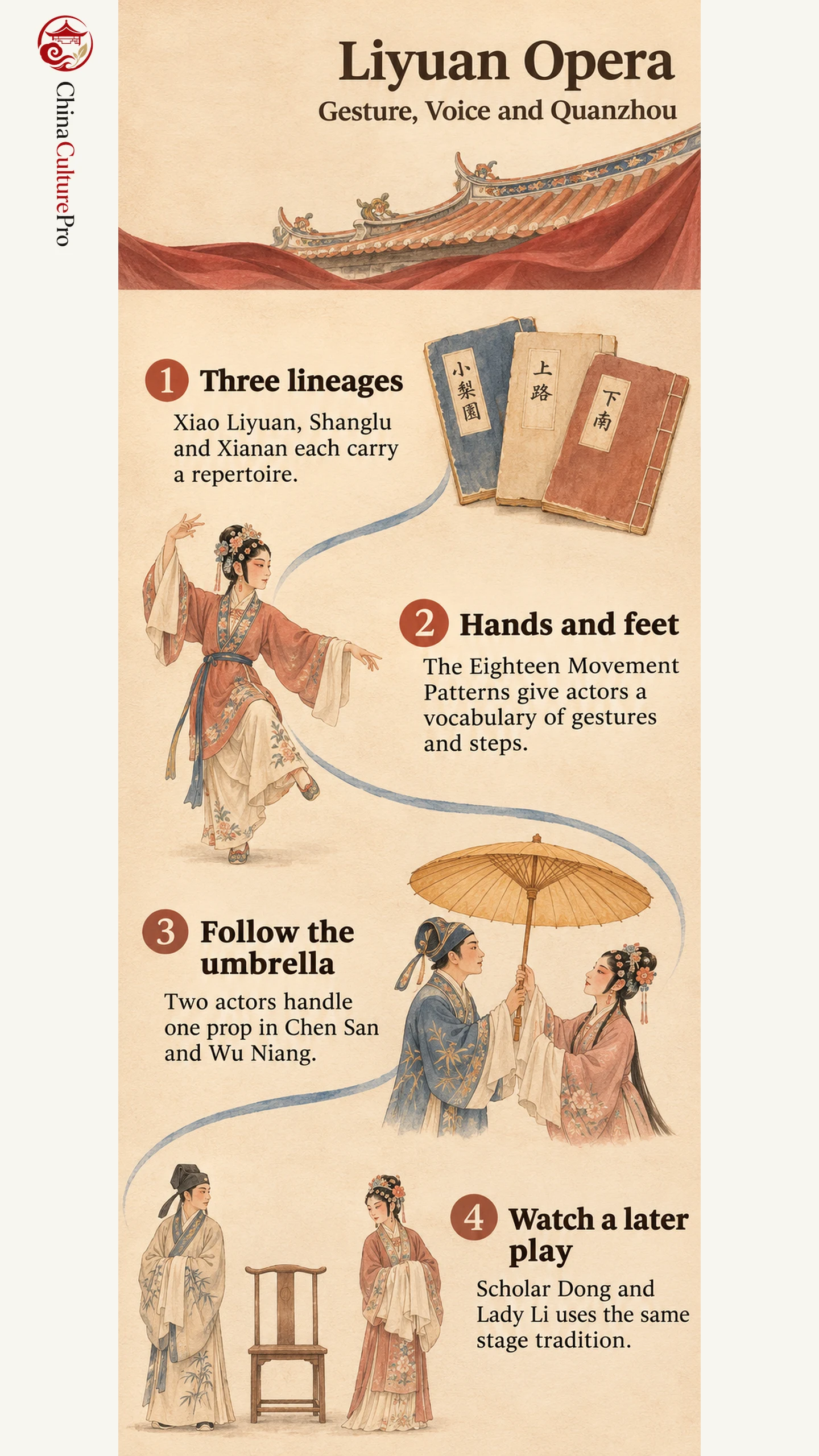
When two characters reach for the same umbrella, a pause can show who is willing to let go. A glance or turn is part of what the audience reads in that moment.
Three Lineages in Quanzhou
The Quanzhou tradition has three lineages, each with a repertoire of its own. Xiao Liyuan (小梨园, Xiǎo Líyuán) was also called the seven-performer troupe. Shanglu (上路, Shànglù) and Xianan (下南, Xiànán) are the two lineages of Da Liyuan (大梨园, Dà Líyuán). Each maintains an inherited group of plays traditionally known as the eighteen repertory titles.[1][2]
The inherited repertoire includes plays with roots in early southern drama, which makes it possible to study how older texts have been carried into performance. The genre circulated across southern Fujian and among Southern Min-speaking communities farther afield, including in Southeast Asia.[1][2]
How Gesture Follows the Voice
The Eighteen Movement Patterns (十八步科母, Shíbā Bù Kēmǔ) are a basic part of stage training. They organize ways to place a hand, turn the body, direct the eyes and take a step. In stage training, eighteen refers to a set of movement patterns. In repertoire, it refers to a lineage’s inherited plays.[1][3]
Look at where a motion starts and ends relative to the words. A performer may bring a hand up toward the face as a line unfolds, then settle into a new posture as the line ends. The drum and melodic accompaniment help give the audience a sense of timing, even when the words are unfamiliar.[2][3]
Two Works to Start With
Try the umbrella excerpt of Chen San and Wu Niang (陈三五娘, Chén Sān Wǔ Niáng). The two performers can lift the umbrella, carry it through a turn or take hold of it together. As one actor reaches for the umbrella, follow the other actor’s gaze. A response can start before the hands meet.[3][4]
For a later work, try Scholar Dong and Lady Li (董生与李氏, Dǒng Shēng yǔ Lǐ Shì), performed by the Fujian troupe in 1993. The heritage profile of Zeng Jingping (曾静萍, Zēng Jìngpíng) records both plays in her repertoire and describes how she adapted familiar gestures to individual characters.[4][5]
FAQs About Liyuan Opera
Does Liyuan always refer to the Quanzhou opera?
Liyuan (梨园, Líyuán) means Pear Garden and can refer broadly to theatrical life. In the study of Китайская опера the full name Liyuan opera identifies the Quanzhou genre.
How is Liyuan opera related to Nanyin?
Nanyin (南音, Nányīn) is a musical tradition of southern Fujian. It shares a local language and musical environment with the opera, which puts music to work alongside plot, roles and movement.[1][2][6]
Источники
[1] China Intangible Cultural Heritage Network. Liyuan Opera
[2] Fujian Provincial Government. National ICH: Liyuan Opera
[3] Fujian Provincial Government. Movement and the Umbrella Excerpt
[4] China Intangible Cultural Heritage Network. Zeng Jingping
[5] Wenyi Bao. New Generations in Classical Theater
[6] University of Sheffield dissertation. Nanyin Musical Culture in Southern Fujian