


Quick Answer: What Is Lion Head Goose by Lv Ji?
Lion Head Goose (狮头鹅图, Shī Tóu É Tú) is a Ming hanging scroll by Lv Ji, also written Lü Ji (吕纪, Lǚ Jì), in the Liaoning Provincial Museum. The 2018 exhibition description lists the painted silk at 192.5 × 106 cm. A white goose stands beneath flowering plum branches beside a porous garden rock. The contrast between delicately described plumage and darker, more forceful tree and rock forms is central to viewing the work.[1]
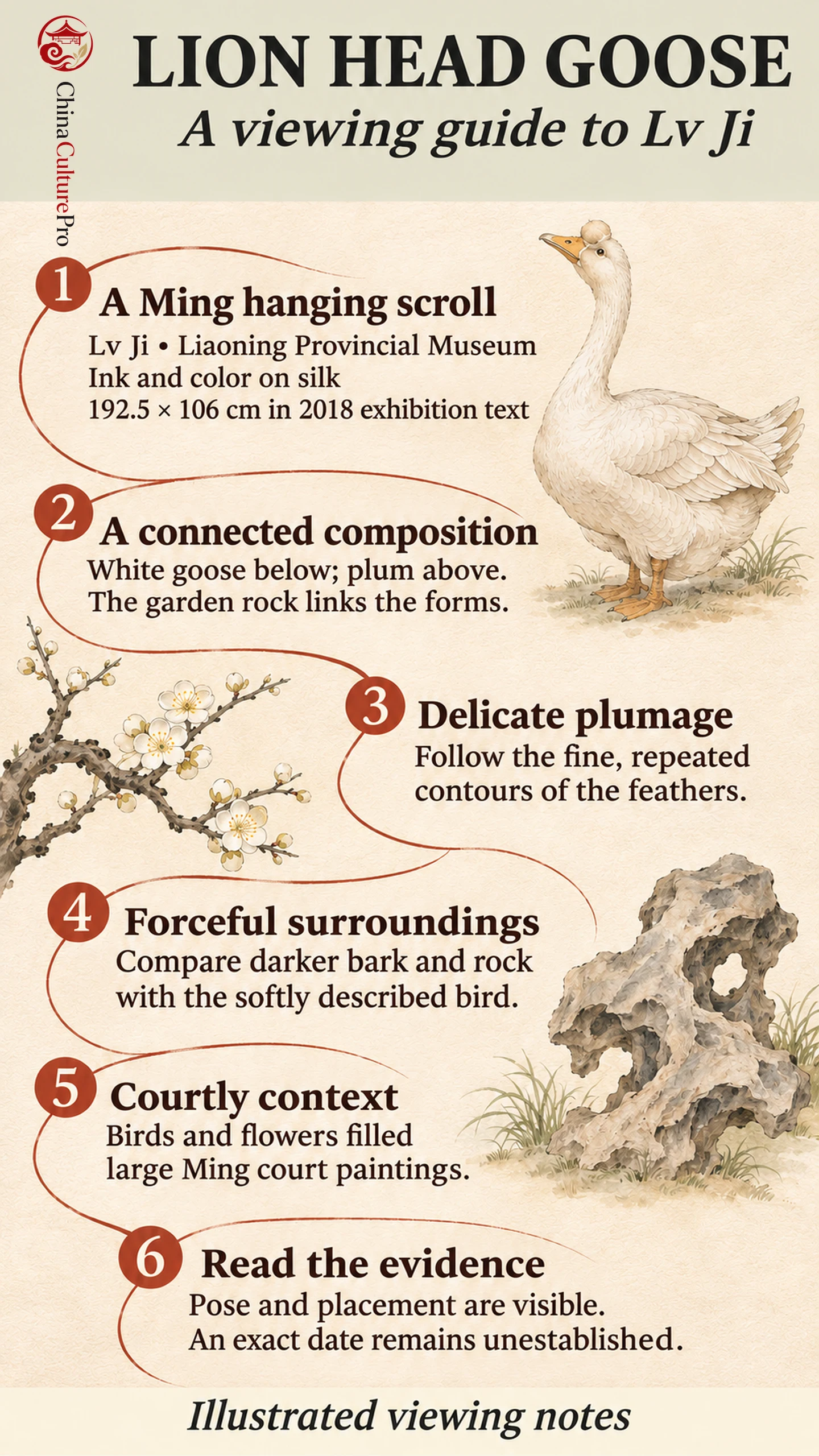
The goose occupies only part of this large vertical field, yet its lifted head helps connect the lower ground with the spreading branches above. Follow that relationship first; close details become easier to understand once you know how the composition directs attention.
The Hanging Scroll at a Glance
| Поле | Identification |
|---|---|
| Художник | Lv Ji / Lü Ji |
| Период | Ming dynasty |
| Format | Hanging scroll |
| Среда | Ink and color on silk |
| Painted dimensions in the 2018 exhibition description | 192.5 cm high × 106 cm wide |
| Collection | Liaoning Provincial Museum |
| Main subjects | One white goose, flowering plum and an ornamental rock |
The exhibition account records a short artist’s signature and seal, but does not establish an exact painting year. Keep the period identification separate from a precise date that the available record does not supply.[1]
Lv Ji’s works and style provide the wider context. He was a major court painter of bird-and-flower subjects, active around the late fifteenth and early sixteenth centuries.[2][3]
How the Goose, Tree and Rock Form One Design
In the reproduction, the goose stands low on the left, with its head lifted toward the right. A substantial old trunk enters from the right and sends flowering branches across the upper space. The rock rises beside the bird, while smaller plants soften the interval between the two.[1]
Rather than scanning these as separate illustrations, trace a circuit. Start with the goose’s rounded body, move along its neck toward the branches, then follow the trunk down toward the perforated rock. Compare the open space around the pale bird with the tightly worked dark forms on the right.
The goose’s body gives the lower field a broad, readable shape. Branches divide the upper field into much smaller intervals. Between them, the rock offers both weight and openings: its irregular edge is substantial, but its holes let the background remain part of the design.
The guide to Chinese scholars’ rocks explains the appreciation of such unusual forms. Here the rock also performs an immediate pictorial job, helping link the bird’s ground-level presence with the tree’s upward reach.
Fine Feathers Against Forceful Ink
Lv Ji’s practice brought together fine-brush painting, gongbi (工笔, gōngbǐ), and the freer handling associated with xieyi (写意, xiěyì). His training and court work drew on earlier bird-and-flower traditions while allowing different kinds of brushwork within a single scene.[2]
In Lion Head Goose, compare the repeated contours of the feathers with the broken, weightier handling of the trunk and rock. The bird’s pale surface remains articulated rather than simply left as an undifferentiated white silhouette. The surrounding dark forms supply a contrasting scale and density of marks.[1][4]
That contrast makes gongbi and xieyi useful viewing terms. They help you ask how carefully bounded forms coexist with more abbreviated or textured passages; they should not become a rule that everything in one painting must belong to a single technique.
Large, richly organized bird-and-flower paintings were valued in Ming court settings. Other surviving works by Lv Ji show the scale and decorative vitality of that practice. This context helps explain the ambition of the goose composition, but does not prove an undocumented imperial commission for this particular scroll.[2][5]
What the Setting Can and Cannot Tell Us
The plum blossoms are part of the painted setting, not merely a detachable emblem. Their pale dots and small branches spread across an area much larger than the goose itself. The guide to plum blossom meaning offers cultural background; begin here with what the blossoms do to the balance and rhythm of this image.
Bird-and-flower paintings can also carry auspicious meanings. Those meanings depend on the chosen combination: an interpretation supported for paired mandarin ducks and particular flowers cannot simply be transferred to a single goose beneath plum branches.[5]
The same restraint applies to narrative. The lifted head can suggest attention, but the image does not let us hear a branch move or establish exactly what startled the bird. You can describe the pose and explore its visual effect without inventing an event outside the frame.
For a broader account of this genre, see Chinese bird-and-flower painting. It places observation, decorative arrangement and possible symbolism within the same field of study.
A Four-Step Close-Looking Method
- Recover the vertical composition. View the entire painting before enlarging the bird. Locate the pale goose, upper branches and darker mass on the right.
- Trace the goose’s pose. Follow body, neck, head and bill. Ask where their direction leads your eye, then check that relationship against the whole image.
- Compare three surfaces. Examine feather contours, bark and rock. Notice differences in repeated line, dark wash and irregular texture and ask how each contributes to the difference between soft plumage and solid surroundings.
- Separate observation from explanation. Distinguish visible pose and placement from a proposed mood, symbolic reading or story. Keep only interpretations that the image and relevant evidence can support.
A useful second viewing reverses the order: start with the dark tree, descend through the rock, then return to the goose. This tests whether the picture holds together beyond the immediately attractive bird.
FAQs About Lion Head Goose by Lv Ji
Does the title describe a mythical lion-headed creature?
No. The picture shows a goose with a raised forehead profile, not a hybrid animal with a lion’s face. Read the title alongside the depicted bird.
Do we know the exact year the painting was made?
The sources used here identify it as a Ming work by Lv Ji but do not establish an exact year. The artist’s known period of activity does not by itself date this sheet.[1][2]
Why is the painter also called Lü Ji?
“Lv” is a practical spelling used when the letter ü is unavailable. Lü Ji and Lv Ji refer here to the same Ming painter, whose Chinese name is 吕纪.
Источники
[1] Liaoning Provincial Museum, exhibition description reproduced by Sina Collection. Lion Head Goose in the museum’s ancient painting exhibition
[2] National Palace Museum, via TELDAP. Marvelous Attainments of Creation: The Paintings of Lü Ji
[3] Tokyo National Museum. Birds and Flowers of the Four Seasons: Lü Ji’s period and court practice
[4] Liaoning Daily. 辽博首推国宝数字藏品, discussion of the painting’s techniques
[5] The Metropolitan Museum of Art. Lü Ji: Mandarin Ducks and Cotton Rose Hibiscus, court context and symbolism