


Quick Answer: What Is White Clouds at the Xiao and Xiang Rivers?
White Clouds at the Xiao and Xiang Rivers(潇湘白云图,Xiāoxiāng báiyún tú)is a horizontal landscape by Dong Qichang(董其昌,Dǒng Qíchāng)in the Liaoning Provincial Museum collection. Its cloud-filled scenery belongs to his late-Ming engagement with earlier painting traditions.[1]
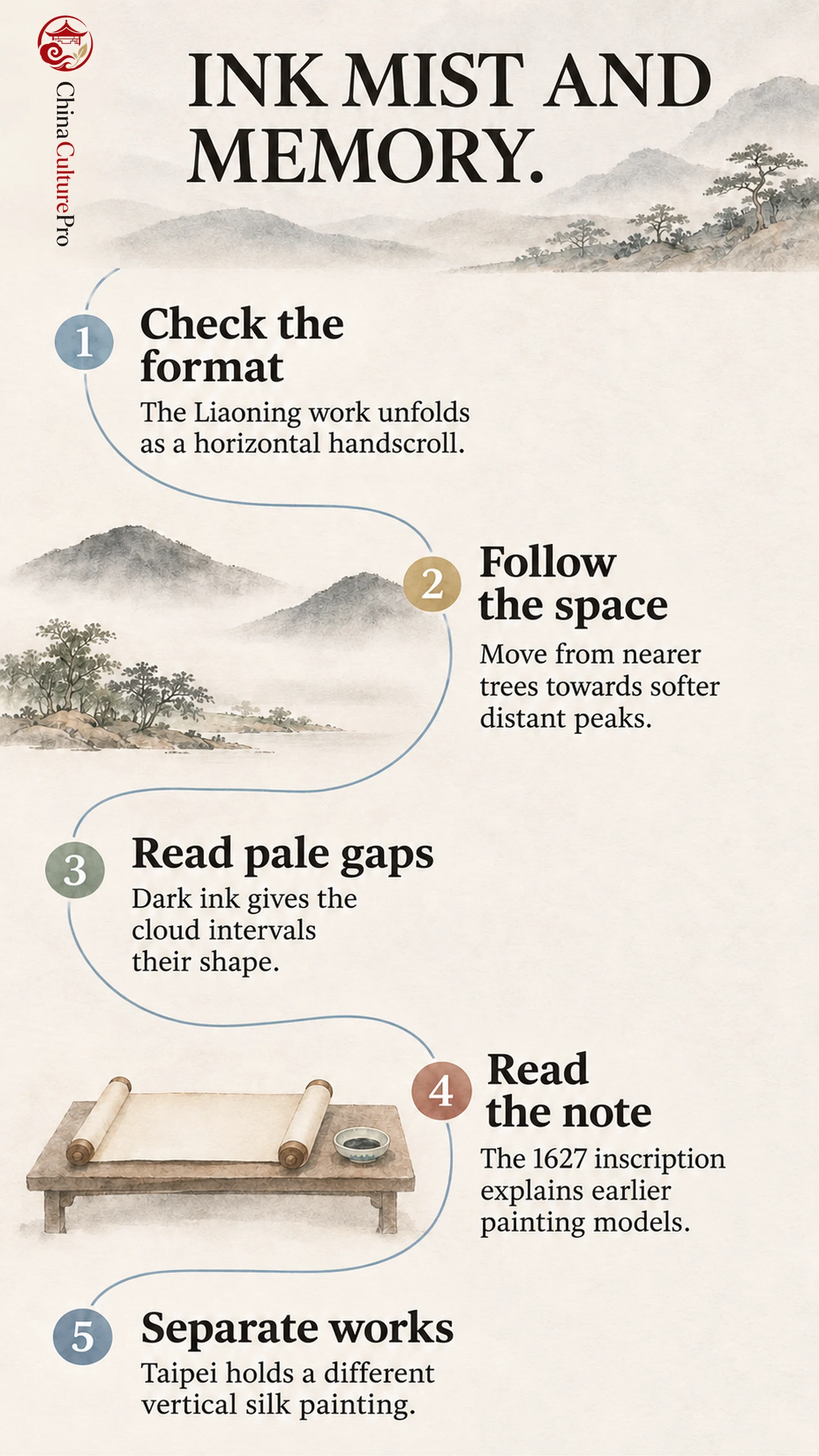
- Format: A paper handscroll with landscape and accompanying writing.
- Visual focus: Dark wooded slopes, pale cloud passages and softened distant peaks.
- Dated evidence: The artist’s landscape note carries a date corresponding to 1627.[2]
The Liaoning work should be distinguished from a similarly titled hanging scroll in Taipei.
Clouds move through this landscape as broad openings between dark mountain bands. Nearer the viewer, angular branches and small roof outlines give the scenery a firmer rhythm. Following those changes makes the work easier to understand than treating its long silhouette as a single mountain panorama.
The Liaoning Handscroll and Its 1627 Inscription
The landscape extends sideways across paper. Its format creates a succession of encounters: banks and trees enter the view, mountains gather behind them, and mist opens distances between the forms. A traditional handscroll is encountered in sections, usually progressing from right to left; a reduced photograph places that unfolding experience within one narrow strip. The distinction between hanging scrolls and handscrolls therefore changes how this composition is read.
Dong’s note at the left of the landscape ends with the third lunar month of the dingmao year, corresponding to 1627. The accompanying calligraphy photograph includes a different dated inscription, corresponding to 1619. These dates belong to their respective written components; they should not be flattened into a claim that every part of the assembled work was made together.[2]
Reading the Landscape from Right to Left
At the right, relatively open ground and a line of trees lead toward a more densely worked central slope. Tall trunks and sharp, angular branches interrupt the rounded masses of foliage. The closer forms have distinct edges, so the eye can settle on individual trees before moving into the less definite terrain behind them.
Across the middle, mountains form a dark, undulating band. Broad pale intervals cut into their lower edges, allowing nearer tree groups to appear in front of slopes that seem to dissolve. Distance emerges through these interruptions as much as through smaller scale.
Toward the left, a cluster of plain roof outlines introduces a compact settlement. Its straight lines contrast with the foliage around it. Beyond the buildings, pale cloud passages lead the eye back toward the distant peaks.[2]
How Ink Makes the White Clouds Visible
The clouds are most evident where darker mountain forms stop. Their pale passages connect across the view, sometimes broadening into open space and sometimes narrowing between wooded slopes. The surrounding marks make those intervals read as atmosphere.
Compare the edges closely. Nearer banks carry repeated, directional strokes. Some distant peaks have darker upper ridges that soften downward into a hazier base. Clusters of ink marks suggest vegetation without describing every leaf. Those differences give the landscape both a solid structure and a sense of moisture.
The effect does not require every cloud to receive a white outline or an opaque white filling. It depends chiefly on the relationship between pale ground and adjoining ink. This is a useful distinction when examining Chinese painting techniques: an area with few marks can still do substantial compositional work.[2]
Dong Qichang’s Note on Earlier Painters
In his inscription, Dong connects the changing mist of Dong Yuan(董源,Dǒng Yuán), whom he calls Beiyuan, with the painting of Mi Fu(米芾,Mǐ Fú). He then describes gaining insight into moxi(墨戏,mòxì), or “ink play,” through Mi’s White Clouds at the Xiao and Xiang Rivers. Dong uses the note to explain what he learned from earlier painting, not to identify a specific viewpoint on the rivers.[2]
“Ink play” here directs attention to what the medium can do: gather into dark masses, break into separate touches and leave room for mist. Dong’s reference does not establish that the landscape is a line-for-line copy of a particular surviving original. The inscription tells us about his artistic allegiance; the arrangement of this painting must still be examined on its own.
A smaller imperial poem appears separately above the landscape. It is a later layer of response, visually distinct from Dong’s larger writing. Reading inscriptions and seals as additions made by different hands helps keep the painter’s explanation separate from the work’s subsequent reception.[2]
Separating the Liaoning and Taipei Works
The Taipei painting catalogued as Imitating Mi’s White Clouds of Hsiao and Hsiang is a different object: a hanging scroll on silk, measuring 123.2 × 51.9 cm. Its own inscription refers to imitating a Mi painting from Dong’s collection. Those measurements and that vertical format should not be assigned to the Liaoning handscroll.[3]
The river name also belongs to a much wider landscape tradition associated with Hunan. Xiao and Xiang Rivers attributed to Dong Yuan is another distinct work, on silk in Beijing. Dong Qichang helped establish its familiar title. Shared subject matter and a collector’s involvement do not make these paintings interchangeable.[4]
FAQs About White Clouds at the Xiao and Xiang Rivers
Is this a hanging scroll or a handscroll?
The Liaoning landscape discussed here is a horizontal handscroll. Taipei holds a separate vertical painting with a related title.[2][3]
Are the white clouds painted in white pigment?
Their main visible effect comes from pale intervals between inked forms. A photograph alone cannot establish every material used.[2]
Is this the same painting as Dong Yuan’s Xiao and Xiang Rivers?
No. They are separate paintings by different artists, held in different collections.[1][4]
Источники
[1] China Academy of Art Art Museum. Interview with Dong Baohou on the Liaoning loans
[2] Shufa Yishu Wang. Dong Qichang paintings, part three: landscape and calligraphy photographs
[3] National Palace Museum, Taipei. Imitating Mi’s White Clouds of Hsiao and Hsiang
[4] Palace Museum, Beijing. Xiao and Xiang Rivers catalogued under Dong Yuan