


Quick Answer: What Is Xiao and Xiang Rivers?
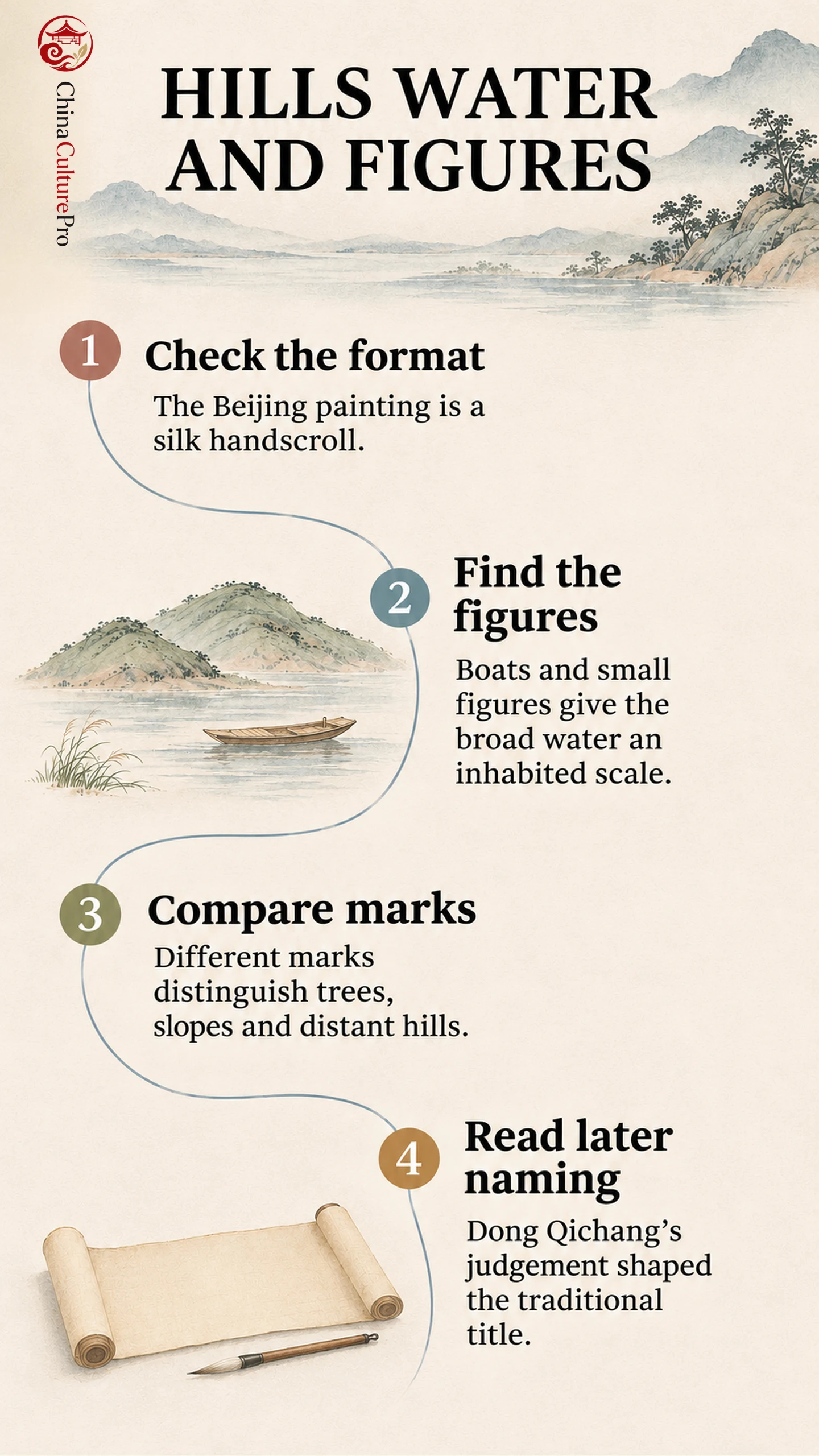
Xiao and Xiang Rivers(潇湘图,Xiāoxiāng tú)is a silk handscroll catalogued under Dong Yuan(董源,Dǒng Yuán)by Beijing’s Palace Museum.[1]
- Landscape: Low hills, wooded banks and broad water passages.
- Human details: Boats, shore figures and a curved fishing net.
- Viewing task: Compare the expansive terrain with its small, carefully placed activities.
The title identifies a landscape tradition, while the small figures invite a closer examination of what happens within it.
Rounded hills extend across the upper field, while water opens between their projecting banks. The foreground is less crowded, yet small people and boats interrupt its stillness. One of the image’s pleasures is this change of scale: a landscape first encountered as a broad atmosphere gradually reveals distinct human actions.
The Beijing Silk Handscroll and Its River Setting
The museum lists the painted silk at 50 × 141.4 cm, with colour. The name refers to Hunan’s Xiao and Xiang rivers and a broader river-and-lake landscape tradition.[1]
Its horizontal proportions matter. In the handscroll format, a viewer encounters a changing field rather than a single upright mountain. Even when the whole painted section is reproduced at once, the banks invite the eye to move laterally and then back into the hills.
The water does much of the organizing. A pale channel separates one tongue of land from another; a distant inlet carries the eye behind a closer slope. These intervals make the rounded masses distinct without isolating them into separate scenes.
That relationship offers a useful introduction to Chinese landscape painting: distance can emerge from repeated openings and overlaps, even when no spectacular peak commands the centre.
Following Hills, Islands and Human Activity
At the right, the hillside descends toward a narrow shoreline. Below it, a small group stands on a projecting patch of ground. Their light garments contrast with the darker bank, and their vertical bodies make its low horizontal outline easier to notice.
Farther left, a boat occupies the open water. A small patch of red clothing and the dark shape above the passengers draw attention to a group that would otherwise be easy to miss. The vessel is separated from both the near shore and the more distant wooded ground, giving its placement a clear sense of space.
Across the left half, a curved net extends into the water below a tree-covered bank. Small pale figures are distributed around it, while another boat lies farther left. The curve forms a conspicuous countershape to the land: it encloses water rather than building another solid island.
A tufted strip of reeds projects from the lower left. Beyond it, the forest grows denser, with many slender trunks gathered beneath overlapping dark crowns. The close vegetation and tiny groups on the water give the landscape an inhabited scale.
Ink Dots, Texture Strokes and Light Colour
The rounded slopes are not uniformly filled. Darker touches gather along some ridges, while paler passages open beneath them. Their unequal distribution prevents the hills from looking like repeated copies of one rounded shape.
The museum’s detailed guide identifies short hemp-fibre texture strokes(披麻皴,pīmá cūn)near the slopes’ feet and pale ink dots on the hilltops.[2] The technical terms become useful when tied to those locations, rather than applied indiscriminately to every mark.
Look also at the difference between trees and distant hills. Nearer vegetation has more individually legible trunks and branches. Farther away, clustered touches and soft contours make the mass readable without describing each plant. The change lets similar materials—ink, colour and silk—produce distinct degrees of visual density.
Small coloured figures supply another register. Their light robes and occasional stronger accents remain separate from the hills’ subdued surfaces. The image can therefore sustain broad atmospheric continuity without making every part equally vague.
How Later Naming Shapes the Painting’s Identity
The picture has no artist’s inscription or seal. Dong Qichang(董其昌,Dǒng Qíchāng)named it using the Xuanhe Catalogue of Paintings(宣和画谱,Xuānhé huàpǔ).[1] The Palace Museum also notes an alternative interpretation associating it with the river god’s marriage story.[2] That possibility should remain an interpretation of the scene, rather than a certainty imposed on every small figure.
Shanghai Museum’s record distinguishes the painting from Dong’s front inscription and later appended writing.[3] Reading those inscriptions and seals separately helps distinguish the image from its subsequent reception. A later title can be historically important without becoming an autograph statement by the original painter.
For comparison, White Clouds at the Xiao and Xiang Rivers is a separate painting by the much later Dong Qichang, held in Liaoning.[4] Similar river names do not identify the same object or the same artist.
FAQs About Xiao and Xiang Rivers
Does the painting bear Dong Yuan’s signature?
No. The painted section has no artist’s inscription or seal.[1]
Is the scene an exact map of two rivers?
The title invokes the Xiao-Xiang landscape tradition; it does not establish an exact mapped viewpoint.
Is this the Eight Views of the Xiao and Xiang?
No. This is one continuous landscape, not an eight-part sequence of named views.
Источники
[1] Музей Гугун. Dong Yuan: Xiao and Xiang Rivers handscroll
[2] Palace Museum, Minghuaji. Xiao and Xiang Rivers: brushwork and interpretations
[3] Shanghai Museum. Xiao and Xiang Rivers: painting and appended inscriptions
[4] China Academy of Art Art Museum. Interview with Liaoning Museum’s Dong Baohou: the separate Dong Qichang painting