


Quick Answer: What Is Whispering Pines on a Mountain Path?
Whispering Pines on a Mountain Path(山路松声图,Shānlù sōngshēng tú) is a large Ming-dynasty hanging scroll by Tang Yin(唐寅,Táng Yín) in Taipei’s National Palace Museum. Pines, falling water and small figures share a steep mountain setting.[1]
- First impression: High cliffs occupy much of the vertical field.
- Human detail: Find the small figures on the bridge below the pines.
- Reading key: The poem invites imagined listening, extending what the image can show.
The landscape and inscription work together, but neither makes the figures securely identifiable portraits.
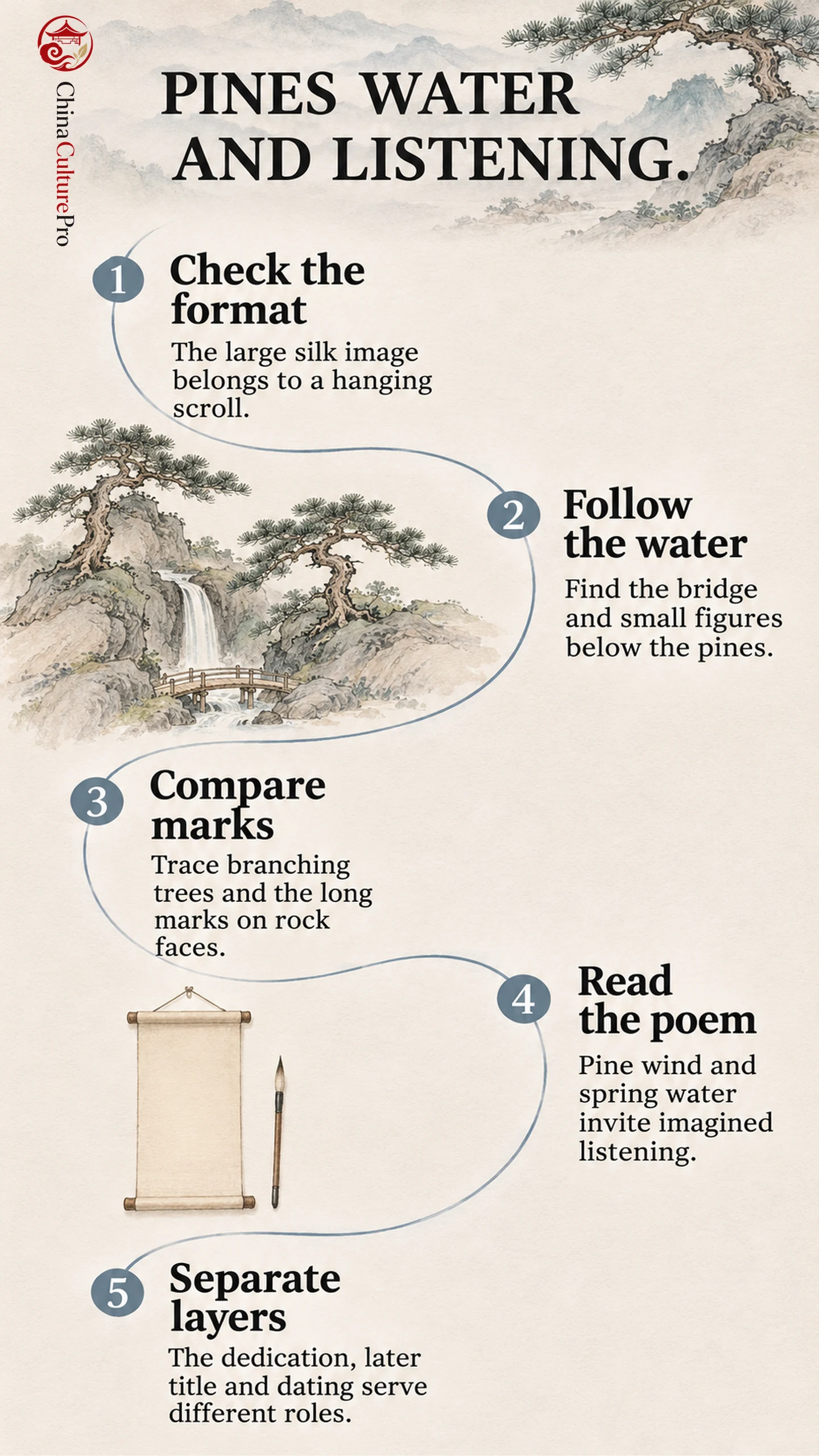
The waterfall descends through rock and foliage before reaching the lower bridge and pool. A viewer can follow its pale channels downward, then return through the pine trunks toward the cliffs. That movement connects the small human encounter with the much larger terrain. The title’s sound becomes more suggestive after the eye has found these visible relationships.
The Large Silk Hanging Scroll
The image-bearing silk measures 194.5 × 102.8 cm, with the collection identifier 故畫000466. The work is generally dated to 1516 in museum commentary, although the artist’s inscription does not state a year.[1]
The substantial vertical field accommodates several changes of scale. The foreground trees are large enough for their branching structure to be conspicuous; the figures are much smaller; distant peaks can fade to narrow silhouettes. Look at the whole image before examining an enlarged detail, so that a close view of the bridge does not obscure its place below the mountain.
A photograph of the complete mounted object also includes fabric beyond the painted silk. Those borders belong to the scroll’s presentation rather than the mountain scene. The guide to Chinese scroll formats explains how the format shapes viewing.
Following the Waterfall and the Mountain Path
Start near the upper left with the large cliff faces. Dark vegetation interrupts their upper edges, while lighter channels descend between and across rock forms. The water does not appear as one uninterrupted stripe from summit to foreground. It emerges, disappears behind intervening forms and becomes visible again below.
The pine canopy occupies a wide band beneath the cliffs. Below it, a narrow bridge crosses the falling water. The small figures are situated within this passage rather than isolated against an empty background. Look at their size beside a nearby trunk and rock face: the comparison establishes how much of the scene extends beyond their immediate surroundings.
Continue downward to the lower falls. Pale streams curve over the ledge before entering water marked with small repeated ripples. Nearby boulders give that flowing pattern firmer points of resistance. Toward the right, quieter banks and distant trees open a different route into the landscape.
These connections matter more than treating each feature as a separate emblem. Water, bridge, tree and path supply ways for the eye to move through the painting. They place the figures’ encounter within the wider Chinese landscape-painting tradition.
Pine Forms, Rock Lines and Song Precedents
The pines have trunks and branches that bend, overlap and spread beneath clustered foliage. Compare those turns with the longer downward marks on the rock faces. The two kinds of movement work together without becoming identical surface patterns.
The rock handling develops axe-cut texture strokes(斧劈皴,fǔpī cūn) into elongated marks, and the composition has been connected with the Song painter Li Tang(李唐,Lǐ Táng).[1] That connection does not make the work a straightforward copy. The turning mountain forms also suggest a comparison with Guo Xi(郭熙,Guō Xī), so Li Tang’s name alone cannot explain every feature.[2]
For a useful related example, consider Li Tang’s Wind in Pines. Compare how a major mountain mass is arranged before looking for differences in individual marks. The broader guide to Chinese painting techniques distinguishes outlines, texture strokes and washes.
How the Four-Line Poem Suggests Sound
The poem at the upper right has four seven-character lines. In a plain paraphrase, a wild mountain path introduces pine sounds joining the sound of spring water. The speaker then invites quiet, unhurried listening and describes an expansive sense of the Dao(道,dào) arising.[1]
The verse gives the viewer something the image cannot literally supply: sound. Look back at the canopy, pale falls and small figures after reading it. Their arrangement can suggest a place for listening, even though no painted mark produces an audible pine wind or stream.
The final line moves from sound in the landscape toward an inward response. The poem changes the act of looking by asking the viewer to imagine another sense alongside sight.
The Dedication, Later Title and 1516 Dating
The dedication presents the painting to a respected local official surnamed Li, identified as Li Jing(李经,Lǐ Jīng), magistrate of Wu County.[1] The 1516 dating follows historical reconstruction of the gift context rather than a year written beside the signature.[2]
The familiar title also has a later layer. It appears on a label by the collector Liang Qingbiao(梁清标,Liáng Qīngbiāo); the artist’s original title, if he gave the work one, is not known.[2] The later title echoes the poem’s mountain-path and pine-sound imagery, although the label does not establish that Tang Yin chose those words as a title.
Distinguish these roles when reading inscriptions and seals: the artist’s poem, his dedication, a later title label and collection marks do different jobs. They help explain the object’s history without proving that the bridge figure is either the painter or his recipient.
FAQs About Whispering Pines on a Mountain Path
Why does the title refer to sound?
The poem brings together pine wind and flowing water, inviting the viewer to imagine listening.[1]
Is 1516 written in the inscription?
No. It is a historical dating associated with the gift context, rather than an inscribed year.[2]
Is this Seeing Off a Guest on a Mountain Path?
No. The Princeton work is separate. Its poem shares the opening imagery but ends with a departing rider and farewell, unlike the listening passage here.[3]
Источники
[1] National Palace Museum. Whispering Pines on a Mountain Path: object record and inscription
[2] Zhu Longxing. Exploring Tang Yin’s Whispering Pines on a Mountain Path, relevant pages 96–99
[3] Princeton University Art Museum. Seeing Off a Guest on a Mountain Path